 |
We have to consider two issues to implement quantum computer.
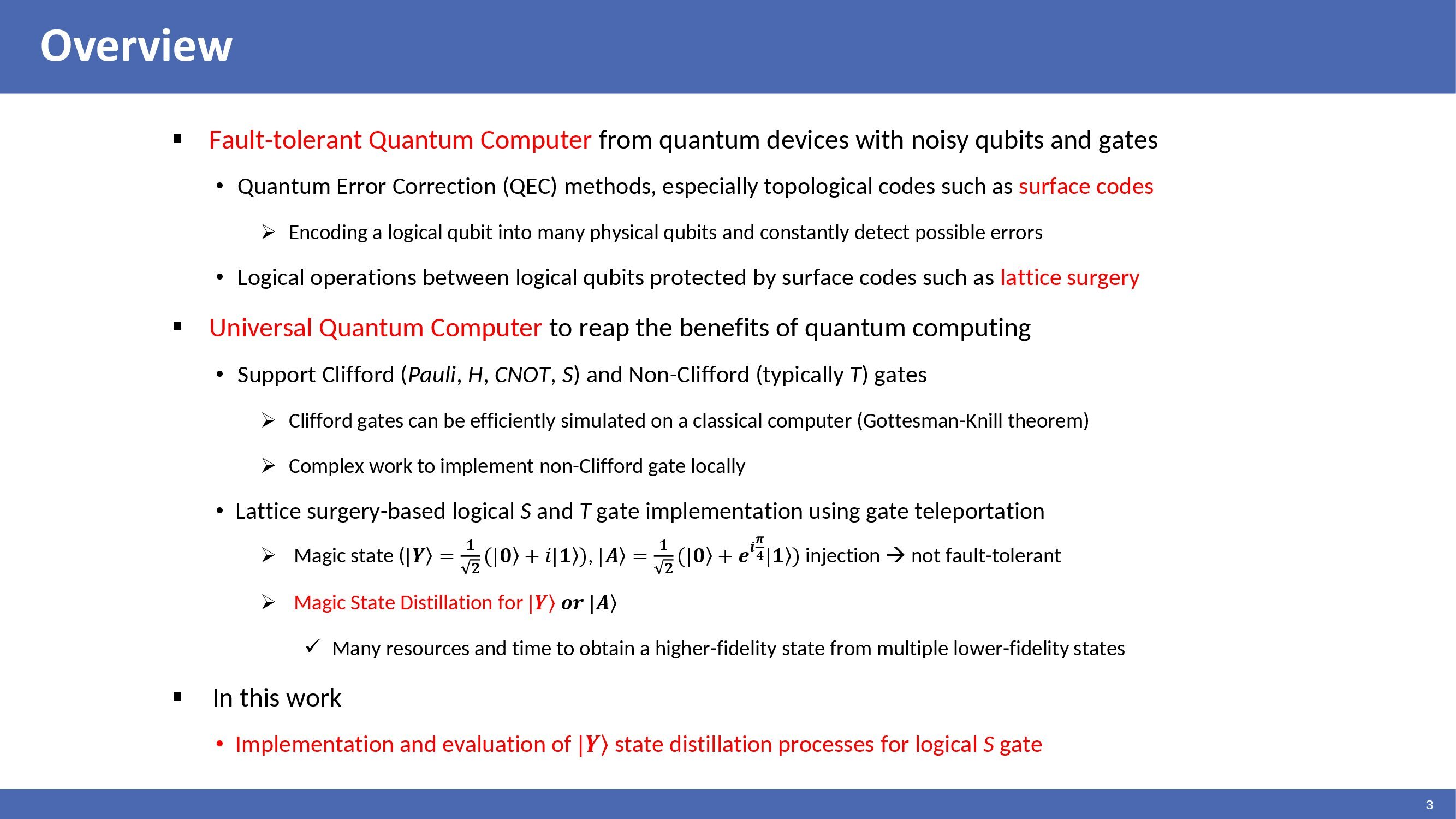
First, we need a fault-tolerant quantum computer from quantum devices with noisy qubits and gates. There are many studies on quantum error correction methods, especially topological codes such as surface codes. The lattice surgery model effectively performs logical operations between logical qubits protected by surface code.
Second, we need a universal quantum computer to reap the benefits of quantum computing. Therefore, we must support Clifford and non-Clifford gates. Clifford gates can be efficiently simulated on a classical computer. However, it takes complex work to implement non-Clifford gates locally. In particular, the logical S and T gate can be implemented by lattice surgery-based gate teleportation that requires the magic state. The magic state is injected using a state injection procedure. However, the injected magic state is not fault-tolerant and has low fidelity. Thus, it needs to be distilled by the magic state distillation procedure. Magic state distillation is not easy to implement because it costs many resources and time to obtain a higher-fidelity magic state from multiple lower-fidelity states. Previous studies have proposed several magic state distillation protocols and calculated their costs numerically.
In this work, we have implemented and evaluated magic state distillation processes for |Y>. |
 IEEE/ICACT20240330 Slide.02
[Big Slide]
IEEE/ICACT20240330 Slide.02
[Big Slide]