 |
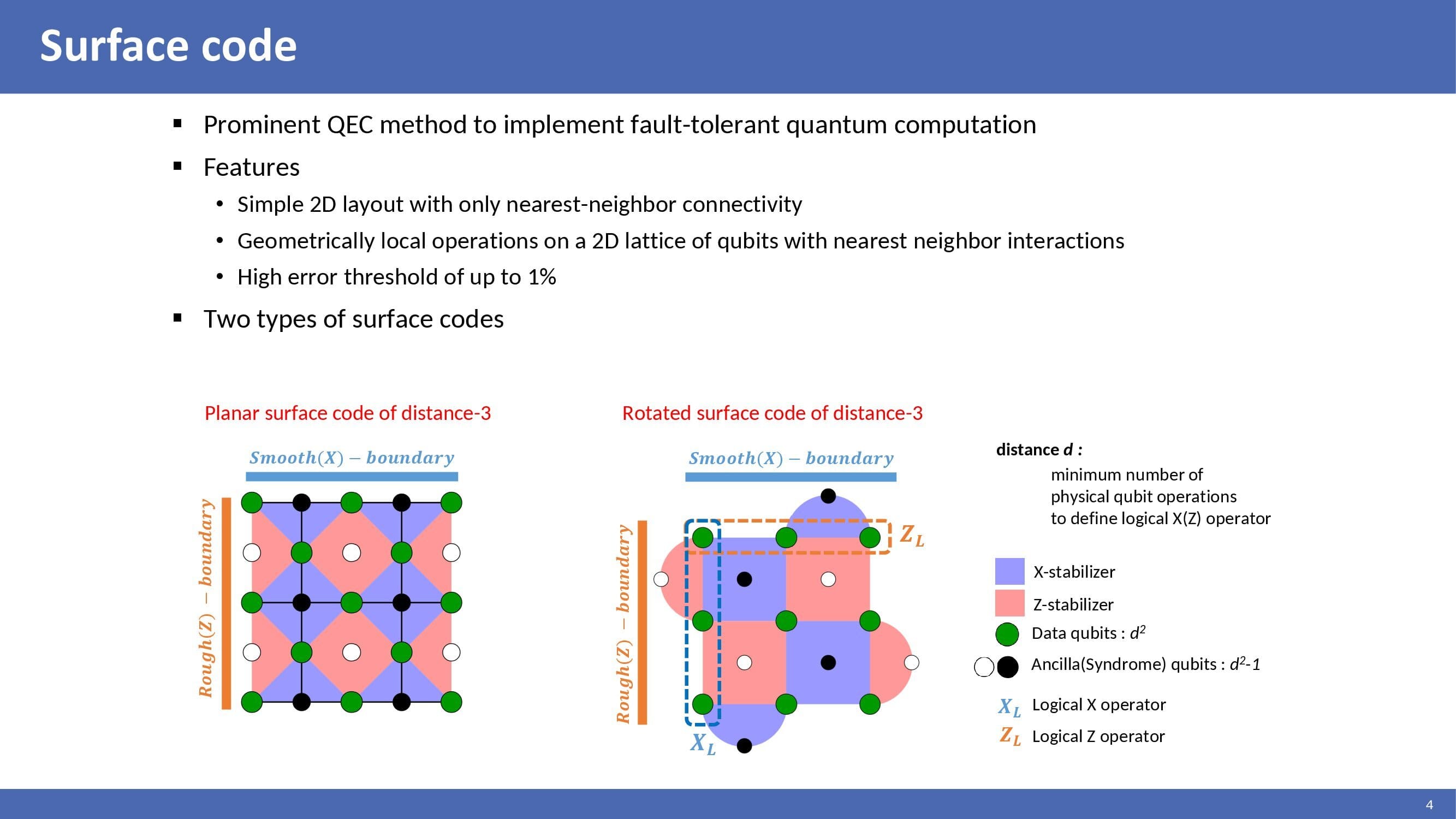
Surface code is considered a prominent QEC method to implement fault-tolerant quantum computation. It has the following features. Simple 2D layout with only nearest-neighbor connectivity. Geometrically local operations on a 2D lattice of qubits with nearest neighbor interactions. High error threshold of up to 1%. Generally, there are two types of surface codes: planar and rotated. Rotated surface code is a rotated form of planar surface code. It has the same functionality but can be configured into fewer qubits. Distance is the minimum number of physical qubit operations to define logical X(Z) operator. So distance 3 surface code is the smallest code because it can correct at least single qubit error. In this figure, green circles are physical data qubits, and white or black circles are physical ancilla qubits. The blue and pink plaquettes are X and Z stabilizers, respectively. The figure's top and bottom edges are called smooth or X boundary. The left and the right edges are called rough or Z boundaries. X products connecting X-boundarires are called logical X operators. Z products connecting Z-boundaries are called logical Z operators.
|
 IEEE/ICACT20240330 Slide.03
[Big Slide]
IEEE/ICACT20240330 Slide.03
[Big Slide]