 |
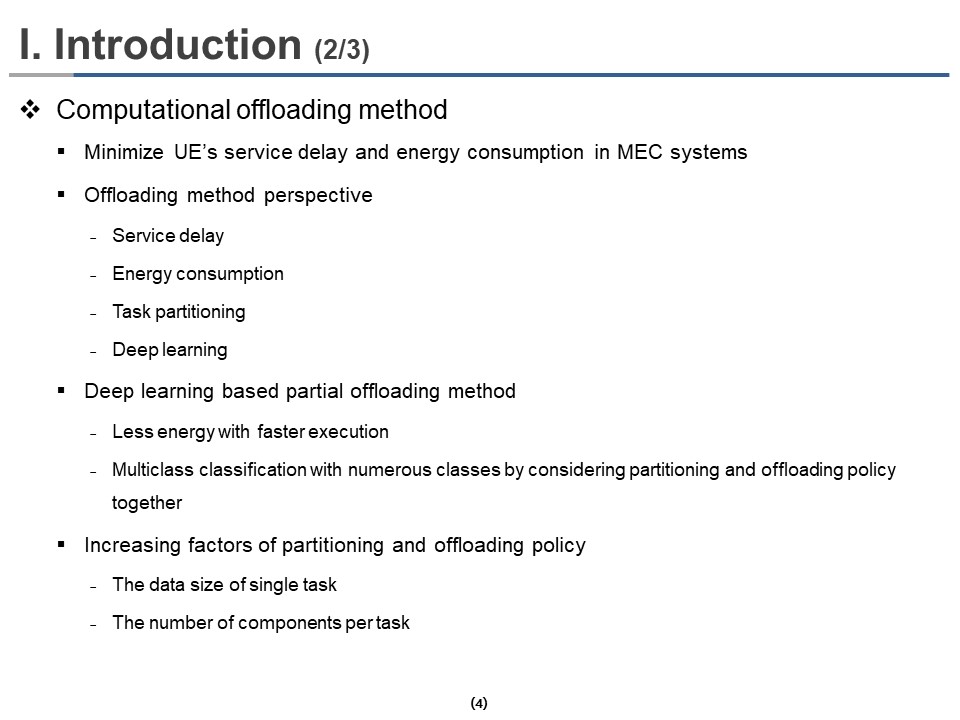
Several computational offloading methods have been introduced to minimize UE service delay and energy consumption in MEC systems. These methods are compared and analyzed from the perspective of a service delay, energy consumption, task partitioning, and deep learning.
The deep learning-based partial offloading method consumes less energy with faster execution in MEC networks than the conventional methods. However, this method performs multiclass classification with numerous classes by combining partitioning and offloading policies. So, the number of class partitioning and offloading policies increases exponentially as the data size of a single task and the number of components per task increases.
|
 IEEE/ICACT20220171 Slide.04
[Big Slide]
[YouTube]
IEEE/ICACT20220171 Slide.04
[Big Slide]
[YouTube]