 |
To the overview of recent service mesh trends, nowadays, Service mesh with an independent sidecar is favored for its flexible capability and cost-effectiveness in a variety of purposes with the ability to be transparent under network layers.
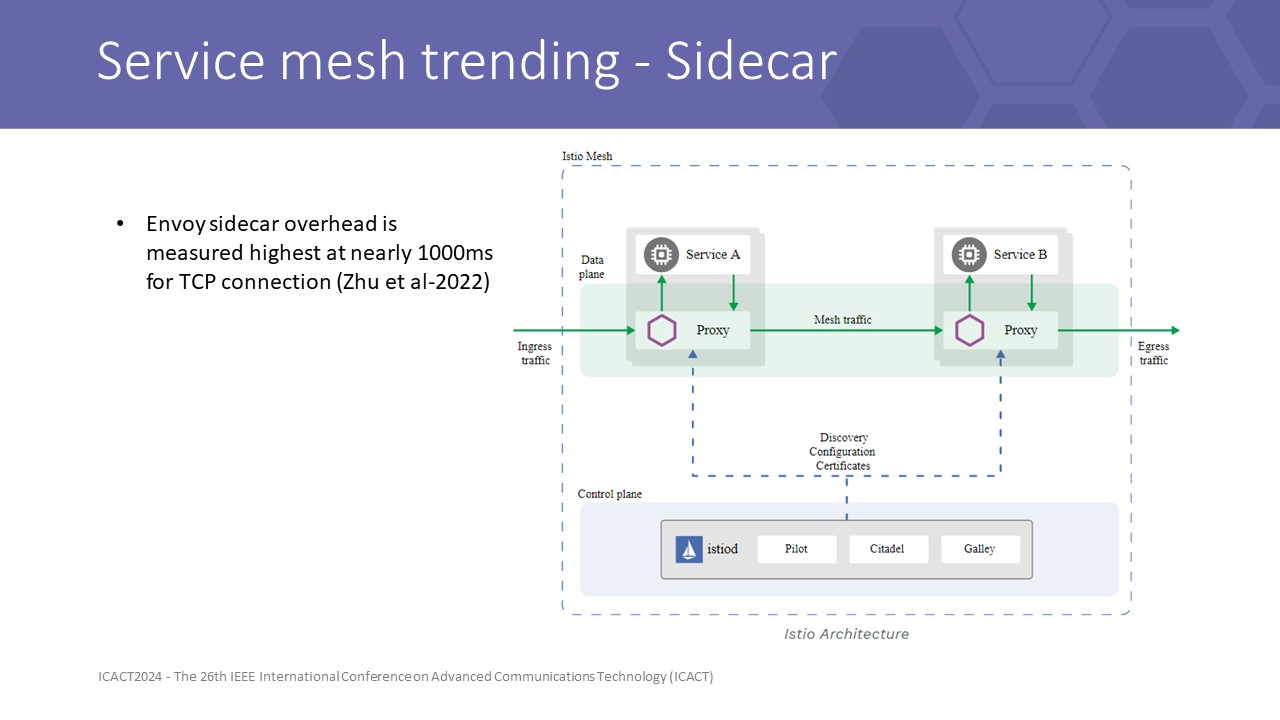
Here is the abstract architecture of the sidecar approach with an example of the most popular Istio control plan with the Envoy sidecar.
This architecture adds hops and management filters over the transmit way, the service mapping, service discovering, and routing logic are handled here at the sidecar. The application just needs to send to a specific port that maps to the next service layer to successfully deliver the messages.
This is great if the problem is not ultra-low latency. So this architecture, added a few to a hundred milliseconds to the round trip time each hop. This overhead latency was also studied in previous research, especially in the paper of Zhu et al. They announced a method to predict the overhead of latency when using a sidecar. The results show that it could add nearly 1000ms on average to direct TCP connection round trip time with disabled filter profiles. In gRPC mode, the number multiply 3 to 5 times.
This strongly reinforces our approach not to leverage sidecar connection to satisfy the URLLC requirements
|
 IEEE/ICACT20240417 Slide.04
[Big Slide]
IEEE/ICACT20240417 Slide.04
[Big Slide]