 |
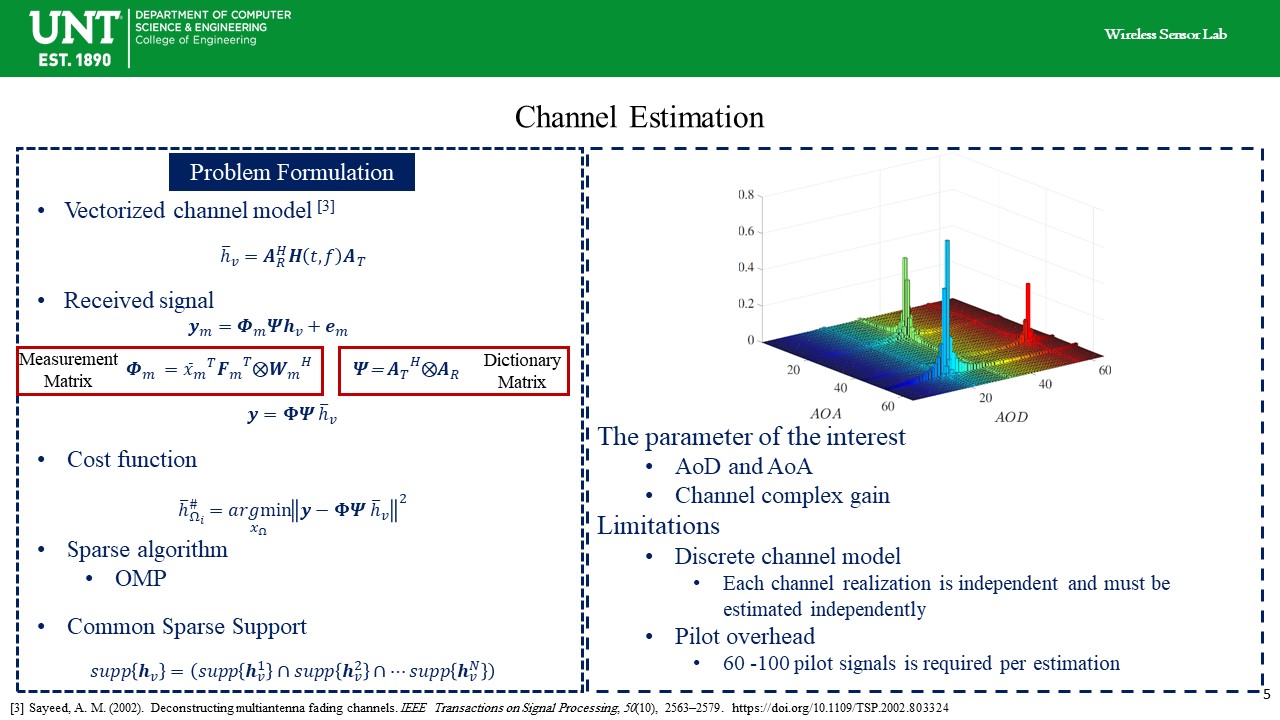
To estimate the channel parameters, we need to formulate the input-output relationship for the millimeter-wave system. Since the channel is sparse, the number of paths between the transmitter and receiver is much less than the channel dimension. One needs to formulate an input-output relationship in a sparse way. For this purpose, we need to use a sparse representation of the channel. The channel transfer matrix is mapped to its sparse unitary equivalent representation in the angular domain using the virtual channel model introduced by Sayeed. We formulate the received signal using the measurement matrix Phi and fixed dictionary matric Psi. This is a common formulation for millimeter-wave sparse communication. Then, we have a cost function formulated as a minimum square error. We are using Orthogonal Matching Pursuit for channel estimation. OMP is a fast greedy algorithm; since the estimation is not our primary focus in this paper, it satisfies the expectations. The figure here on the right shows example 64 by 64 sparse millimeter-wave channel with three paths. We can see that most of the matrix elements are zero, and there are few dominant components. We aim to estimate AoD and AoA using a minimum number of measurements. The state of the art measurements is shown to be about 60 to 100 for a 64 by 64 channel.
Because the channel transfer function is quantized, then one needs to transmit 60 to 100 pilot signals to estimate each channel realizations. This wastes the bandwidth and other resources.
|
 IEEE/ICACT20210129 Slide.05
[Big Slide]