 |
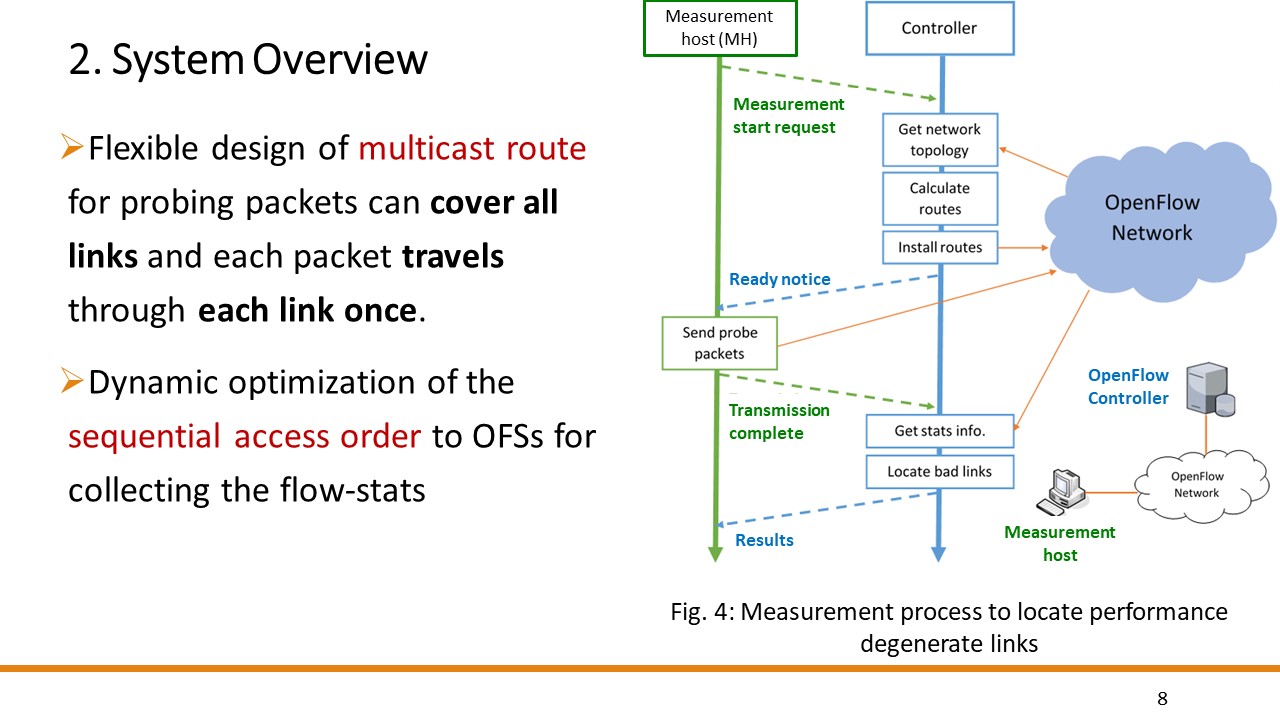
Our framework is for OpenFlow-based full-duplex networks consisting of the OpenFlow controller and OpenFlow switches,
with the measurement host that sends a series of multicast probe packets traversing all links in the network. A measurement host is directly connected to an OpenFlow switch (called ``measurement node¡®¡¯). The input port of the measurement node connecting the measurement host is called ``root port''.
The process begins when the measurement host sends a measurement request to the OpenFlow controller. Then, the OpenFlow controller obtains network topology, calculates probe packet routes, and installs them into OpenFlow switches.
After that, the measurement host starts sending the probe packets.
Each probe packet (or a copy of it as multicasting) starting from the root port travels through each link once and only once (in each direction of a full-duplex link separately) and is discarded at a leaf port (an input port of the last OpenFlow switch of the measurement flow).
A measurement path from the root port to a leaf port is called ``terminal path''. The number of probe packets arriving at an individual input port on each OpenFlow switch is passively recorded as flow-stats at each OpenFlow switch and then, if needed, is collected by the OpenFlow controller.
Finally, the OpenFlow controller calculates the packet loss rate to detect a high-loss link or a high-loss segment. This process is recursively performed until locating all high-loss links. |
 IEEE/ICACT20210168 Slide.08
[Big Slide]