 |
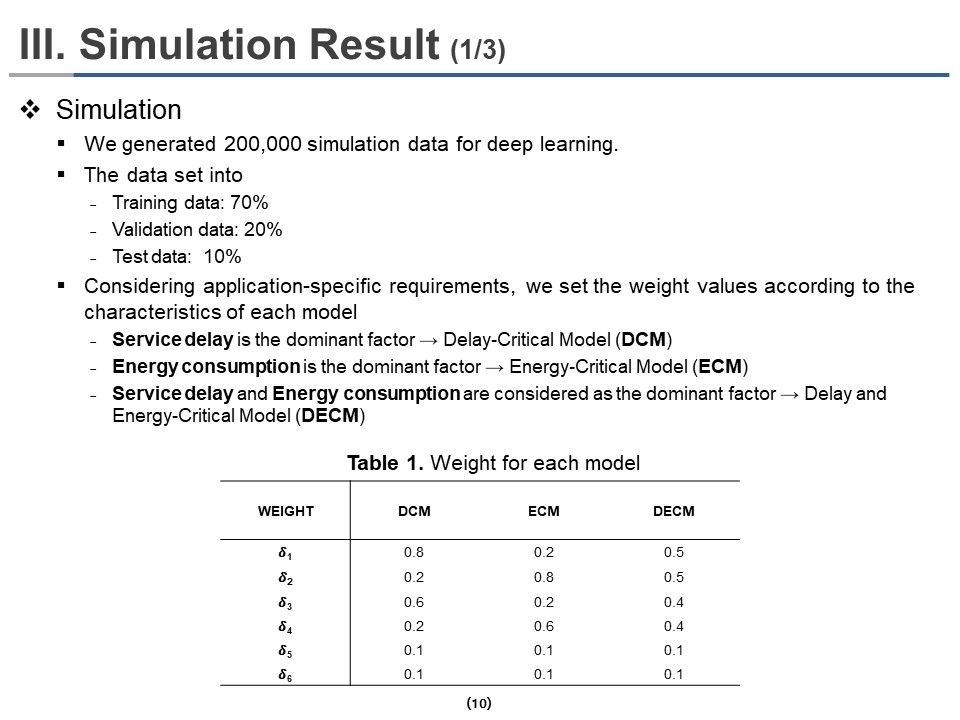
We generated 200,000 simulation data for deep learning. The data is randomly divided into training, validation, and test data by 70%, 20%, and 10%, respectively.
(system model part) We identify and analyze how changing the weight factors that determine delay and energy prioritization affect delay and energy changes when performing offloading. To consider various delays and energy priorities, we evaluate the energy consumption and service delay of partial offloading by setting weighting coefficients according to three scenarios.
Table 1 shows the weight coefficient of the three models. Considering application-specific requirements, we set the weight values according to the characteristics of each model. We considered three different models, which are the delay-critical model (DCM), energy-critical model (ECM), and delay and energy-critical model (DECM).
|
 IEEE/ICACT20220171 Slide.10
[Big Slide]
[YouTube]
IEEE/ICACT20220171 Slide.10
[Big Slide]
[YouTube]