ICACT20210244 Slide.18
[Big slide for presentation]
ICACT20210244 Slide.18
[Big slide for presentation]
|
Chrome Text-to-Speach Click!! Click!! |
 |
I'd like to summarize my presentation.
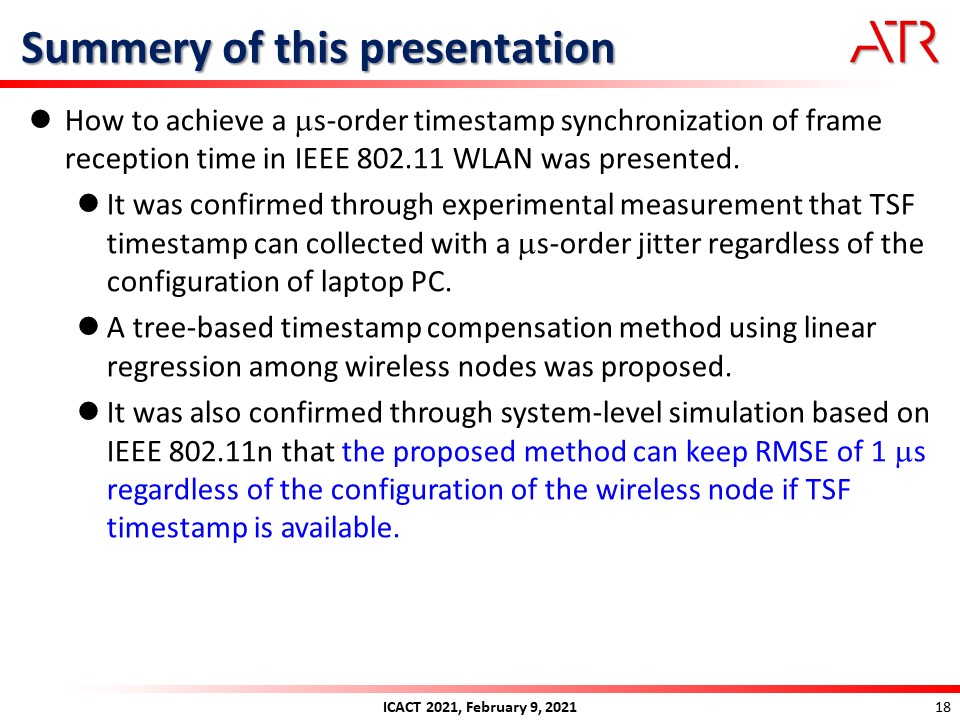
I explained how to achieve a us-order timestamp synchronization of frame reception time in IEEE 802.11 WLAN.
At first, through experimental measurement, we confirmed that TSF timestamp can collected with a us-order jitter regardless of the configuration of laptop PC.
Next, we proposed a tree-based timestamp compensation method using linear regression among wireless nodes.
Finally, we confirmed through system-level simulation based on IEEE 802.11n that the proposed method can keep RMSE of 1 us regardless of the configuration of the wireless node if TSF timestamp is available.
This beings us to the end of my presentation. Thank you for your attention.
|
|
ICACT20210244 Slide.17
[Big slide for presentation]
|
Chrome Text-to-Speach Click!! |
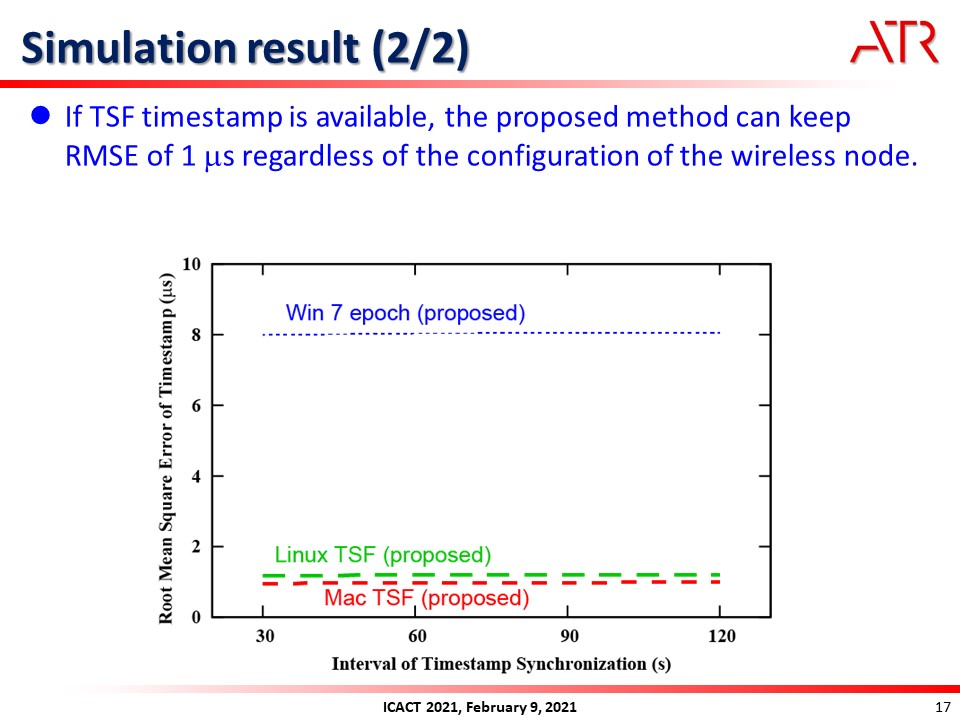 |
This graph shows the small region of the RMSE.
We can find the proposed method can keep RMSE of 1 us regardless of the configuration of the wireless node if TSF timestamp is available.
|
|
ICACT20210244 Slide.16
[Big slide for presentation]
|
Chrome Text-to-Speach Click!! |
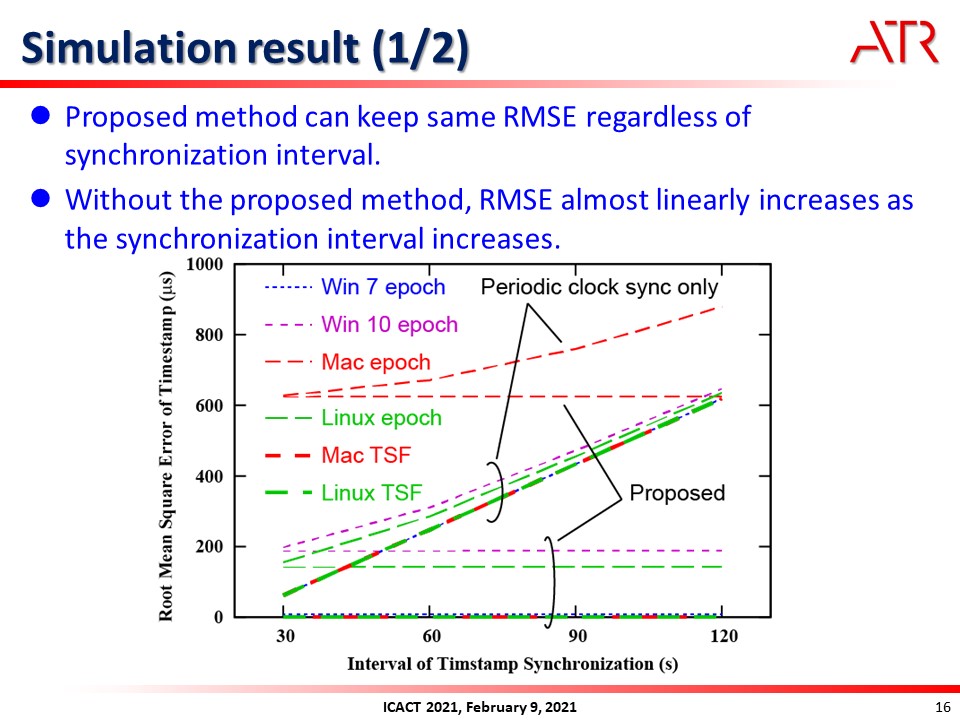 |
This graph shows the RMSE performance of the timestamp compensation obtained by the simulation.
The horizontal axis shows the interval of timestamp synchronization or compensation, and the vertical axis shows the RMSE of the timestamp after compensation.
As shown in this graph, the proposed method can keep same RMSE regardless of synchronization interval.
On the other hand, if the proposed method is not employed, the RMSE almost linearly increases as the synchronization interval increases.
|
|
ICACT20210244 Slide.15
[Big slide for presentation]
|
Chrome Text-to-Speach Click!! |
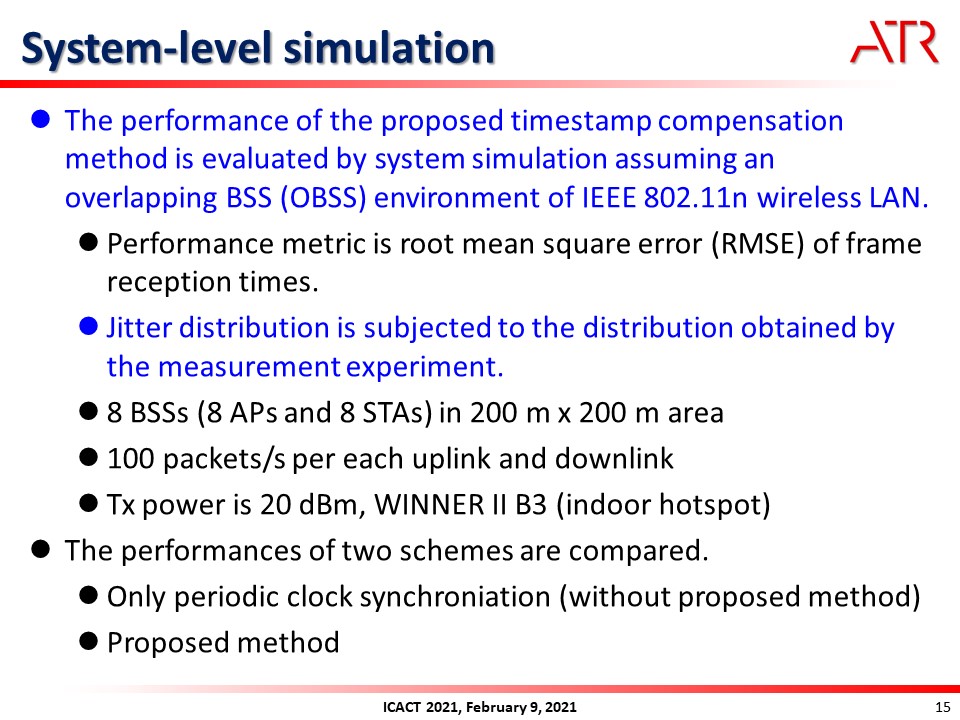 |
The performance of the proposed timestamp compensation method is evaluated by system simulation assuming an overlapping BSS environment of IEEE 802.11n wireless LAN.
Performance metric is the root mean square error of frame reception times.
In this simulation, the jitter distribution is subjected to the distribution obtained by the measurement experiment.
We assumed 8 BSSs, and each BSS consists of one AP and STA in an area with a size of 200 m squares.
100 packets were transmitted per second on each uplink and downlink.
The transmission power was set to 20 dBm, and we assumed WINNER II B3 indoor hotspot channel as the propagation model.
We compared the performances of two schemes. One is the case when only periodic clock synchronization is performed without proposed method.
The other case is when the proposed method is employed.
|
|
ICACT20210244 Slide.14
[Big slide for presentation]
|
Chrome Text-to-Speach Click!! |
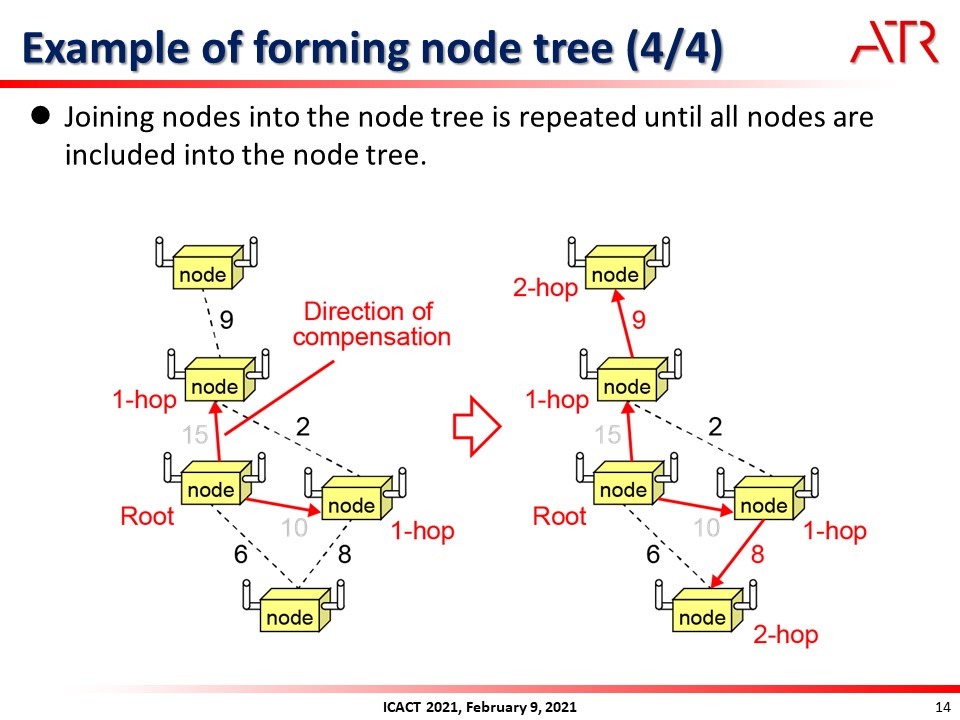 |
This node join process is repeated until all nodes are included into the node tree.
|
|
ICACT20210244 Slide.13
[Big slide for presentation]
|
Chrome Text-to-Speach Click!! |
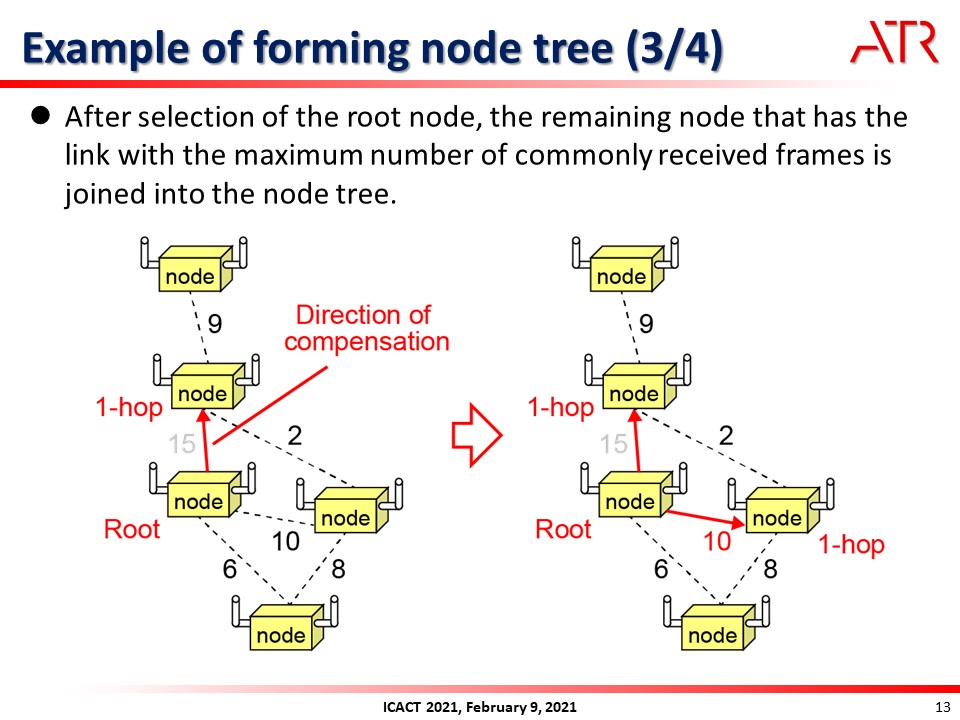 |
After selection of the root node, the remaining node that has the link with the maximum number of commonly received frames is joined into the node tree.
In this example, this node with the link having 10 commonly received frames joins into the node tree.
|
|
ICACT20210244 Slide.12
[Big slide for presentation]
|
Chrome Text-to-Speach Click!! |
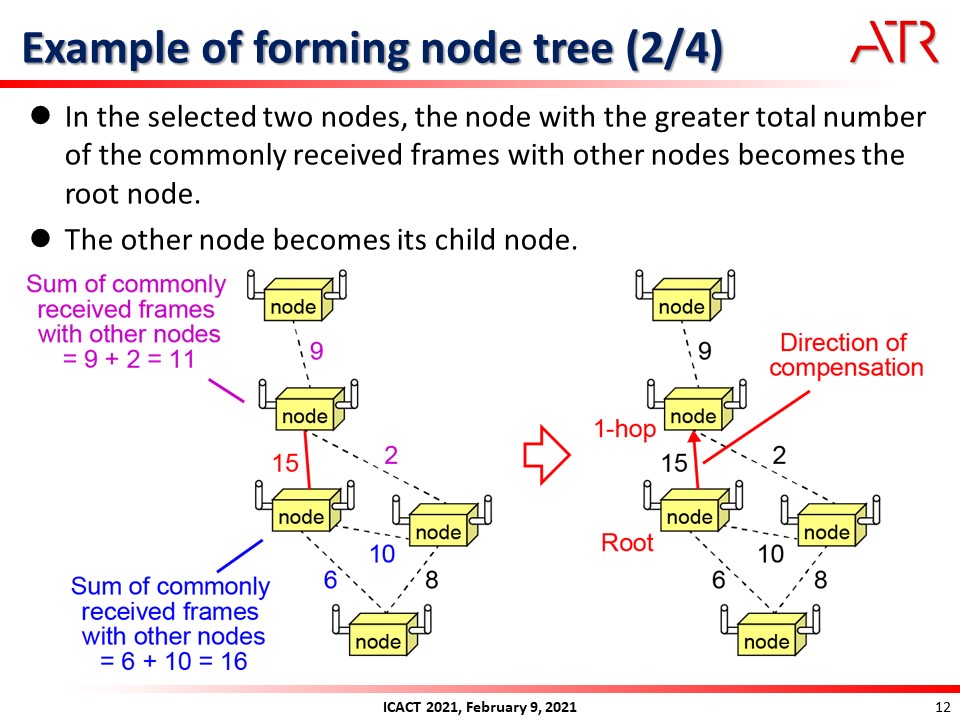 |
Next, we determine the root node for timestamp compensation.
We choose the node with the node with the greater total number of the commonly received frames with other nodes as the root node from the selected two nodes, and the other node becomes its child node.
In this example, the upper node has 11 commonly received frames with other nodes. On the other hand, the lower node upper node has 16 commonly received frames with other nodes. So, the lower becomes the root node, and the timestamp compensation is performed in the direction of this arrow.
|
|
ICACT20210244 Slide.11
[Big slide for presentation]
|
Chrome Text-to-Speach Click!! |
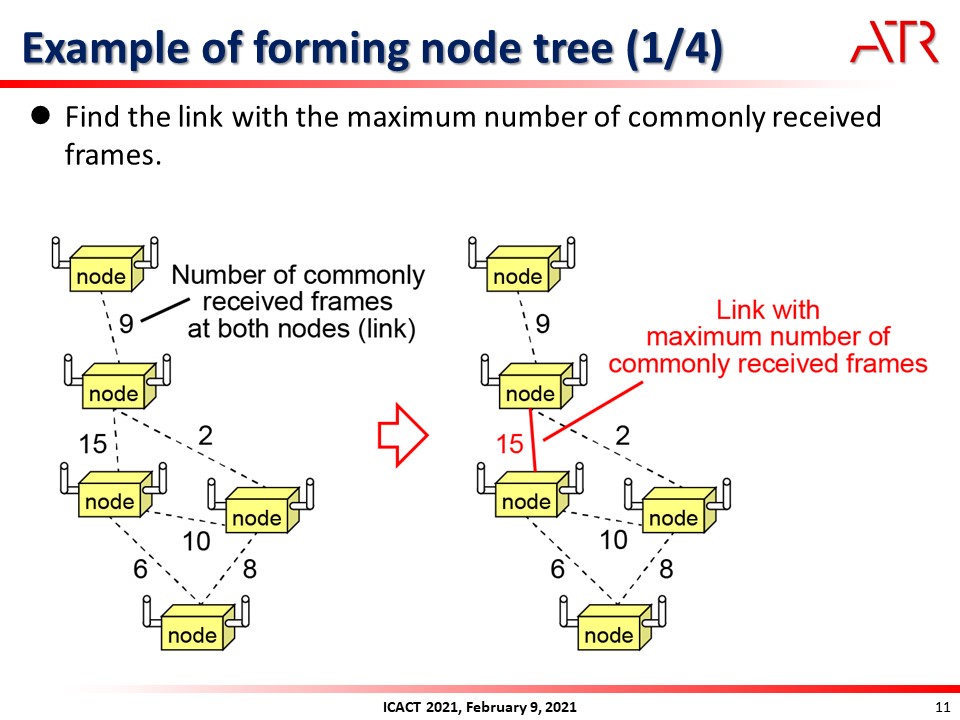 |
In the proposed method, st first, we find the link with the maximum number of commonly received frames.
In this figures, each number shows the number of commonly received frames of each link.
In this case, this link with red color has the maximum number 15 of the number of commonly received frames. So, we select this link.
|
|
ICACT20210244 Slide.10
[Big slide for presentation]
|
Chrome Text-to-Speach Click!! |
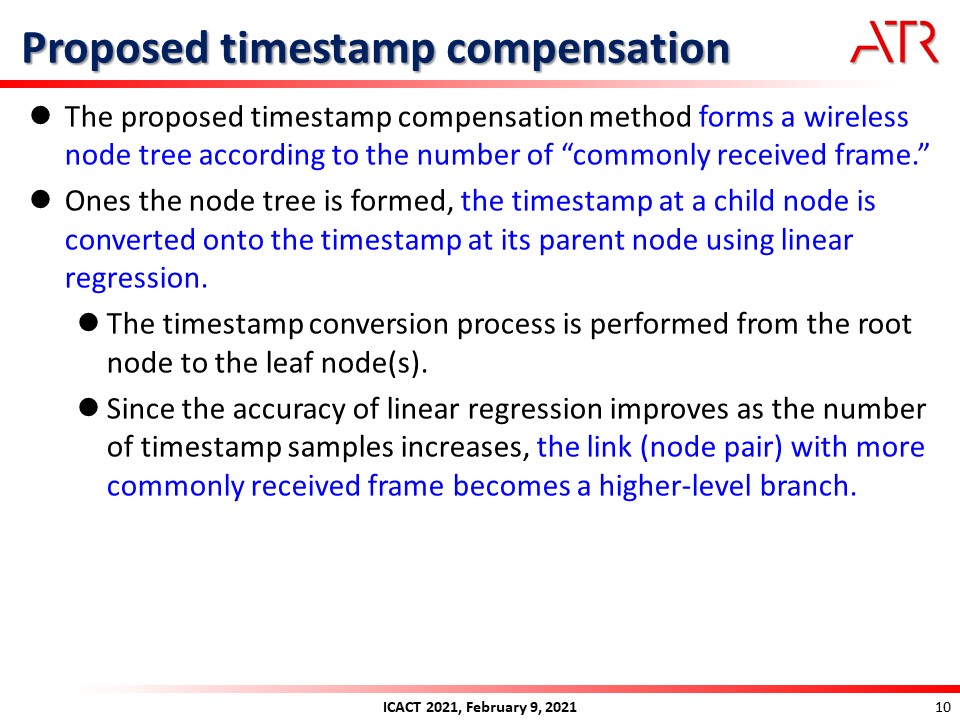 |
Next, I'd like to introduce our proposed timestamp compensation method.
The proposed timestamp compensation method forms a wireless node tree according to the number of commonly received frame at two nodes.
Ones the node tree is formed, the timestamp at a child node is converted onto the timestamp at its parent node using linear regression.
The timestamp conversion process is performed from the root node to the leaf node(s).
Since the accuracy of linear regression improves as the number of timestamp samples increases, the node pair, here we call as "link", with more commonly received frame becomes a higher-level branch.
|
|
ICACT20210244 Slide.09
[Big slide for presentation]
|
Chrome Text-to-Speach Click!! |
 |
On the other hand, the jitter of TSF timestamp is quite small. It is about 1 us regardless of the configuration of laptop PC.
So, TSF timestamp is suitable for access control.
|
|
ICACT20210244 Slide.08
[Big slide for presentation]
|
Chrome Text-to-Speach Click!! |
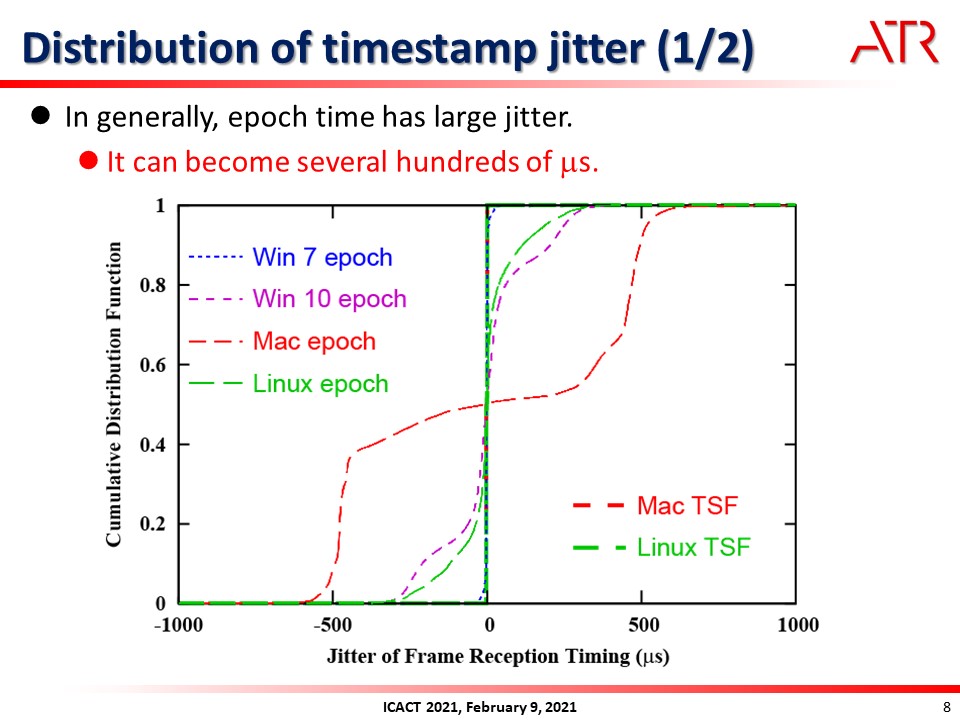 |
This graph shows the cumulative distribution of the timestamp jitter.
The horizontal axis shows the jitter, and the vertical axis shows the CDF of the timestamp jitter.
As shown in this graph, epoch time has large jitter, and it can become several hundreds of us.
|
|
ICACT20210244 Slide.07
[Big slide for presentation]
|
Chrome Text-to-Speach Click!! |
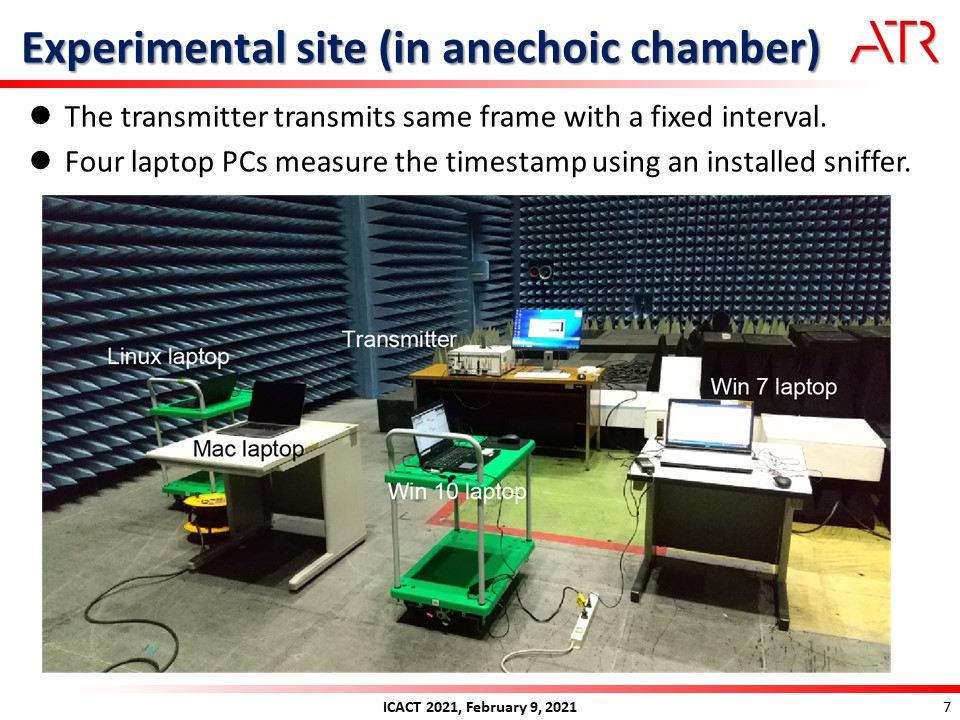 |
This is a picture of experimental site.
In an anechoic chamber, a wireless LAN transmitter and four sniffing PCs are located.
The transmitter transmits same IEEE 802.11g frame with a fixed interval, and the four laptop PCs measure the timestamp using an installed sniffer.
|
|
ICACT20210244 Slide.06
[Big slide for presentation]
|
Chrome Text-to-Speach Click!! |
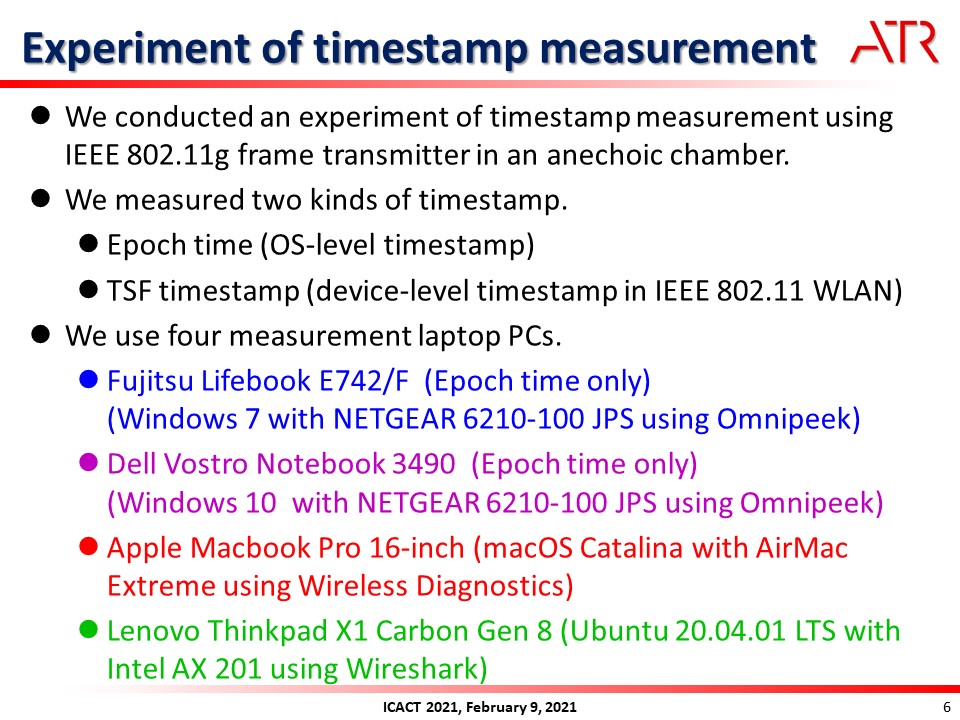 |
At first, we conducted an experiment of timestamp measurement using IEEE 802.11g frame transmitter in an anechoic chamber.
We measured two kinds of timestamp. One is epoch time. This is OS-level timestamp. The other is TSF timestamp. This is device-level timestamp in IEEE 802.11 wireless LAN.
We use four measurement laptop PCs as shown in here. MAC and Linux PCs can obtain TSF timestamp, but Windows PCs cannot obtain TSF timestamp.
|
|
ICACT20210244 Slide.05
[Big slide for presentation]
|
Chrome Text-to-Speach Click!! |
 |
In this presentation, I will introduce how to obtain the timestamp with a small jitter around 1 us through experiment of timestamp measurement.
I will also propose how to compensate for the timestamp error collected from multiple wireless nodes.
We have confirmed that the effectiveness of the proposed time compensation method through computer simulation assuming linear clock drift and taking account for the distribution of timestamp jitter obtained by the experiment of timestamp measurement.
|
|
ICACT20210244 Slide.04
[Big slide for presentation]
|
Chrome Text-to-Speach Click!! |
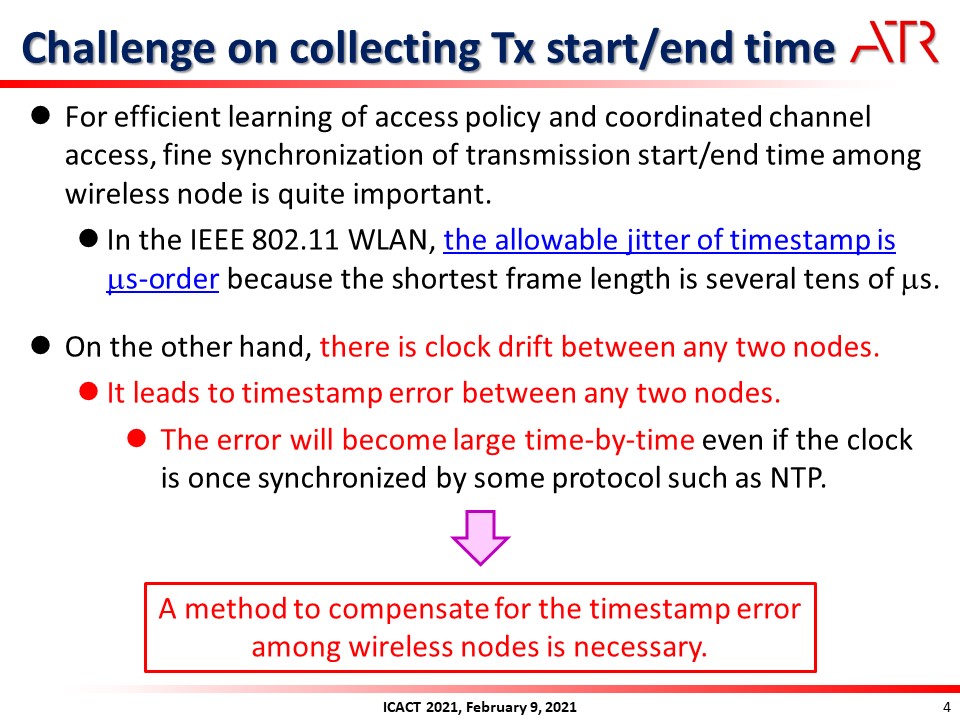 |
For efficient learning of access policy and coordinated channel access, fine synchronization of transmission start/end time among wireless node is quite important.
In the IEEE 802.11 WLAN, the allowable jitter of timestamp is us-order because the shortest frame length is several tens of ms.
On the other hand, there is clock drift between any two nodes, and it leads to timestamp error between any two nodes.
The timestamp error will become large time-by-time even if the clock is once synchronized by some protocol such as NTP.
So, a method to compensate for the timestamp error among wireless nodes is necessary.
|
|
ICACT20210244 Slide.03
[Big slide for presentation]
|
Chrome Text-to-Speach Click!! |
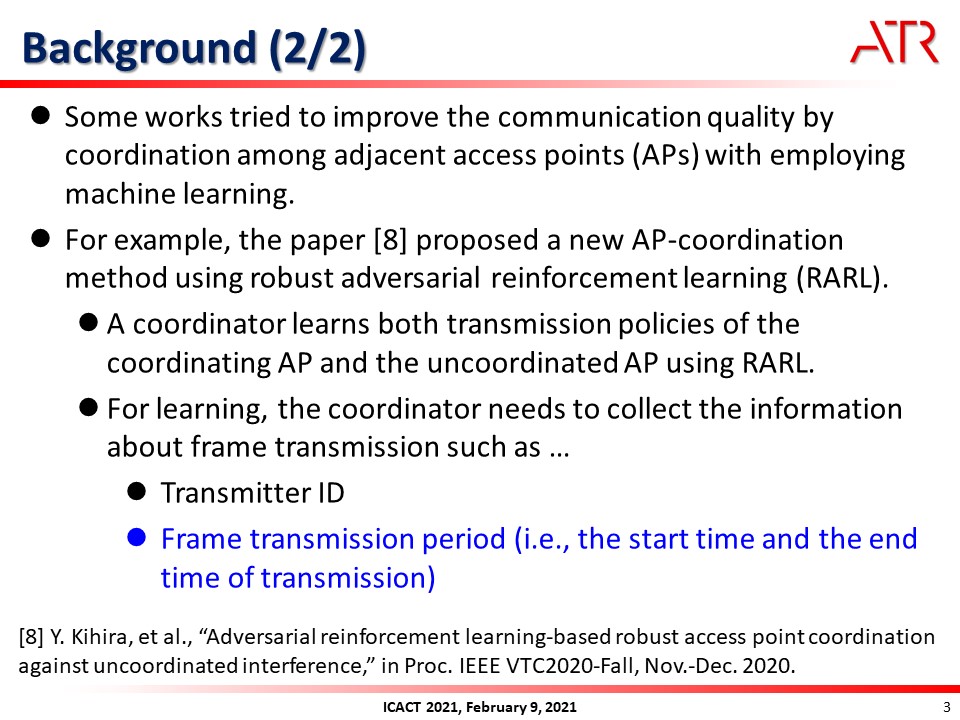 |
Recently, some works tried to improve the communication quality by coordination among adjacent access points with employing machine learning.
For example, the reference [8] proposed a new AP-coordination method using robust adversarial reinforcement learning.
In this method, a coordinator learns both transmission policies of the coordinating AP and the uncoordinated AP using RARL.
To perform learning, the coordinator needs to collect the information about frame transmission such as Transmitter ID and frame transmission period, or the start time and the end time of transmission.
|
|
ICACT20210244 Slide.02
[Big slide for presentation]
|
Chrome Text-to-Speach Click!! |
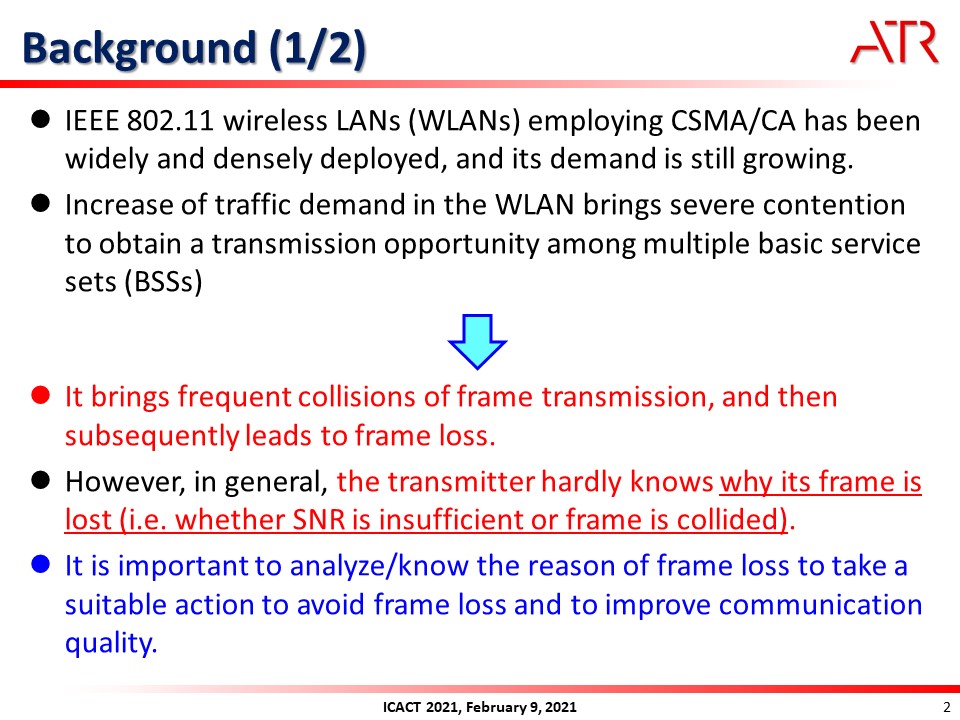 |
IEEE 802.11 wireless LANs (WLANs) employing CSMA/CA has been widely and densely deployed, and its demand is still growing.
In the wireless LAN, the increase of traffic demand brings severe contention to obtain a transmission opportunity among multiple basic service sets , and it brings frequent collisions of frame transmission, and then subsequently leads to frame loss.
However, in general, the transmitter hardly knows why its frame is lost, in other words, whether SNR is insufficient or frame is collided.
So, it is important to analyze and/or know the reason of frame loss to take a suitable action to avoid frame loss and to improve communication quality.
|
|
ICACT20210244 Slide.01
[Big slide for presentation]
|
Chrome Text-to-Speach Click!! |
 |
Thank you chairperson.
I am Kazuto Yano with Advanced Telecommunications Research Institute International, Japan.
My presentation title is "Synchronization of Received Frames among Multiple Wireless LAN Nodes for Robust Access Point Coordination."
|