ICACT20210235 Slide.24
[Big slide for presentation]
ICACT20210235 Slide.24
[Big slide for presentation]
|
Chrome Text-to-Speach Click!! Click!! |
 |
thank you very much
|
|
ICACT20210235 Slide.23
[Big slide for presentation]
|
Chrome Text-to-Speach Click!! |
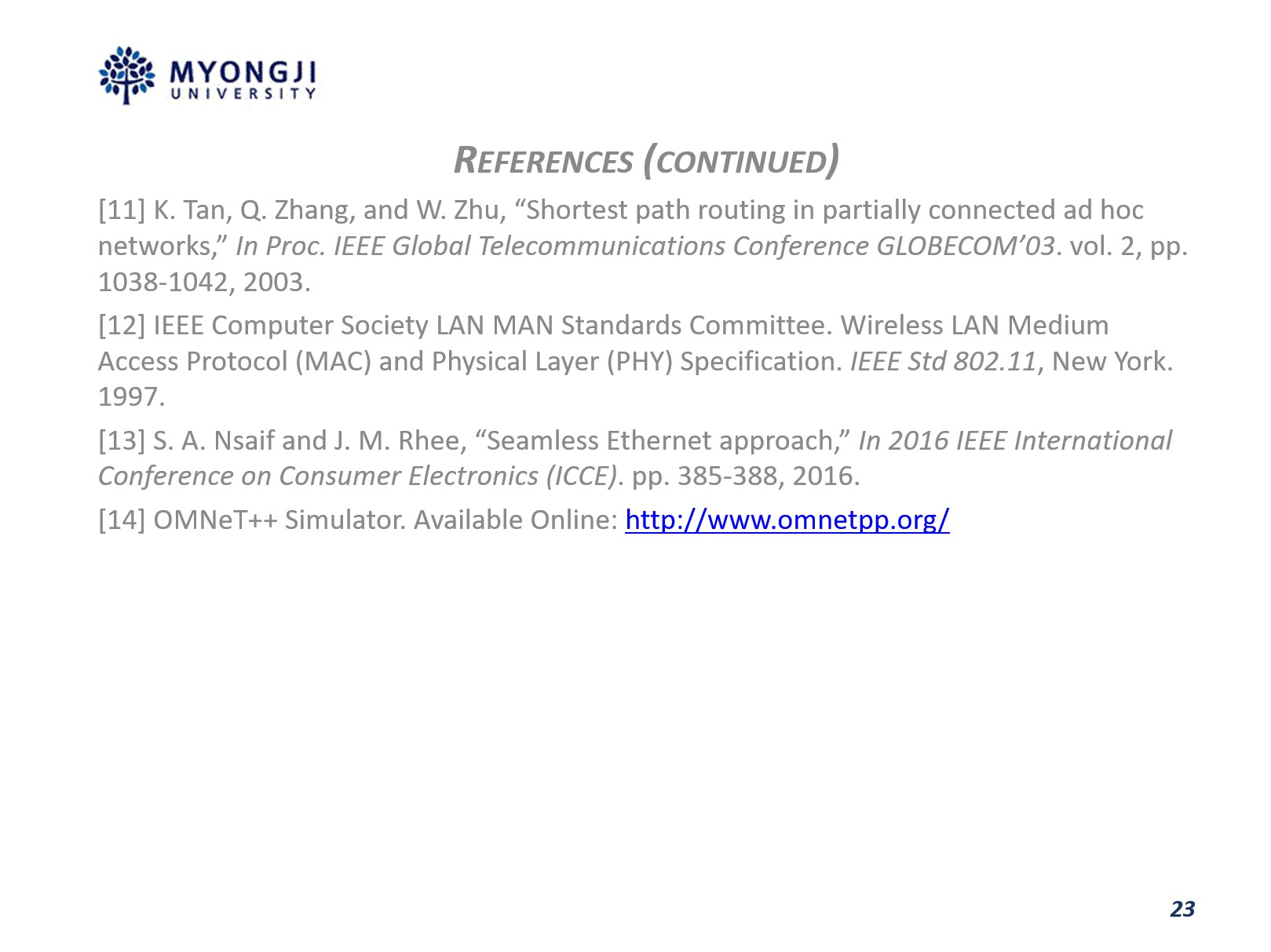 |
These are references that used in our papers.
|
|
ICACT20210235 Slide.22
[Big slide for presentation]
|
Chrome Text-to-Speach Click!! |
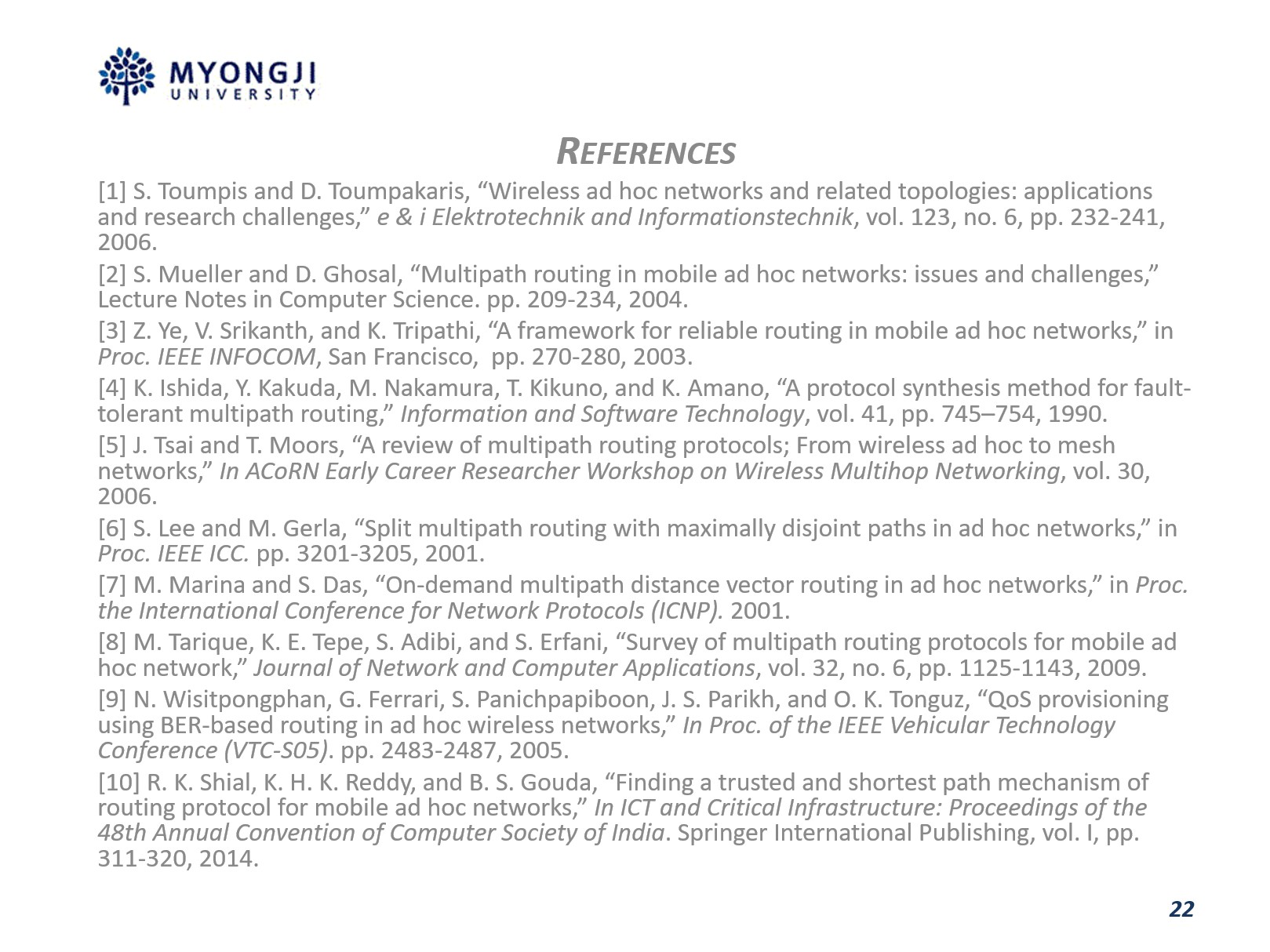 |
These are references that used in our papers.
|
|
ICACT20210235 Slide.21
[Big slide for presentation]
|
Chrome Text-to-Speach Click!! |
 |
This research was supported by the National Research Foundation of Korea (NRF) grant funded by the Korean government (MSIT) both (No. 2020R1A2B5B02002201) and (No. 2019R1F1A1060820).
|
|
ICACT20210235 Slide.20
[Big slide for presentation]
|
Chrome Text-to-Speach Click!! |
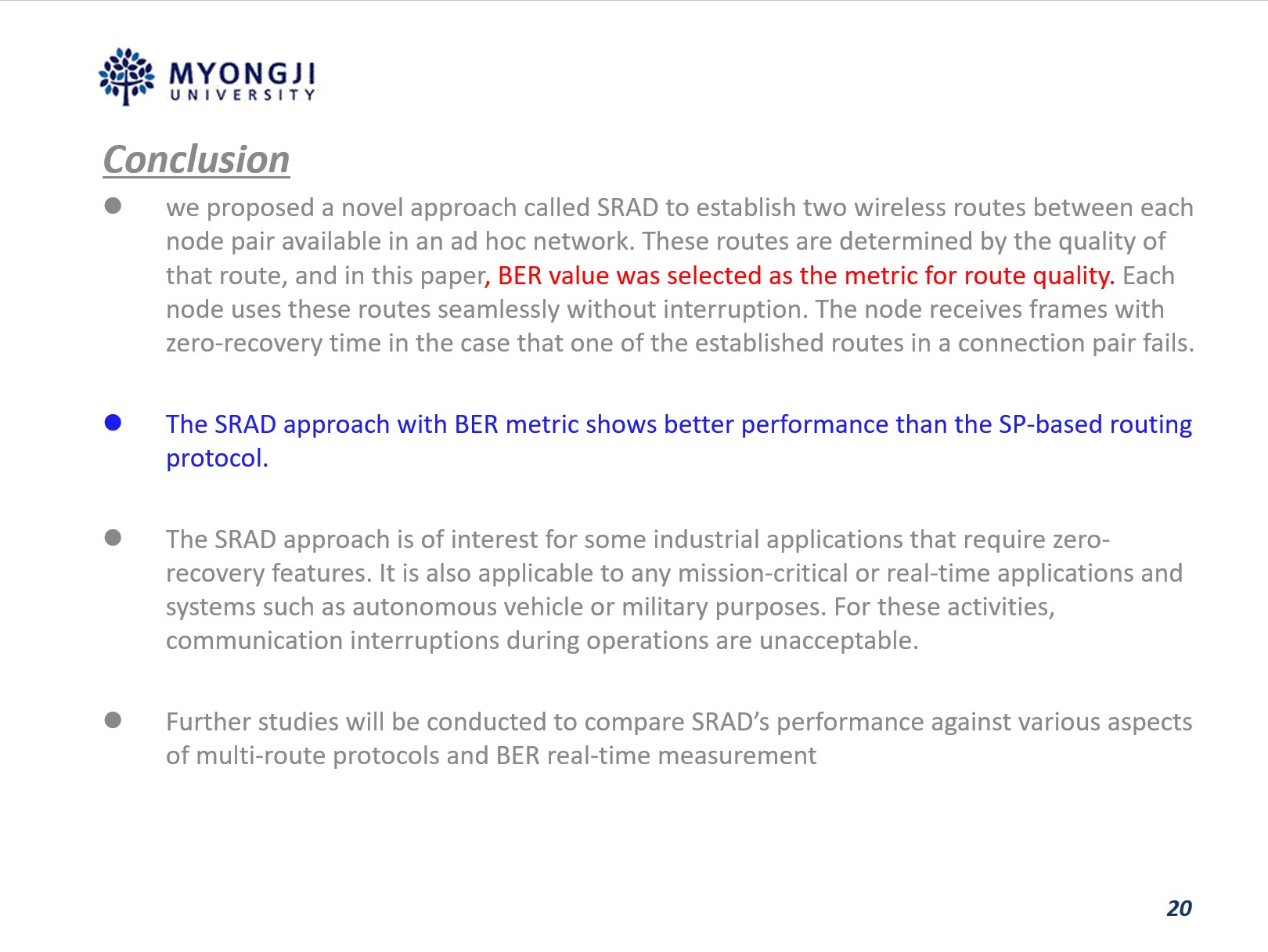 |
In this paper we proposed a novel approach called SRAD to establish two wireless routes between each node pair available in an ad hoc network. These routes are determined by the quality of that route, and BER value was selected as the metric for route quality. Each node uses these routes seamlessly without interruption. The node receives frames with zero-recovery time in the case that one of the established routes in a connection pair fails.
The SRAD approach with BER metric shows better performance than the SP-based routing protocol.
The SRAD approach is of interest for some industrial applications that require zero-recovery features. It is also applicable to any mission-critical and/or real-time applications and systems such as autonomous vehicle or military purposes. For these activities, communication interruptions during operations are unacceptable.
Further studies will be made to compare SRAD’s performance against various aspects of multi-route protocols and BER real-time measurement
|
|
ICACT20210235 Slide.19
[Big slide for presentation]
|
Chrome Text-to-Speach Click!! |
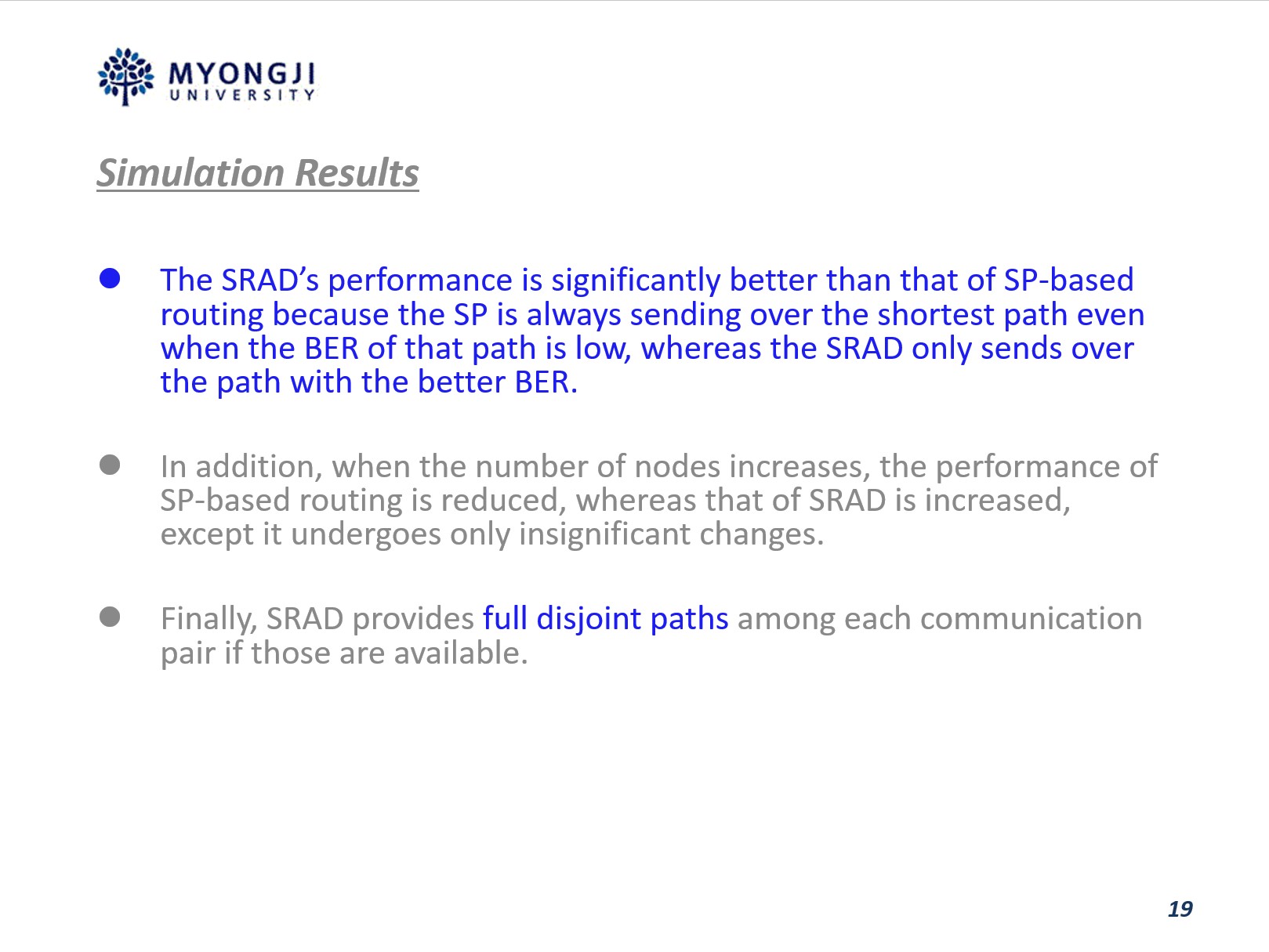 |
The simulation results show the followings;
The SRAD’s performance is significantly better than that of SP-based routing because the SP is always sending over the shortest path even when the BER of that path is low, whereas the SRAD only sends over the path with the better BER.
In addition, when the number of nodes increases, the performance of SP-based routing is reduced, whereas that of SRAD is increased, except it undergoes only insignificant changes.
Finally, SRAD provides full disjoint paths among each communication pair if those are available.
|
|
ICACT20210235 Slide.18
[Big slide for presentation]
|
Chrome Text-to-Speach Click!! |
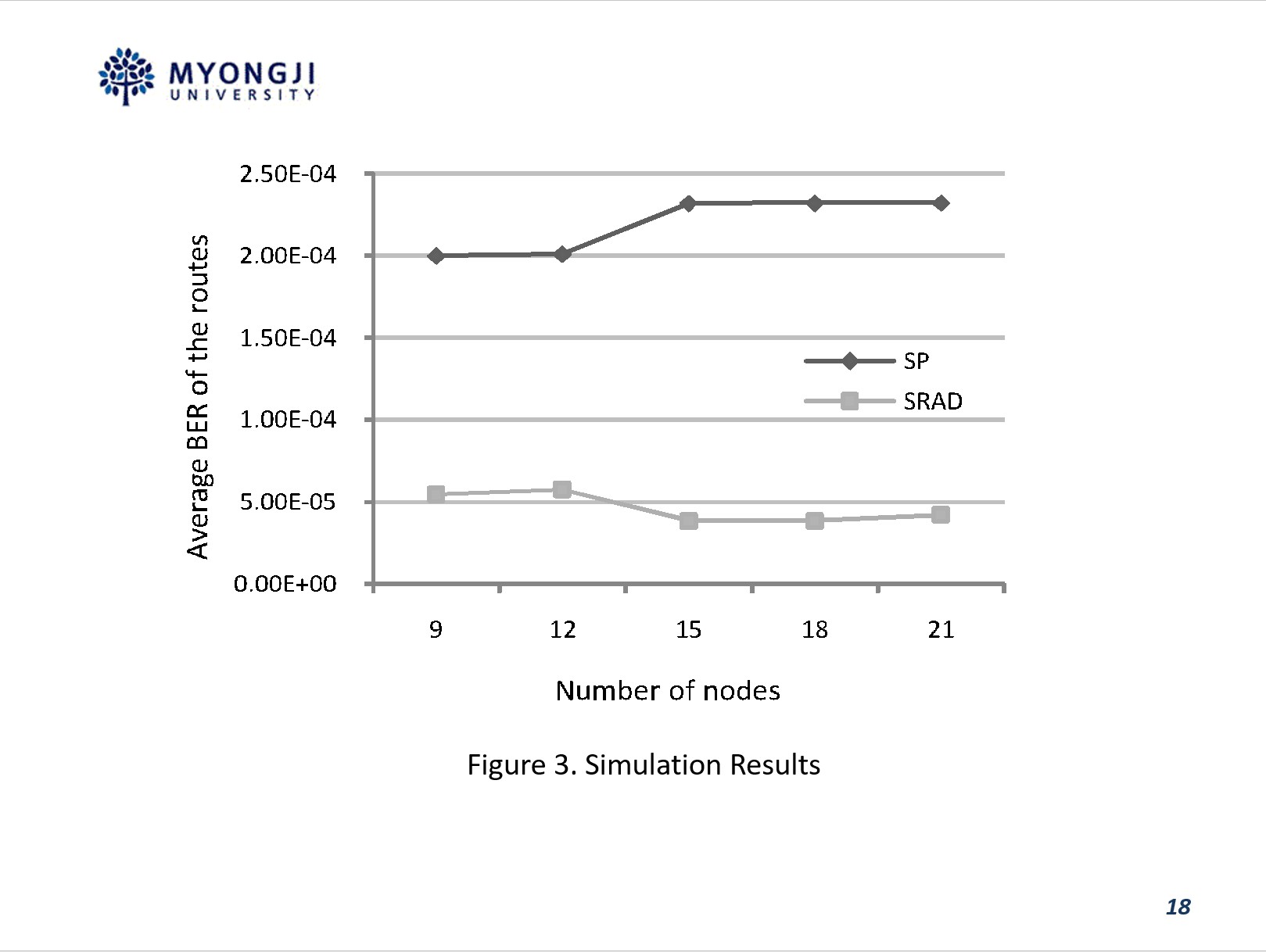 |
Figure 3 shows the performance simulation results for both our SRAD and conventional SP (shortest path) algorithms.
|
|
ICACT20210235 Slide.17
[Big slide for presentation]
|
Chrome Text-to-Speach Click!! |
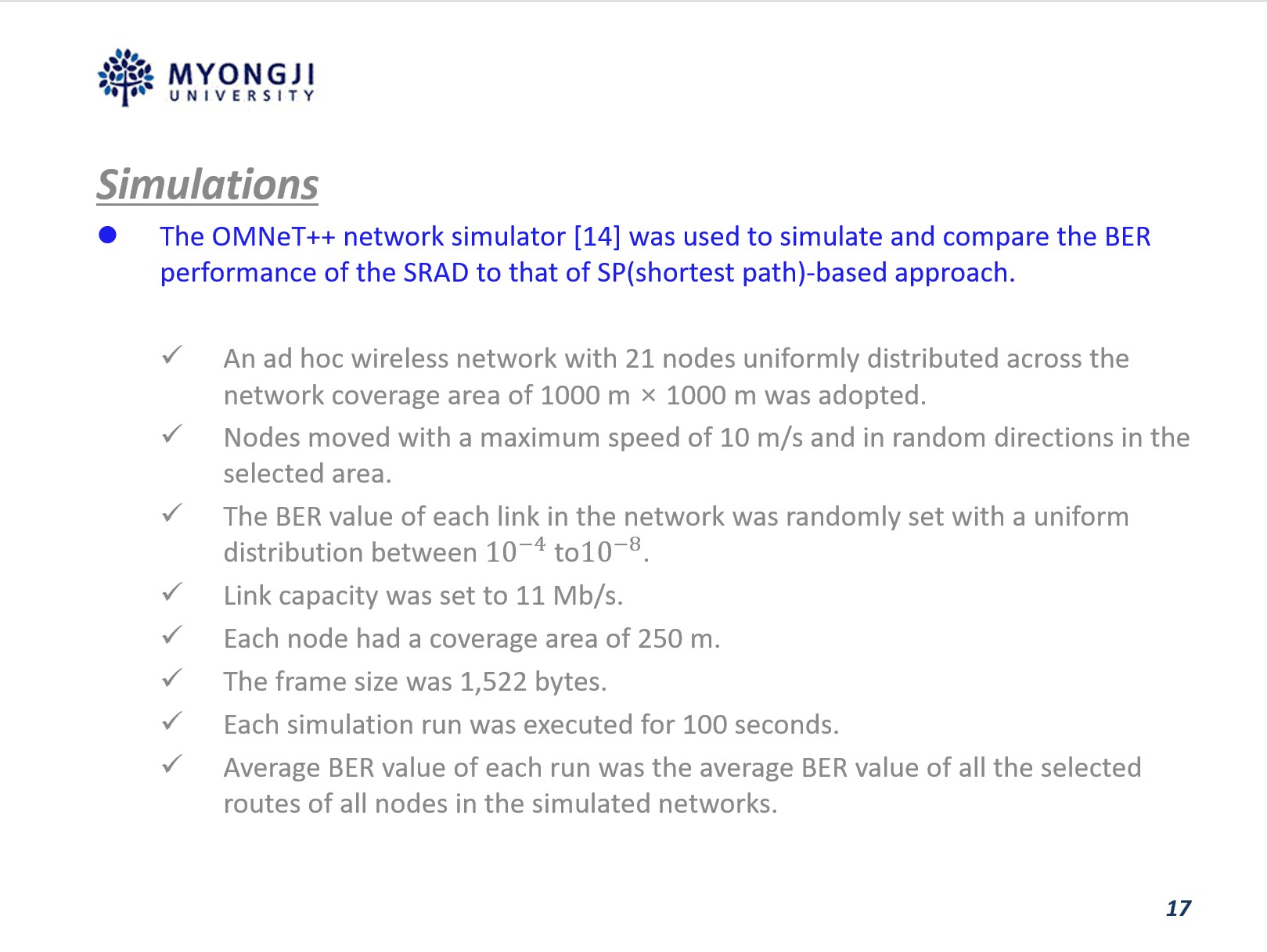 |
For our simulations the OMNeT++ network simulator [14] was used and compare the BER performance of the SRAD to that of SP-based approach.
The followings are parameter values used in our simulations;
An ad hoc wireless network with 21 nodes uniformly distributed across the network coverage area of 1000 m × 1000 m was adopted.
Nodes moved with a maximum speed of 10 m/s and in random directions in the selected area.
The BER value of each link in the network was randomly set with a uniform distribution between 10^(−4) to10^(−8).
Link capacity was set to 11 Mb/s.
Each node had a coverage area of 250 m.
The frame size was 1,522 bytes.
Each simulation run was executed for 100 seconds.
Average BER value of each run was the average BER value of all the selected routes of all nodes in the simulated networks.
|
|
ICACT20210235 Slide.16
[Big slide for presentation]
|
Chrome Text-to-Speach Click!! |
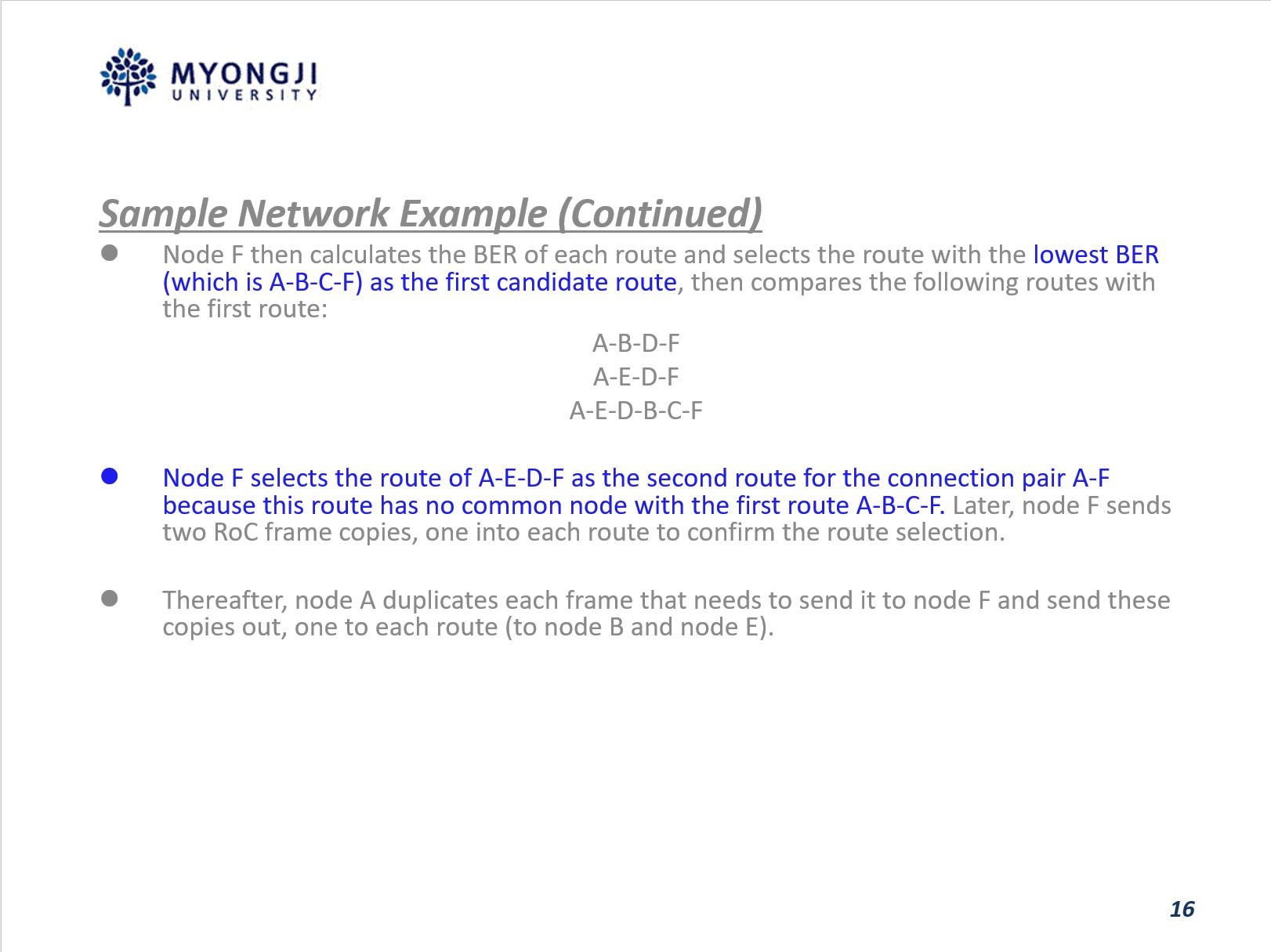 |
For figure 2 example SRAD operation can be made as followings;
Node F calculates the BER of each route and selects the route with the lowest BER (which is A-B-C-F) as the first candidate route, then compares the following routes with the first route:
A-B-D-F
A-E-D-F
A-E-D-B-C-F
Node F selects the route of A-E-D-F as the second route for the connection pair A-F because this route has no common node with the first route A-B-C-F. Later, node F sends two RoC frame copies, one into each route to confirm the route selection.
Thereafter, node A duplicates each frame that needs to send it to node F and send these copies out, one to each route (to node B and node E).
|
|
ICACT20210235 Slide.15
[Big slide for presentation]
|
Chrome Text-to-Speach Click!! |
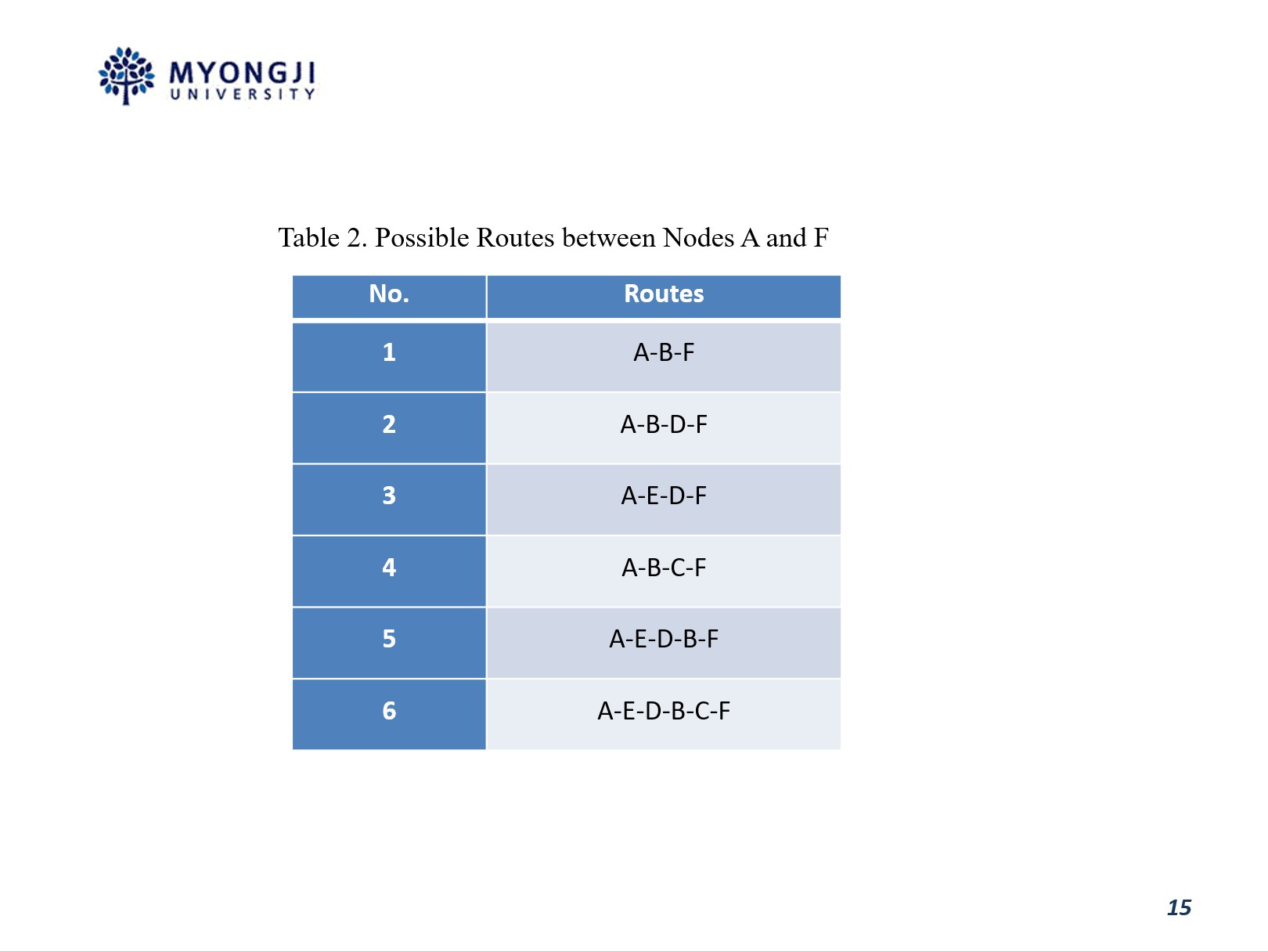 |
Table 2 shows possible six routes between nodes A and F.
|
|
ICACT20210235 Slide.14
[Big slide for presentation]
|
Chrome Text-to-Speach Click!! |
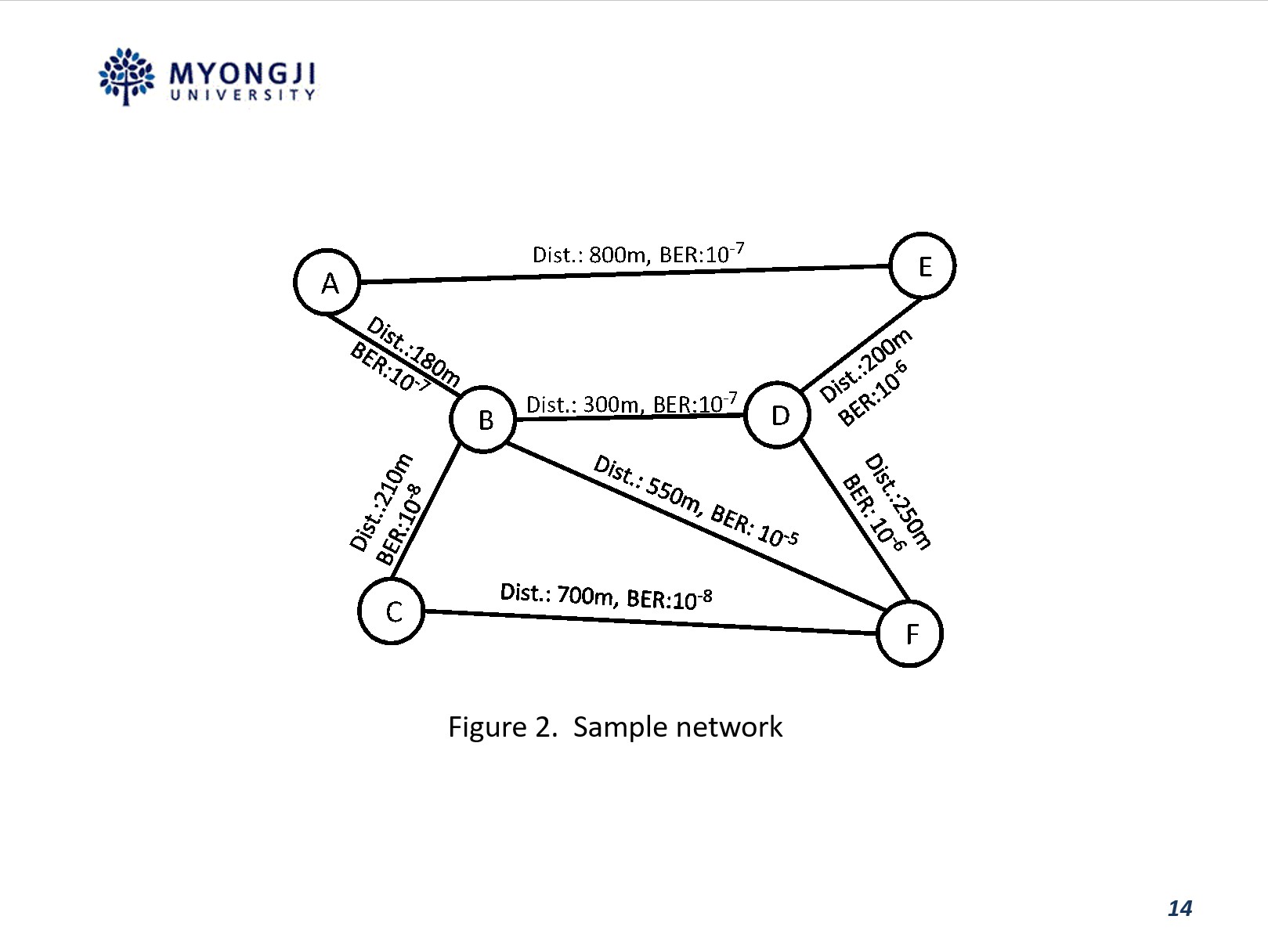 |
Figure 2 shows our sample network example for operation details.
|
|
ICACT20210235 Slide.13
[Big slide for presentation]
|
Chrome Text-to-Speach Click!! |
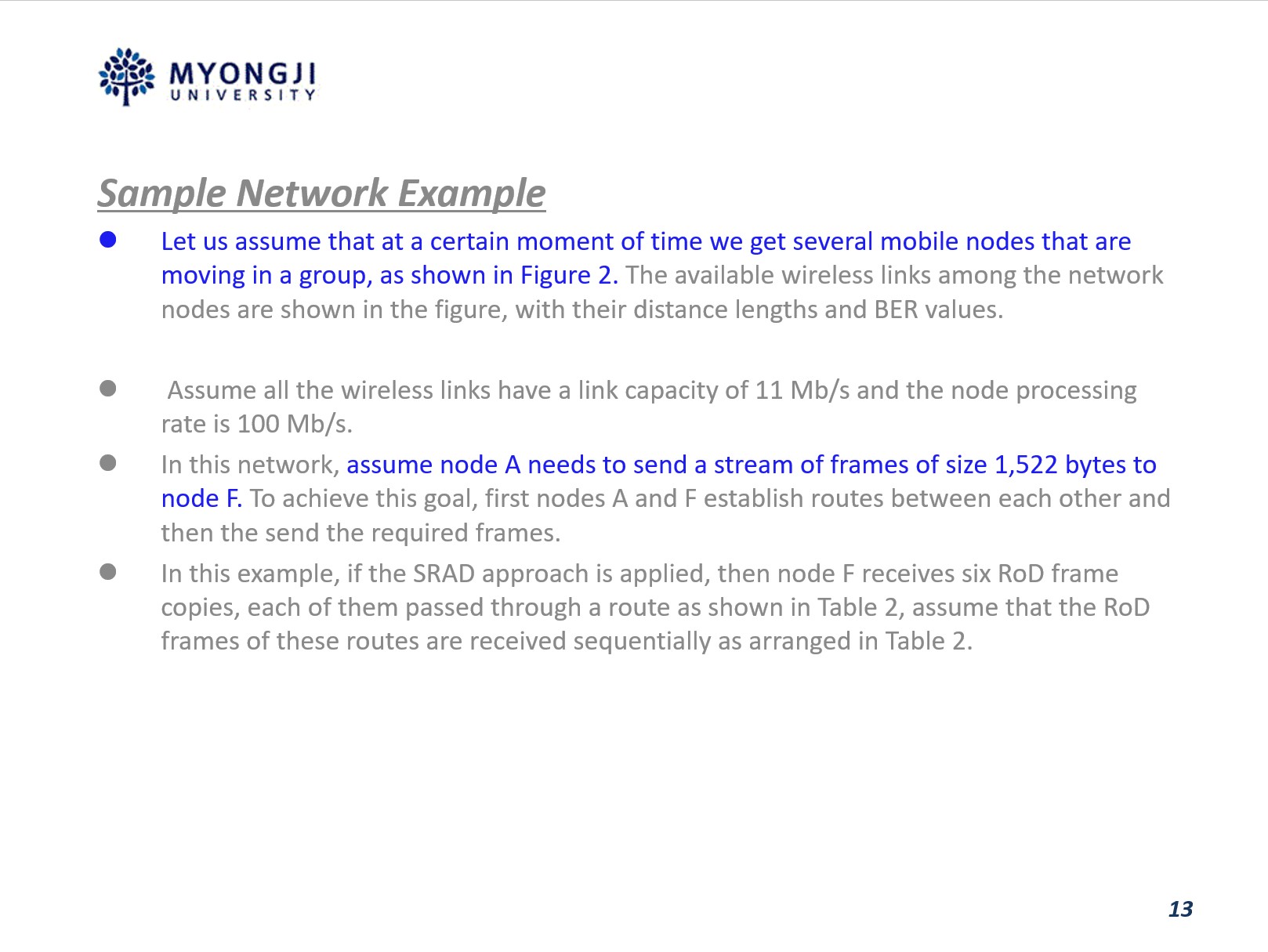 |
For demonstration purpose, we analyzed sample network shown in Figure 2. We assume that at a certain moment of time we get several mobile nodes that are moving in a group, as shown in Figure 2. The available wireless links among the network nodes are shown in the figure, with their distance lengths and BER values.
Also we assume all the wireless links have a link capacity of 11 Mb/s and the node processing rate is 100 Mb/s.
In this network, assume node A needs to send a stream of frames of size 1,522 bytes to node F. To achieve this goal, first nodes A and F establish routes between each other and then the send the required frames.
In this example, if the SRAD approach is applied, then node F receives six RoD frame copies, each of them passed through a route as shown in Table 2, assume that the RoD frames of these routes are received sequentially as arranged in Table 2.
|
|
ICACT20210235 Slide.12
[Big slide for presentation]
|
Chrome Text-to-Speach Click!! |
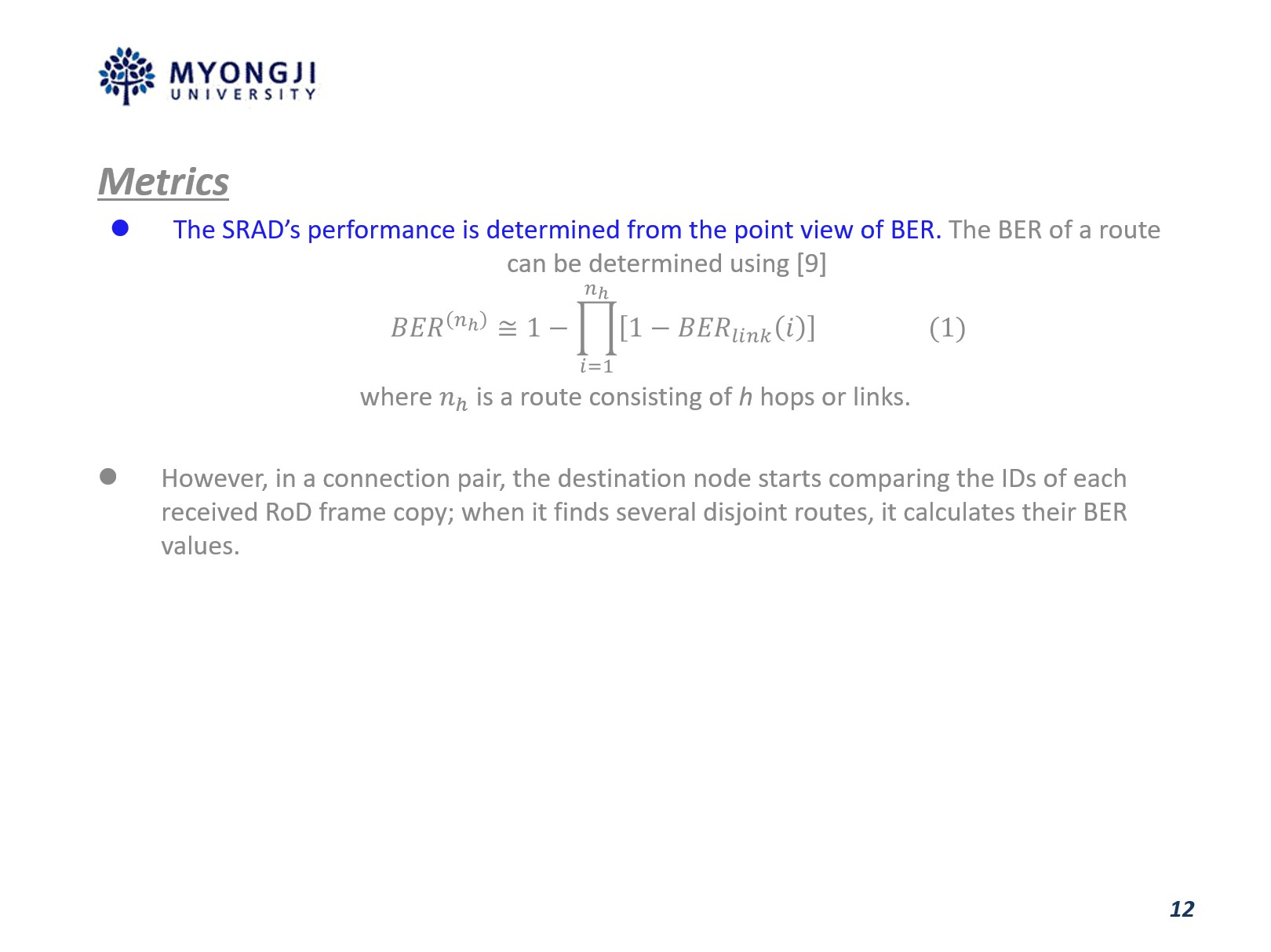 |
As mentioned, we used BER (bit error rate) metrics for performance comparison.
The SRAD’s performance is determined from the point view of BER. The BER of a route can be determined using [9]
〖𝐵𝐸𝑅〗^((𝑛_ℎ ) )≅1−∏1_(𝑖=1)^(𝑛_ℎ)▒〖[1−〖𝐵𝐸𝑅〗_𝑙𝑖𝑛𝑘 (𝑖)] (1)〗
where 𝑛_ℎ is a route consisting of h hops or links.
However, in a connection pair, the destination node starts comparing the IDs of each received RoD frame copy; when it finds several disjoint routes, it calculates their BER values.
|
|
ICACT20210235 Slide.11
[Big slide for presentation]
|
Chrome Text-to-Speach Click!! |
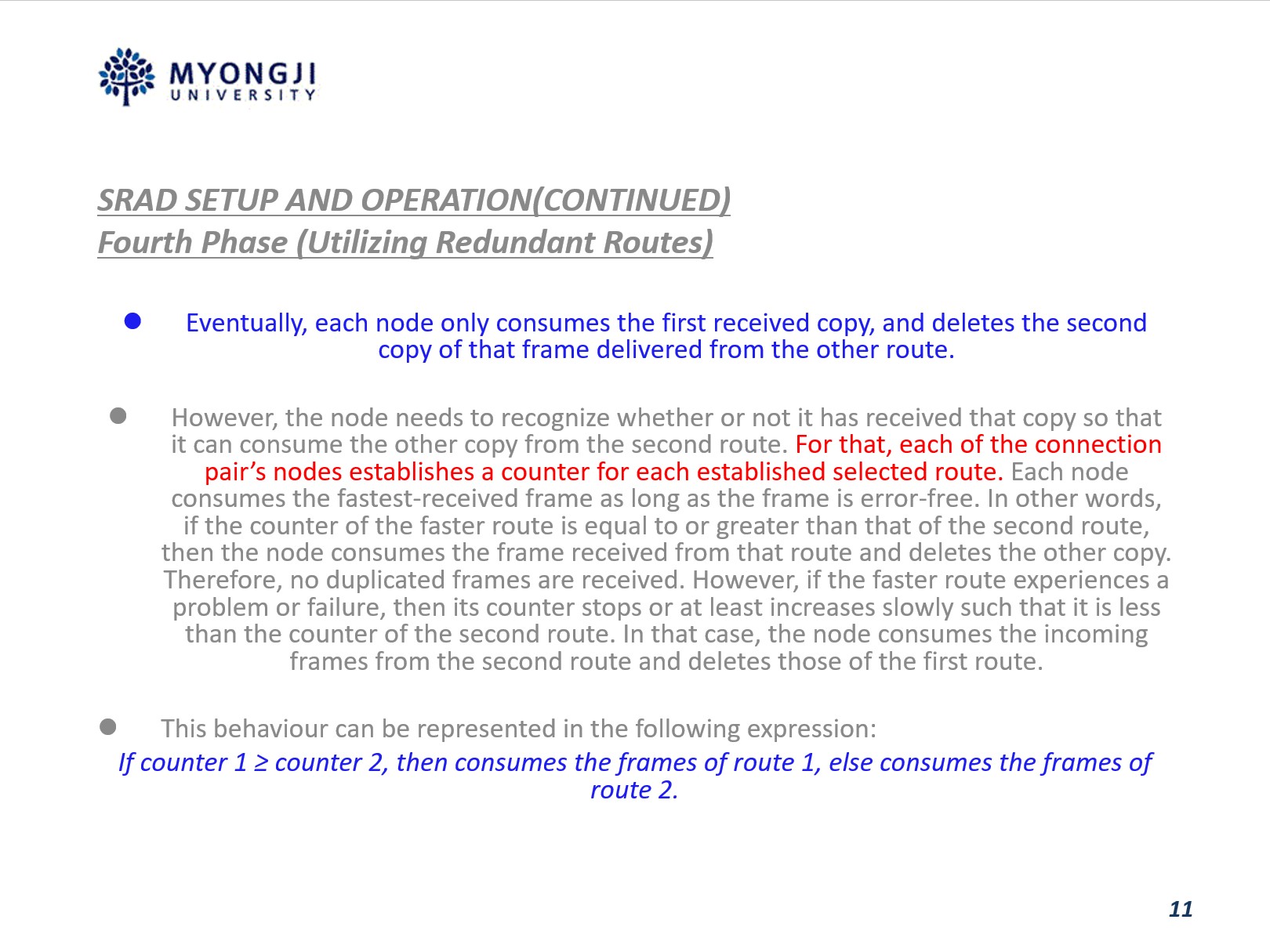 |
The final phase is the Fourth Phase that is Utilizing Redundant Routes.
Eventually, each node only consumes the first received copy, and deletes the second copy of that frame delivered from the other route.
However, the node needs to recognize whether or not it has received that copy so that it can consume the other copy from the second route. For that, each of the connection pair’s nodes establishes a counter for each established selected route. Each node consumes the fastest-received frame as long as the frame is error-free. In other words, if the counter of the faster route is equal to or greater than that of the second route, then the node consumes the frame received from that route and deletes the other copy. Therefore, no duplicated frames are received. However, if the faster route experiences a problem or failure, then its counter stops or at least increases slowly such that it is less than the counter of the second route. In that case, the node consumes the incoming frames from the second route and deletes those of the first route.
This behaviour can be represented in the following expression:
If counter 1 ≥ counter 2, then consumes the frames of route 1, else consumes the frames of route 2.
|
|
ICACT20210235 Slide.10
[Big slide for presentation]
|
Chrome Text-to-Speach Click!! |
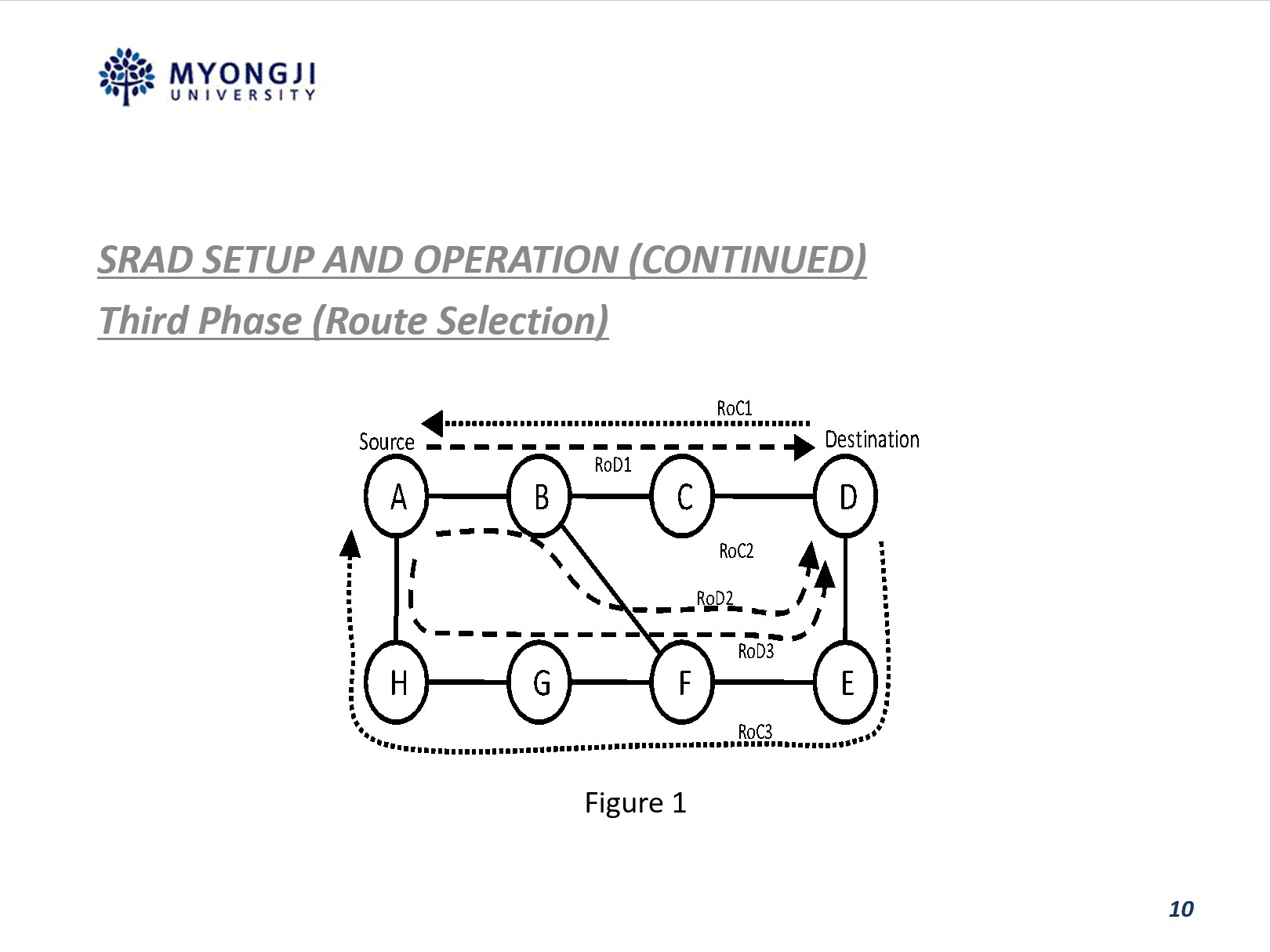 |
Figure 2 shows route selection operation between nodes A and D.
|
|
ICACT20210235 Slide.09
[Big slide for presentation]
|
Chrome Text-to-Speach Click!! |
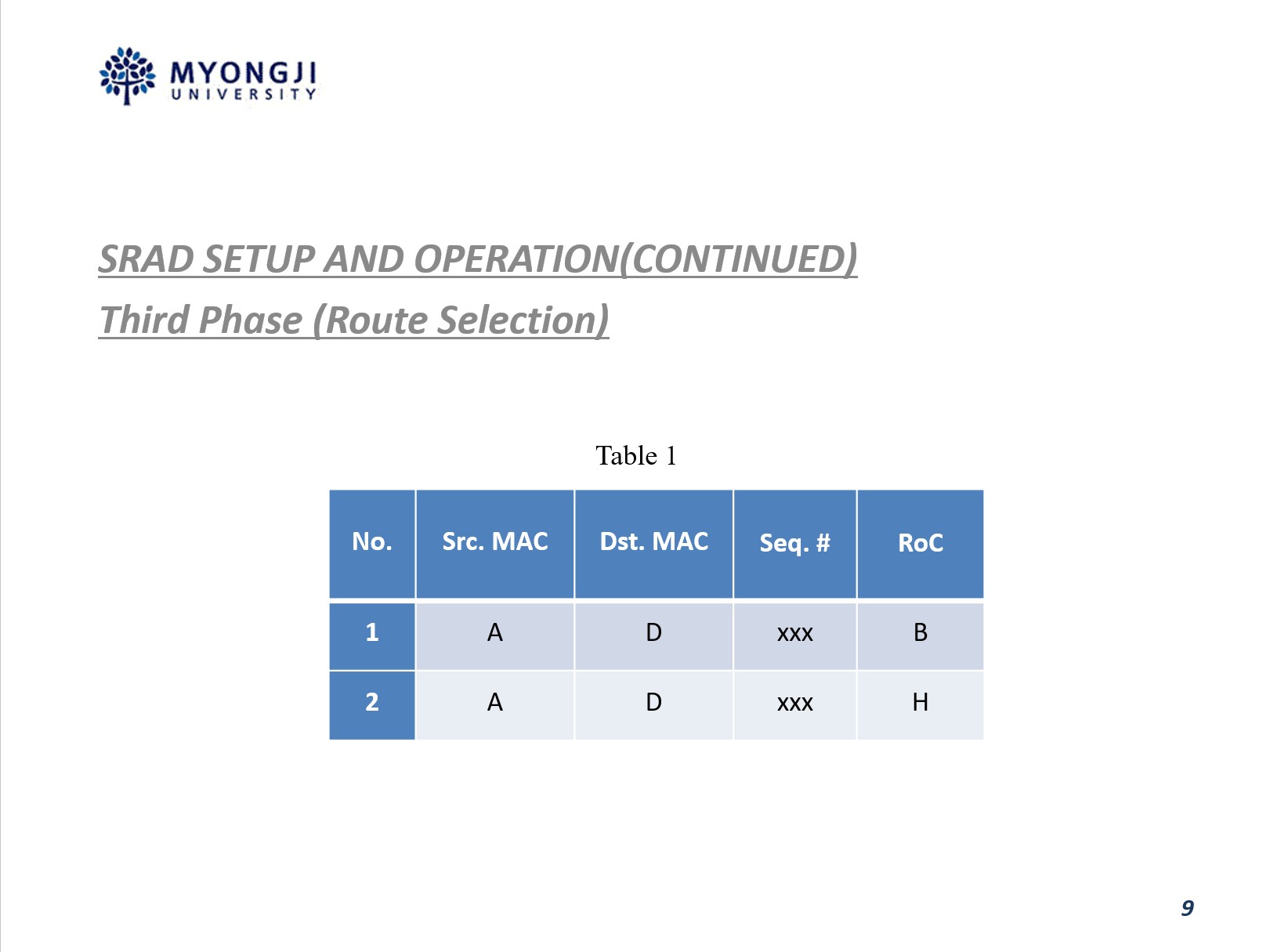 |
Again Table 1 shows an example for the routes table of node A in Figure 1 when it has established two disjoint routes with node D.
|
|
ICACT20210235 Slide.08
[Big slide for presentation]
|
Chrome Text-to-Speach Click!! |
 |
Table 1 shows an example for the routes table of node A in Figure 1 when it has established two disjoint routes with node D.
Note that each node in the network has routes and connection pair (CP) tables. Routes table is used for sending frames to the destination nodes of its connection pairs, whereas the CP table guides the node in forwarding the passing frames of other connection pairs. All nodes employ the same approach when communicating with each other.
|
|
ICACT20210235 Slide.07
[Big slide for presentation]
|
Chrome Text-to-Speach Click!! |
 |
Third Phase is Route Selection:
After each node sends a route discovery (RoD) frame to each corresponding node in its network (which is considered destination nodes in this case), each destination node selects the optimum routes that connect it with each source node from which it received an RoD frame.
|
|
ICACT20210235 Slide.06
[Big slide for presentation]
|
Chrome Text-to-Speach Click!! |
 |
SRAD has four phases operation procedures;
Node discovery
Route discovery
Route Selection
Redundant Route use
First Phase is Node Discovery:
According to the link layer of IEEE 802.11 [12], each node senses any adjacent nodes; the nodes then exchange MAC address and possibly some authentication information to trust each other before considering each other. As a result of this phase, each node builds an adjacent nodes (AdN) table containing the MAC addresses of all adjacent nodes, including the BER values of their links.
Second Phase is Route Discovery:
In this phase, all the network nodes discover the possible routes to each corresponding node in the network.
|
|
ICACT20210235 Slide.05
[Big slide for presentation]
|
Chrome Text-to-Speach Click!! |
 |
The goal of the SRAD approach is to provide seamless wireless communication redundancy for each pair of nodes in an ad hoc wireless network. As a result of applying SRAD approach on any network, a full wireless mesh network is established among the nodes.
The source node of each connection pair duplicates the required frame to be sent, and then sends each copy via a different route to the corresponding destination node of that pair.
This approach allows all nodes communicate with one another at high quality and without interruption.
The SRAD uses several special frames during the setup and monitoring phases. Each of these frames has a unique code and also has a sequence number.
The SRAD approach is applicable to industrial applications that require zero-recovery; and for any mission-critical or real-time applications such as autonomous vehicle and military systems.
|
|
ICACT20210235 Slide.04
[Big slide for presentation]
|
Chrome Text-to-Speach Click!! |
 |
In this paper, we propose a novel multi-route approach called seamless routing for wireless ad hoc networks (SRAD) with BER metric [9] instead of shortest path (SP) metric [10], [11].
Our approach provides seamless communication for each source–destination connection pair. This is accomplished by establishing two disjoint routes between each connection pair in any ad hoc network. Consequently, the destination node receives two redundant frame copies from each sent frame (one from each route). The destination node consumes the fastest copy to reach and subsequently deletes the second copy that is delivered later via the other route.
This approach offers zero-recovery time for the destination node in the case where one of the routes fails. However, route selection depends on the BER values of the routes. In other words, the routes are selected depending on their quality. This feature reduces the received error-frames and thereby the retransmission process for the error-frames;
consequently, frame latency is reduced compared to other approaches such as the SP-based routing protocol
|
|
ICACT20210235 Slide.03
[Big slide for presentation]
|
Chrome Text-to-Speach Click!! |
 |
This paper deals with ad hoc multipath routing. Various multipath routing has been studied so far.
Multipath designs represent a promising method for routing wireless mobile ad hoc networks. This type of routing achieves load balancing and is more resilient to route failures.
Multipath routing allows the establishment of multiple paths between a pair of source and destination nodes [2]–[5]. It is typically proposed to increase the reliability of data transmission or to provide load balancing.
Numerous multipath routing protocols have been proposed for wireless mobile ad hoc networks, such as split multipath routing (SMR) [6] and ad hoc on-demand multipath distance vector (AOMDV) [7]. Tarique et al. [8] investigated multipath routing protocols for mobile ad hoc networks (MANETs) and provided a checklist to enable network designers choose a multipath routing protocol appropriate for the network’s application objectives.
However, the main goal of such protocols is to provide multiple routes to minimize route recovery process and control message overheads. Multiroute protocols are used to distribute data frames into multiple routes of active sessions. This traffic distribution efficiently utilizes available network resources and prevents nodes along the route from becoming congested in situations of heavily loaded traffic [6].
|
|
ICACT20210235 Slide.02
[Big slide for presentation]
|
Chrome Text-to-Speach Click!! |
 |
Ad hoc has the following characteristics:
Wireless ad hoc networks are collections of nodes equipped with wireless transceivers that communicate exclusively over a common wireless channel.
Due to the nature of the wireless channel, each node can only communicate directly with a few other nodes lying in its neighbourhood. On the other hand, the traffic requirements of the network are such that distant nodes may need to exchange data.
Therefore, the nodes intermediate to such communicating pairs must relay data in a multi-hop fashion. The establishment of the network and its operation must be exclusively over the wireless channel, and in a distributed and decentralized manner [1].
Ad hoc networks should be constructed rapidly. Contrary to cellular networks, where an extensive infrastructure must be installed, ideally, wireless ad hoc networks should be formed automatically whenever any number of users happen to be in proximity to one another.
This speed of deployment is very important in a variety of applications, such as networks used in military or autonomous vehicle operations.
|
|
ICACT20210235 Slide.01
[Big slide for presentation]
|
Chrome Text-to-Speach Click!! |
 |
My name is Jong Myung Rhee, professor at Myongji University, South Korea.
Today I will present SRAD, A Novel Approach to Seamless Routing for Wireless Ad Hoc Networks
|