ICACT20220395 Slide.18
[Big slide for presentation]
[YouTube]
ICACT20220395 Slide.18
[Big slide for presentation]
[YouTube] |
Chrome Text-to-Speach Click!! Click!! |
 |
That’s all. Thank you for your listening~ Welcome any comments and questions.
|
|
ICACT20220395 Slide.17
[Big slide for presentation]
[YouTube] |
Chrome Text-to-Speach Click!! |
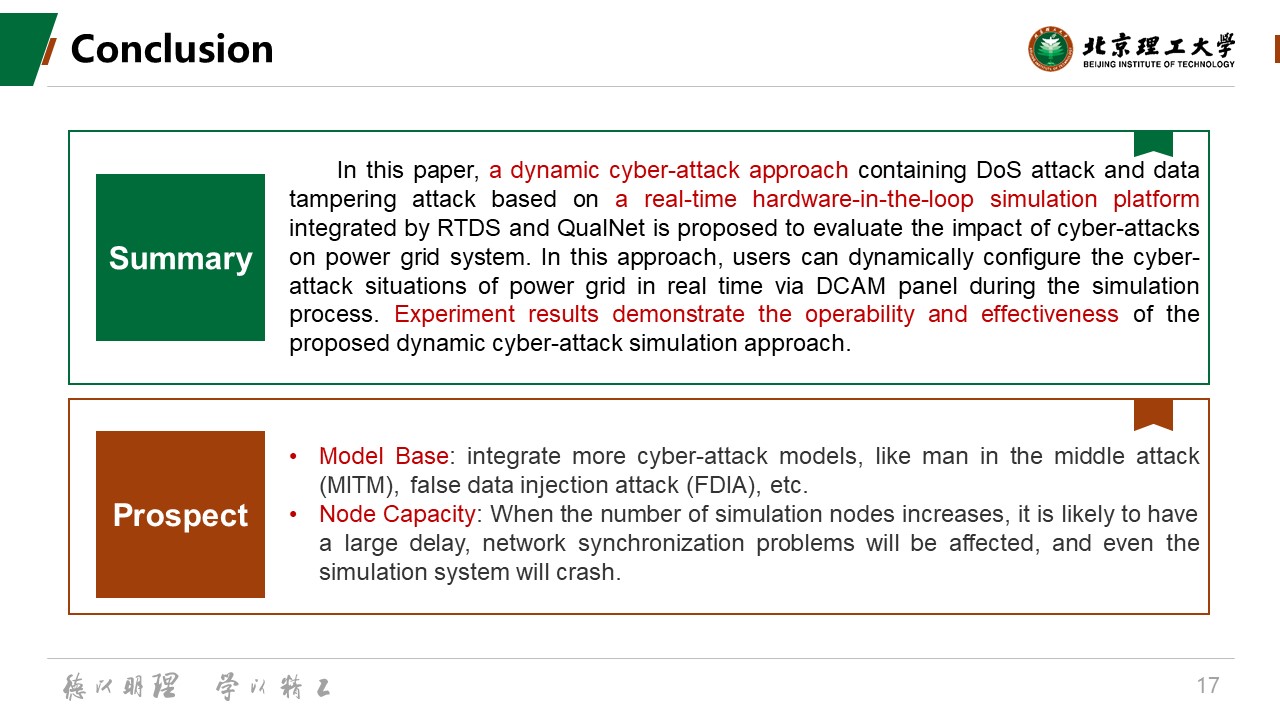 |
This paper mainly proposes a dynamic cyber-attack approach and investigates a real-time hardware-in-the-loop simulation platform. The innovation of this paper is the introduction of dynamic simulation technology. As a result, users can dynamically configure the cyber-attack situations of power grid in real time via DCAM panel during the simulation process.
However there still exist some shortages in the aspect of model base and node capacity. So, in the future, my team and I will go on optimizing the approach on these issues.
|
|
ICACT20220395 Slide.16
[Big slide for presentation]
[YouTube] |
Chrome Text-to-Speach Click!! |
 |
In the last section, I will summarize the results of the paper, and look forward the future work.
|
|
ICACT20220395 Slide.15
[Big slide for presentation]
[YouTube] |
Chrome Text-to-Speach Click!! |
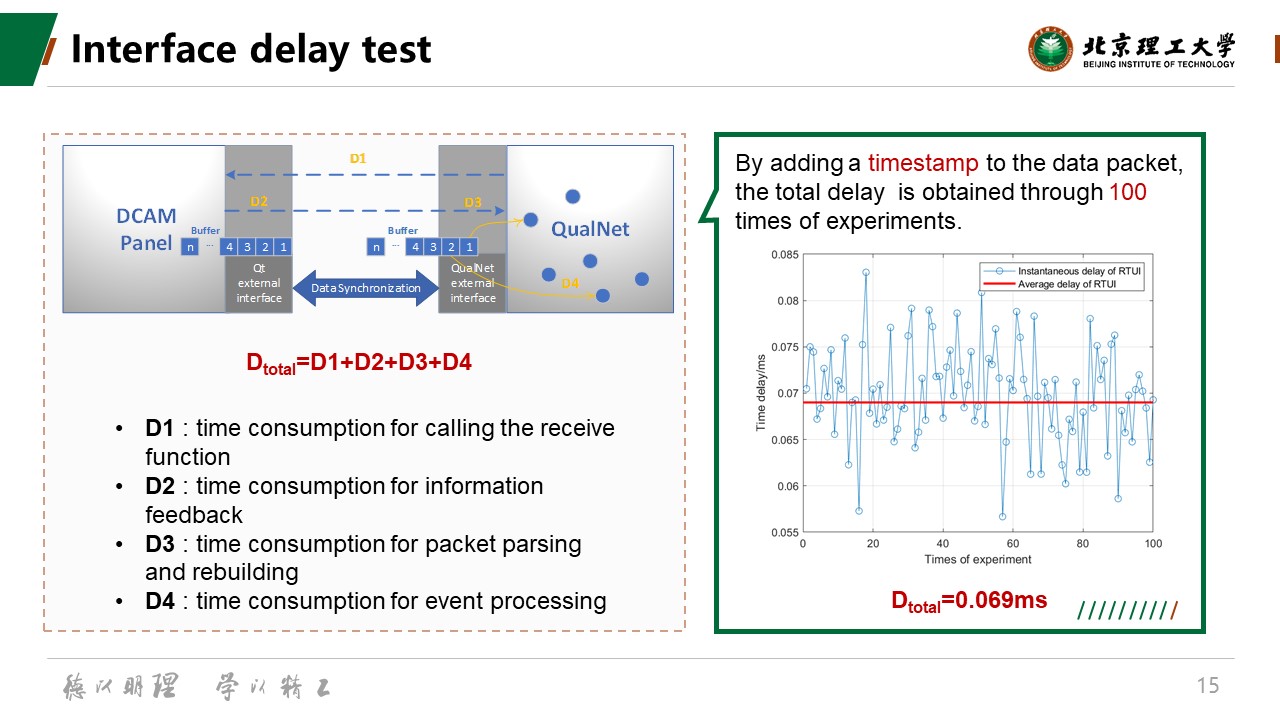 |
This interface delay test is an additional test to guarantee the reliability of testing results.
The delay is mainly composed of four parts: D1 : time consumption for calling the receive function; D2 : time consumption for information feedback; D3 : time consumption for packet parsing and rebuilding; D4 : time consumption for event processing.
By adding a timestamp to the data packet, the total delay is obtained through 100 times of experiments.
As can be seen from the figure, the average delay of RTUI is 0.069ms, which implies the proposed approach can efficiently support the dynamic real-time configuration of cyber-attack with an acceptable time delay of the interface.
|
|
ICACT20220395 Slide.14
[Big slide for presentation]
[YouTube] |
Chrome Text-to-Speach Click!! |
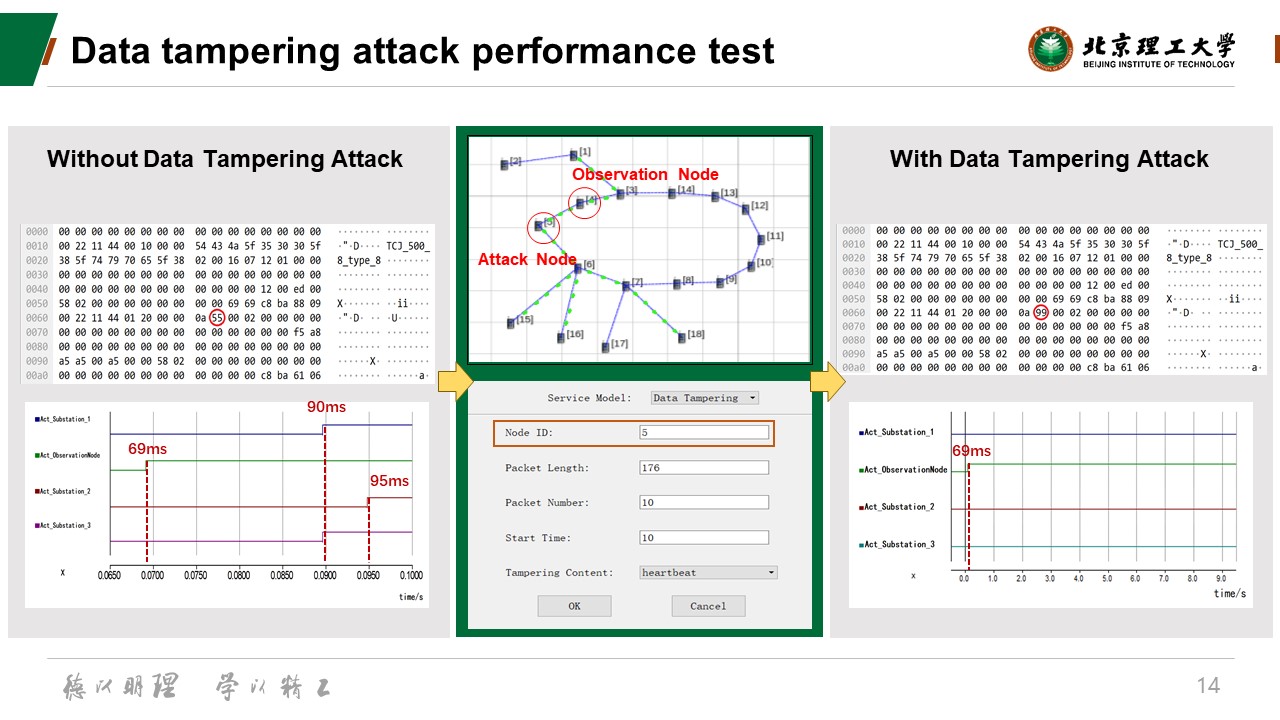 |
In this test, we add one more observation node (Node 4) to avoid systemic error.
In addition, when the scenario runs normally, the flag bit in the data packet is 55 according to the Wireshark software.
In the panel, the data tampering attack experiment is also carried out on Node 5. That is to say, we assume that the downlink control measurement packets from central station to three substations are tampered at Node 5 into heartbeat packets.
Here is the result in the right side. It can be noticed that the flag bit in the data packet has been changed to 99, and the three substations refuse to move and think themselves can normally communicate with the central station.
|
|
ICACT20220395 Slide.13
[Big slide for presentation]
[YouTube] |
Chrome Text-to-Speach Click!! |
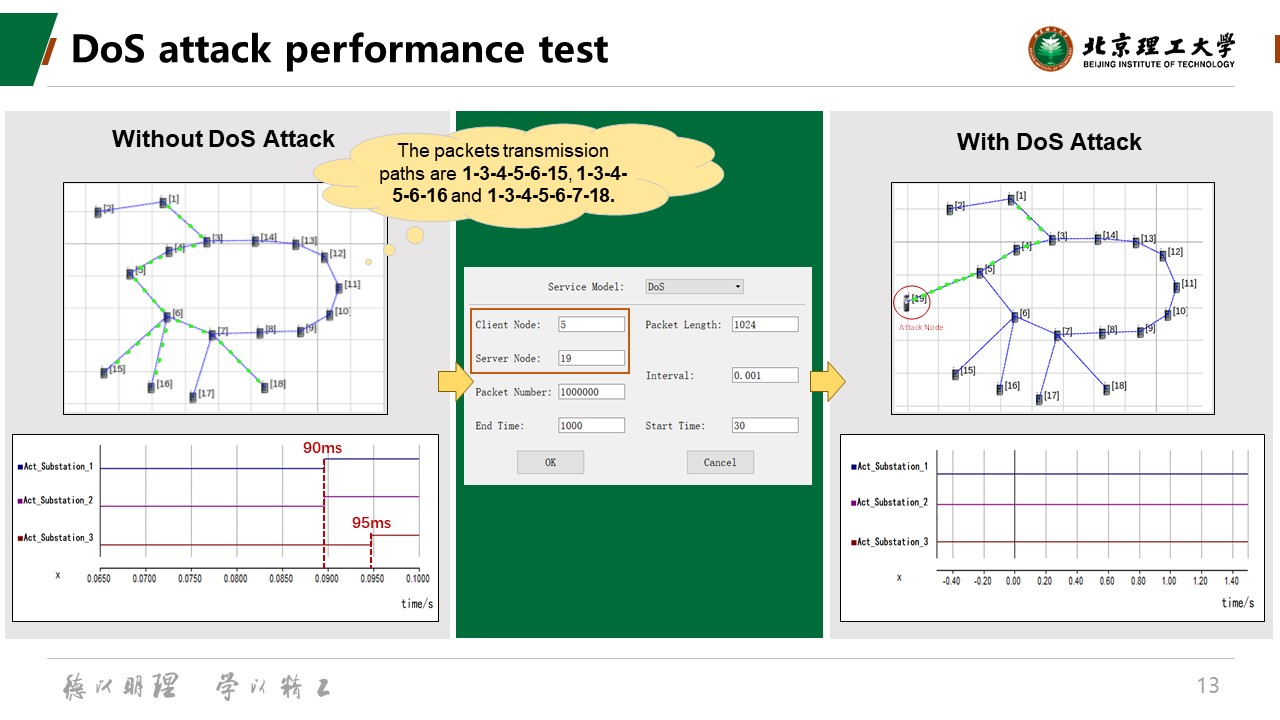 |
When there is no DoS attack, the packets transmission paths are 1-3-4-5-6-15, 1-3-4-5-6-16 and 1-3-4-5-6-7-18. And the time delay of Substation 1, Substation 2 and Substation 3 are 90ms, 90ms and 95ms.
And then we can configure the parameters through the DCAM panel during the simulation. In the panel, the DoS attack experiment is carried out on Node 5, and we choose one outside Node 19 as the attack node.
The result is shown here. As the attack node sending a large number of meaningless information to the client node——Node 5, it can hardly meet its ideal continuity requirement, so the three substations refuse to move.
|
|
ICACT20220395 Slide.12
[Big slide for presentation]
|
Chrome Text-to-Speach Click!! |
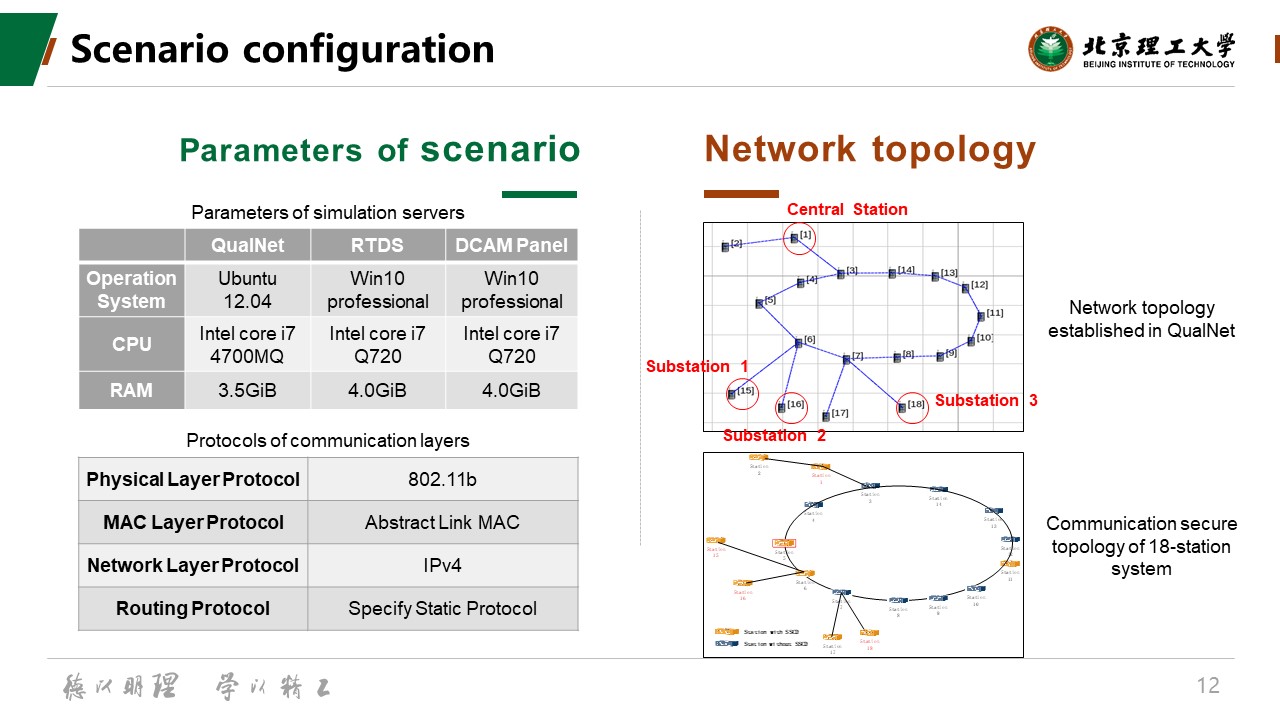 |
Here are the scenario configurations of the tests.
In the left side, the upper table shows the parameters of simulation servers, and the table below indicates the protocols utilized in communication layers.
In the right side, these 2 pictures present the specific topology of the 18-node system for test.As a matter of fact, the nodes in QualNet and the power stations are in one-to-one relationship.
We suppose that the central station (corresponding to Node 1) sends control messages to Substation 1 (corresponding to Node 15), Substation 2 (corresponding to Node 16) and Substation 3 (corresponding to Node 18).
The following experiments, including DoS attack performance test and data tampering performance test, focus on the actions of the substations receiving the control measurement packets.
|
|
ICACT20220395 Slide.11
[Big slide for presentation]
[YouTube] |
Chrome Text-to-Speach Click!! |
 |
To prove the investigated platform and the proposed modeling approach practical, testing experiments are carried out in this part.
|
|
ICACT20220395 Slide.10
[Big slide for presentation]
[YouTube] |
Chrome Text-to-Speach Click!! |
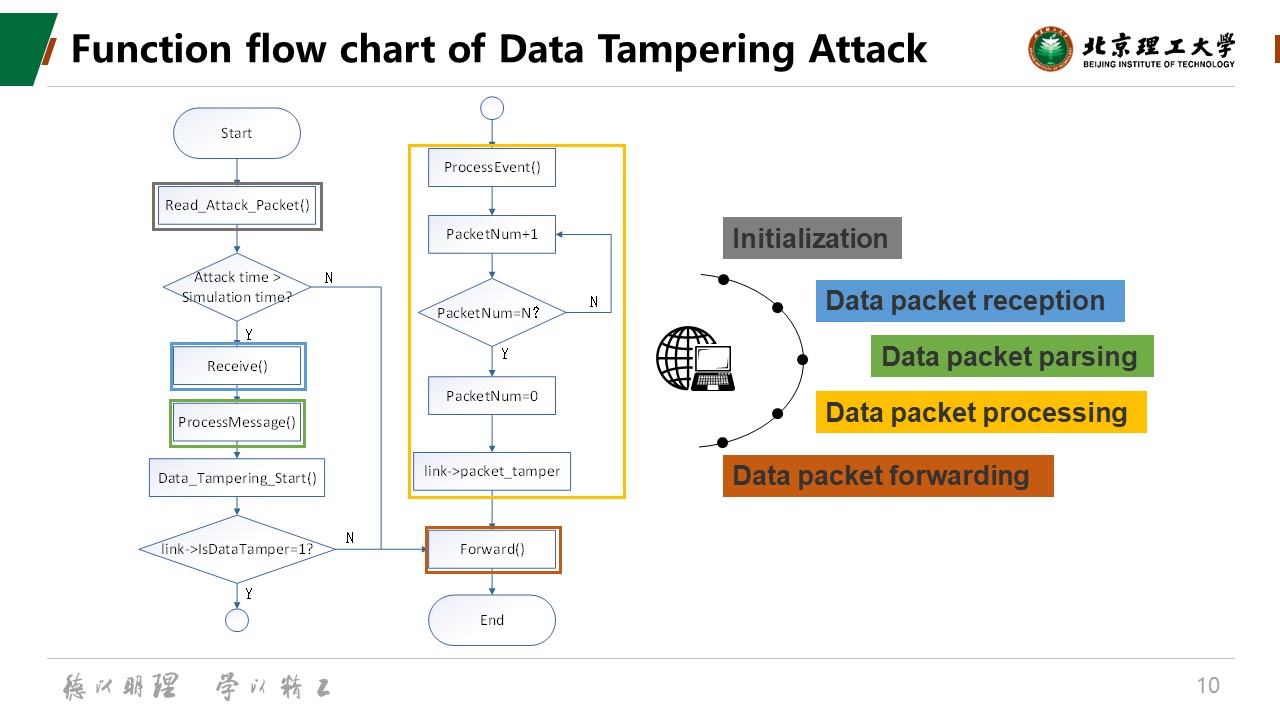 |
This is the function flow chart of data tampering attack.
The process is mainly divided into 5 stages, compared to the DoS attack, Initialization and Data packet forwarding are added.
During Initialization, heartbeat packet and control measurement packet will be stored in the scenario file in advance before simulation. When the simulation starts, the Read_Attack_Packet() function will read the information of the two kinds of packets.
During Data packet forwarding, the Forward() Function achieves packets forwarding to the destination according to the routing table.
The Data packet processing part is different from the DoS attack. The ProcessEvent() Function first judges whether the flag bit “IsDataTamper” is true to decide the start time of data tampering attack. When attack starts, function will tamper the packets to be received according to the request of DCAM panel configuration by forwarding packet_tamper as the replacement packets.
|
|
ICACT20220395 Slide.09
[Big slide for presentation]
[YouTube] |
Chrome Text-to-Speach Click!! |
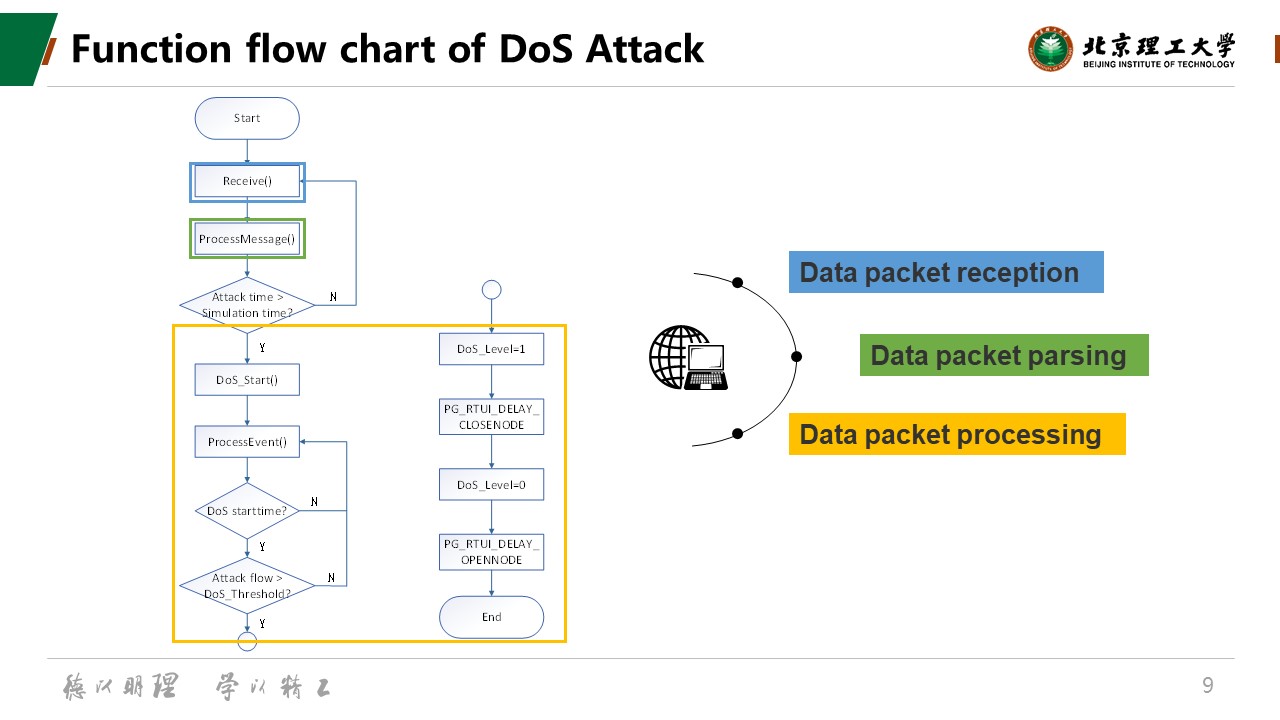 |
The function flow chart of DoS attack is shown here.
The process is mainly divided into three stages, Data packet reception, Data packet parsing and Data packet processing.
During Data packet reception, the Receive() Function keeps on listening a UDP socket RTUI to receive configuration packets sent by DCAM panel.
During Data packet parsing, the ProcessMessage() Function first parses the configuration packets to look up the attack type, and then reads the information of the received packets and calls the corresponding functions to deal with the messages.
During Data packet processing, , the ProcessEvent() Function will first judge the attack start time. If the attack start time is greater than the simulation time, the server node will send meaningless packets of a certain size to the client node at the data flow configured by the user. And when the attack flow is higher than “DoS_Threshold”, function will set “DoS_Level” equal to 1, and close the client node. When the end time comes, function will set “DoS_Level” equal to 0, and open the client node.
|
|
ICACT20220395 Slide.08
[Big slide for presentation]
[YouTube] |
Chrome Text-to-Speach Click!! |
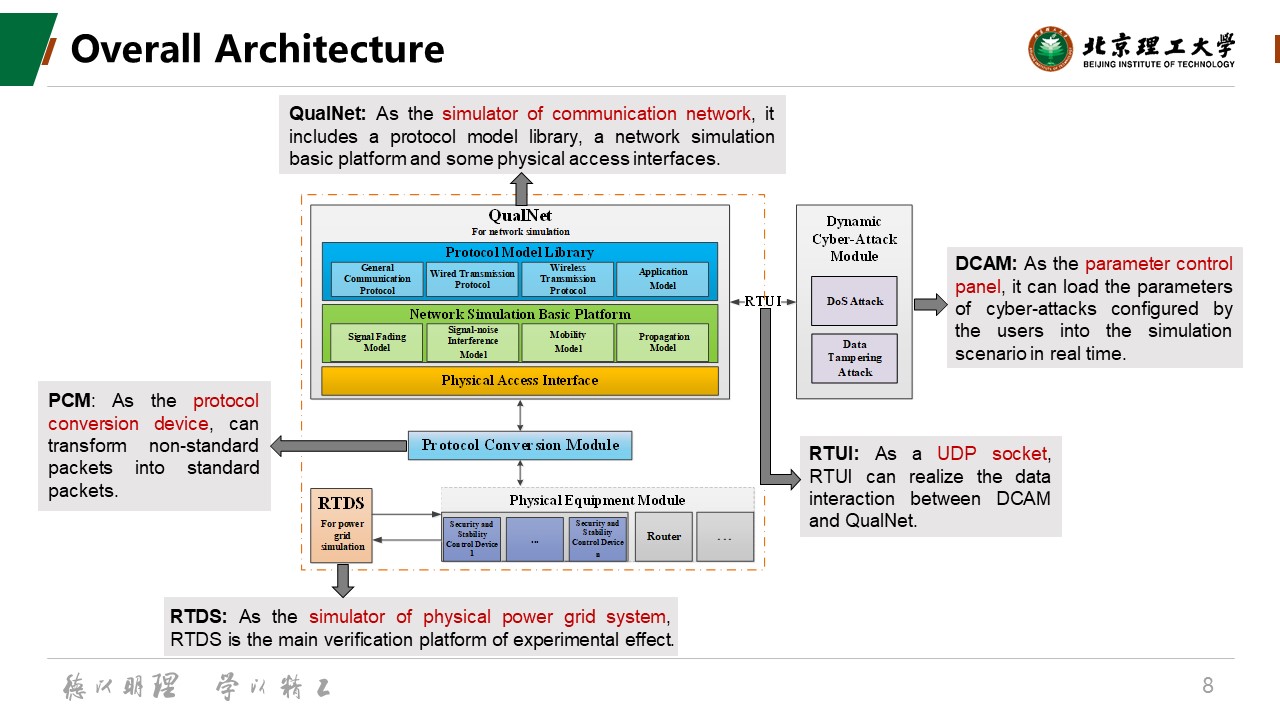 |
The real-time hardware-in-the-loop simulation architecture considered in this paper is here.
This architecture is mainly composed of QualNet simulator, Protocol Conversion Module (PCM), Real-time Digital Simulator(RTDS), Dynamic Cyber Attack Module (DCAM) , Real-Time User Interface (RTUI) and physical equipment module.
Each part cooperates with each other co-ordinately, and plays their respective roles.
The approach proposed in this paper focuses on DCAM and RTUI.
|
|
ICACT20220395 Slide.07
[Big slide for presentation]
[YouTube] |
Chrome Text-to-Speach Click!! |
 |
Then, I’ll show you the details of the 2 modeling methods.
|
|
ICACT20220395 Slide.06
[Big slide for presentation]
[YouTube] |
Chrome Text-to-Speach Click!! |
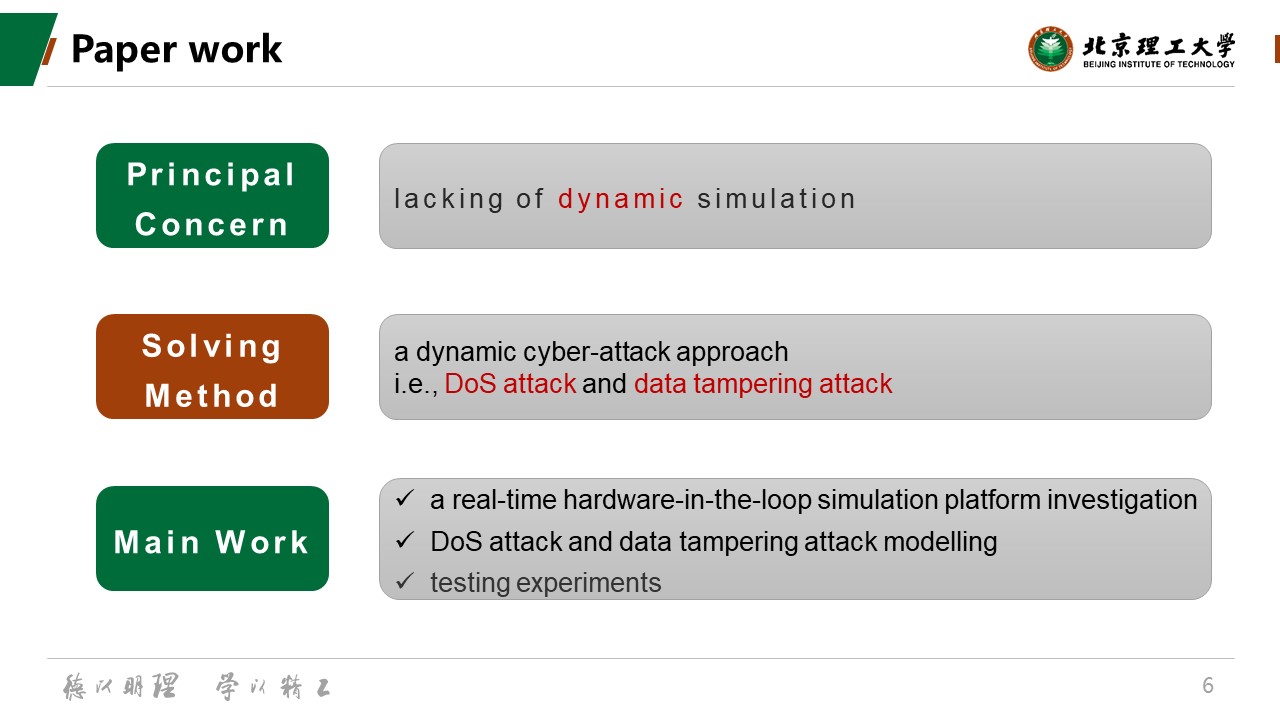 |
Therefore, the work of this paper is summarized as shown.
Aiming at the dynamic simulation, the DoS attack and data tampering attack are modeled. We investigate a real-time hardware-in-the-loop simulation platform integrated by RTDS and QualNet, and conduct some testing experiments on this platform.
|
|
ICACT20220395 Slide.05
[Big slide for presentation]
[YouTube] |
Chrome Text-to-Speach Click!! |
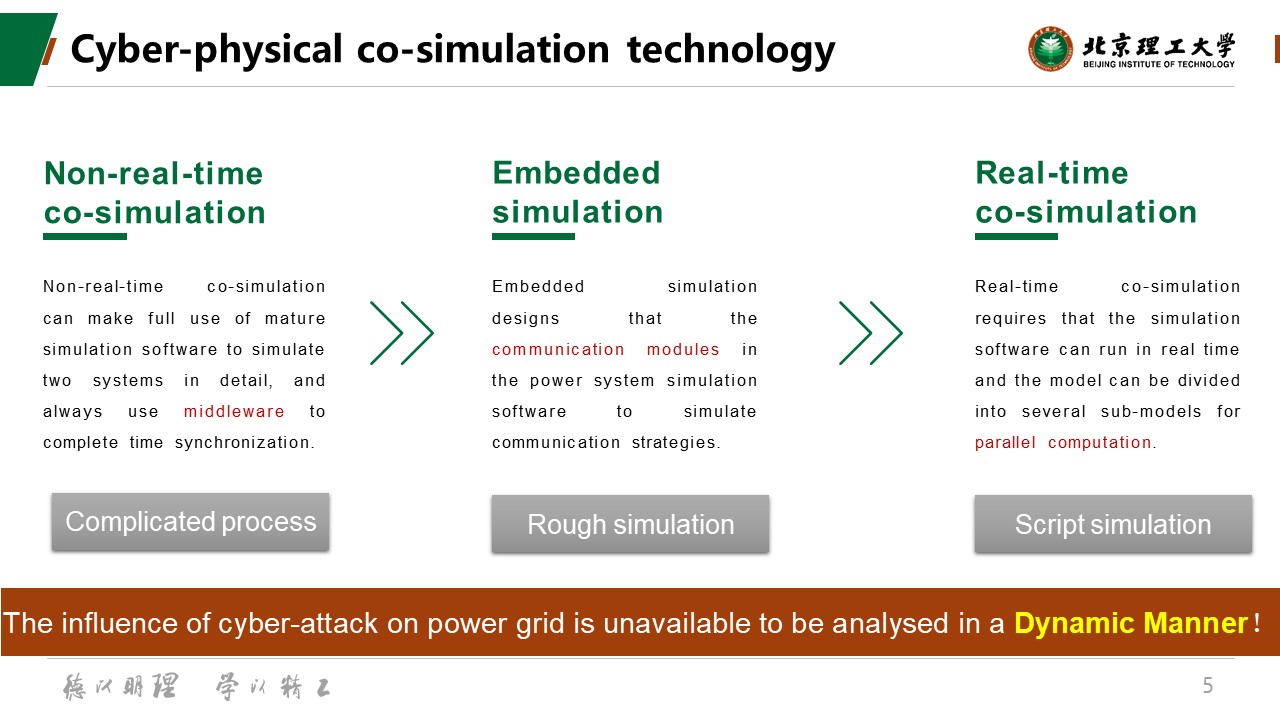 |
Cyber-physical co-simulation technology is the most common technology applied to cyber-attack simulation area of smart grid. It can be divided into 3 kinds: non-real-time co-simulation, embedded simulation and real-time co-simulation.
In the Non-real-time co-simulation system, it always use the middleware to complete time synchronization, which makes the process much complicated.
The Embedded simulation adopts the form of communication modules in the power grid simulation software, where only rough simulation of the communication process can be carried out.
Therefore, the real-time co-simulation of high precision came into being. It can realize parallel computation, highly improving the calculation ability.
However, the current researches are still using script simulation rather than dynamic simulation.
Thus, the dynamic real-time co-simulation is the focus to study.
|
|
ICACT20220395 Slide.04
[Big slide for presentation]
[YouTube] |
Chrome Text-to-Speach Click!! |
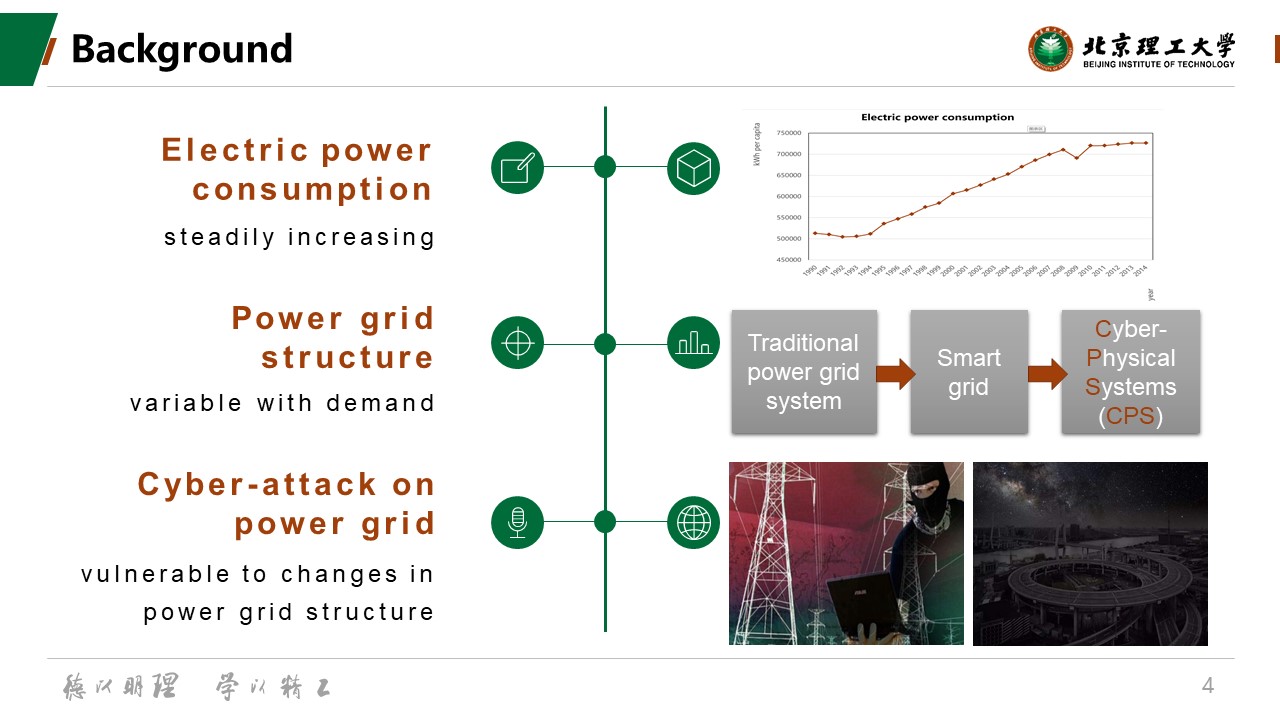 |
According to the World Development Indicators of the world bank, the Electric power consumption in the world increases year by year, which contributes to the great change of the structure of power system. It varies from traditional power grid system to smart grid, and develops towards Cyber-Physical Systems.
In addition to the characteristics of high efficiency and energy saving, the smart grid also exposes many security problems, like cyber-attack. With the tight combination of communication network and power grid, many hackers take the opportunity to launch cyber-attacks on the power grid, resulting in many blackout events, which will cause huge economic and resource losses.
So, it’s urgent to pay more attention to the security and stability of smart grid to prevent further damages from cyber-attacks.
|
|
ICACT20220395 Slide.03
[Big slide for presentation]
[YouTube] |
Chrome Text-to-Speach Click!! |
 |
Let’s look at the introduction part first.
In this part, I’ll show you the research background, the common used technology and my paper contribution.
|
|
ICACT20220395 Slide.02
[Big slide for presentation]
[YouTube] |
Chrome Text-to-Speach Click!! |
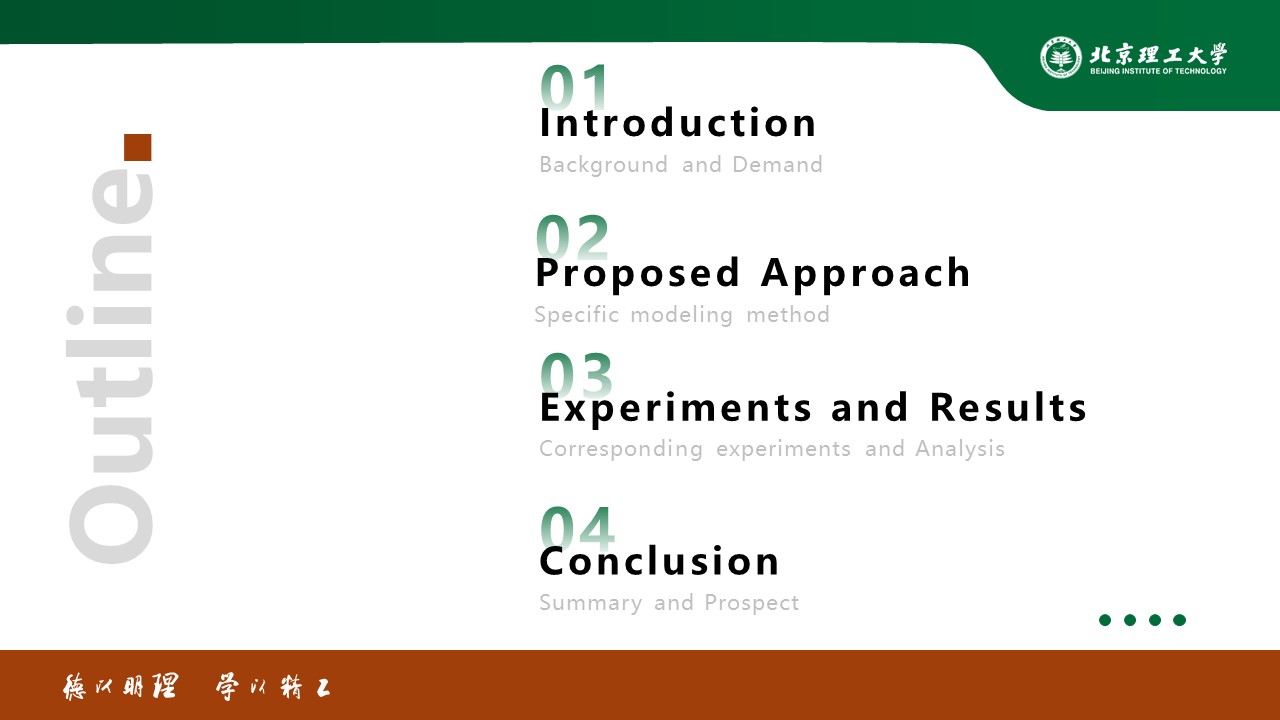 |
My presentation is organized in 4 parts——introduction, proposed approach, experiments and results and conclusion.
|
|
ICACT20220395 Slide.01
[Big slide for presentation]
[YouTube] |
Chrome Text-to-Speach Click!! |
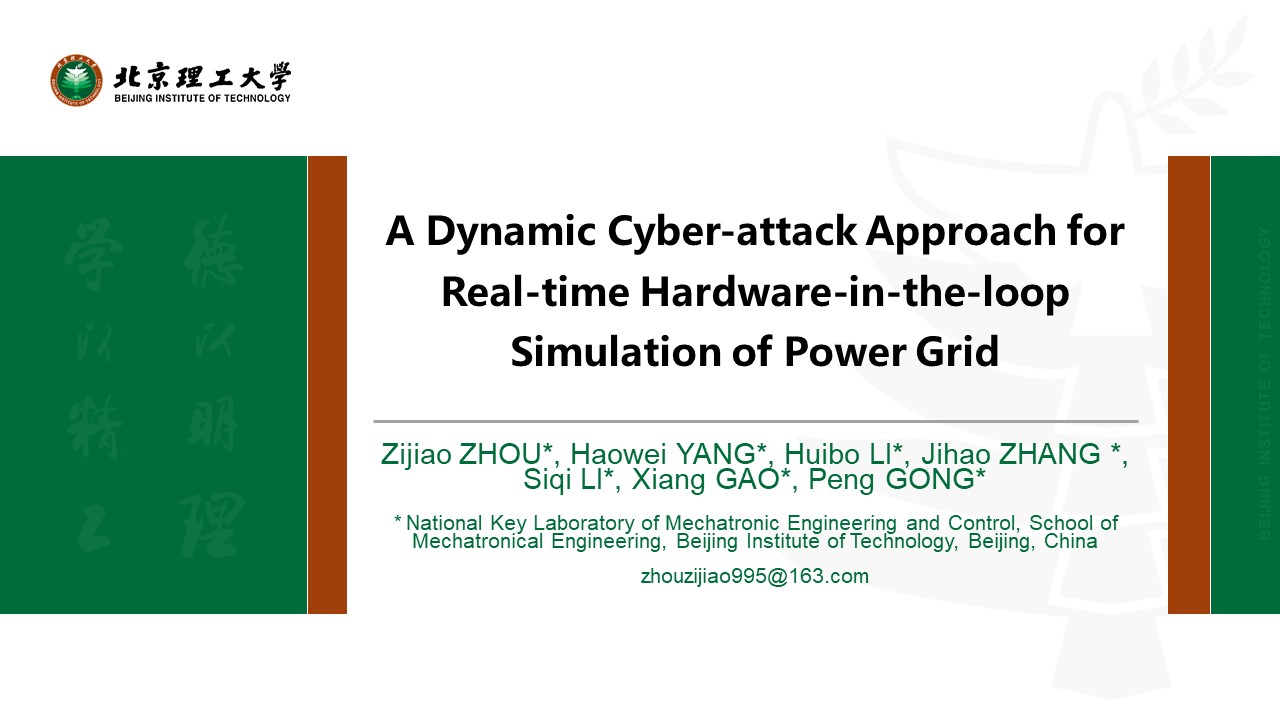 |
Hello, everyone! I’m Zijiao Zhou from Beijing Institute of Technology. It’s my first time to attend such an international academic meeting, so I’m so glad to be here to share you with my paper. The title is A Dynamic Cyber-attack Approach for Real-time Hardware-in-the-loop Simulation of Power Grid.
|