ICACT20260022 Slide.30
[Big slide for presentation]
ICACT20260022 Slide.30
[Big slide for presentation]
|
Chrome Text-to-Speach Click!! Click!! |
 |
In conclusion, MCBGD provides an effective solution for scalable MBQC through innovative decomposition and optimization strategies. Experimental results confirm significant advantages in fidelity, resource efficiency, and scalability.
We envision further advancements through adaptive algorithms, heterogeneous topology support, and hardware integration. Quantum computing promises transformative impacts across scientific and commercial domains, and we invite collective engagement in this groundbreaking field.
Thank you for your attention, and we look forward to future collaborations in advancing quantum technologies.
|
|
ICACT20260022 Slide.29
[Big slide for presentation]
|
Chrome Text-to-Speach Click!! |
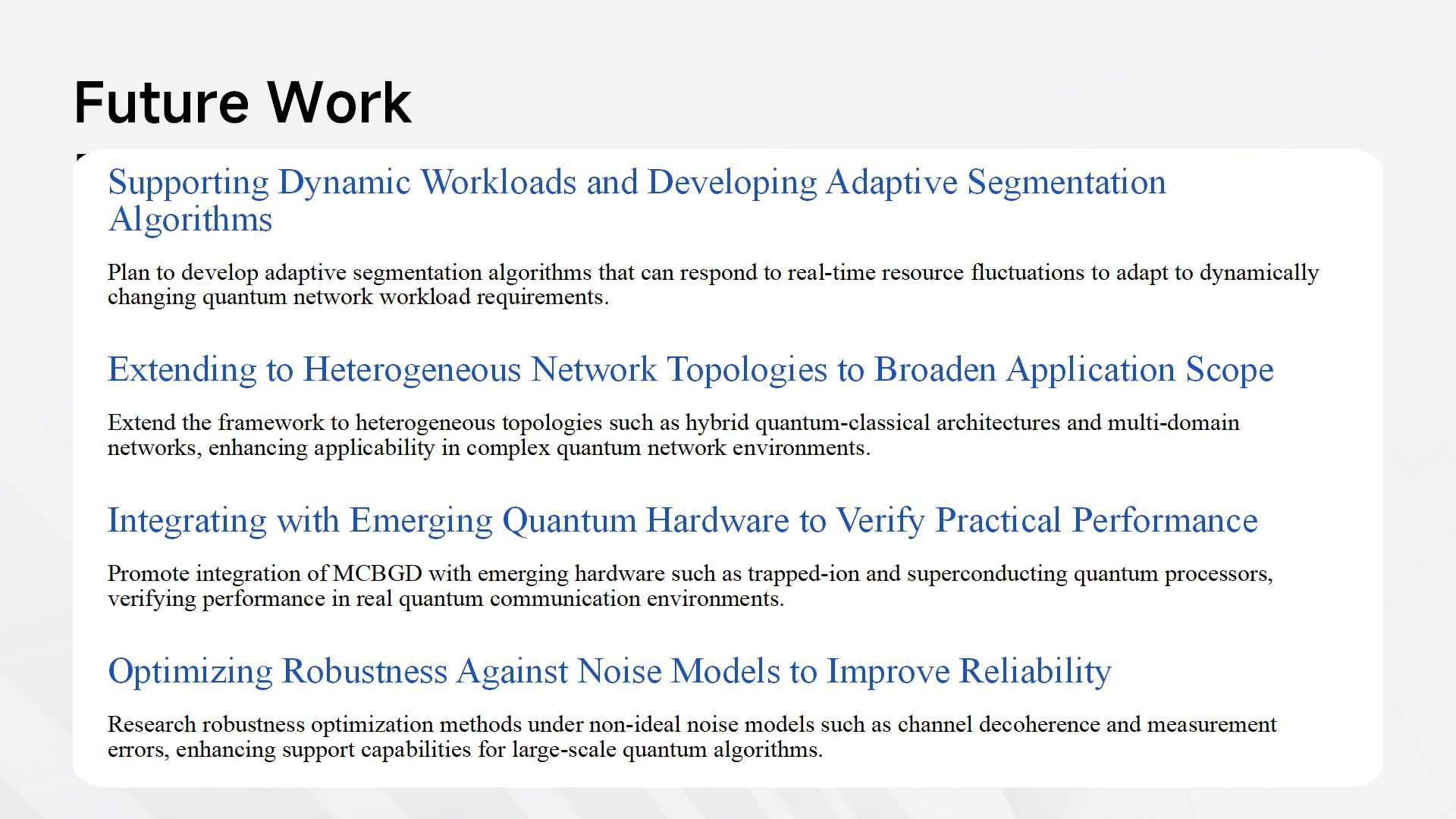 |
Future work includes:
Developing adaptive segmentation algorithms for dynamic workloads.
Extending to heterogeneous network topologies.
Integrating with emerging quantum hardware.
Optimizing robustness under noise models.
|
|
ICACT20260022 Slide.28
[Big slide for presentation]
|
Chrome Text-to-Speach Click!! |
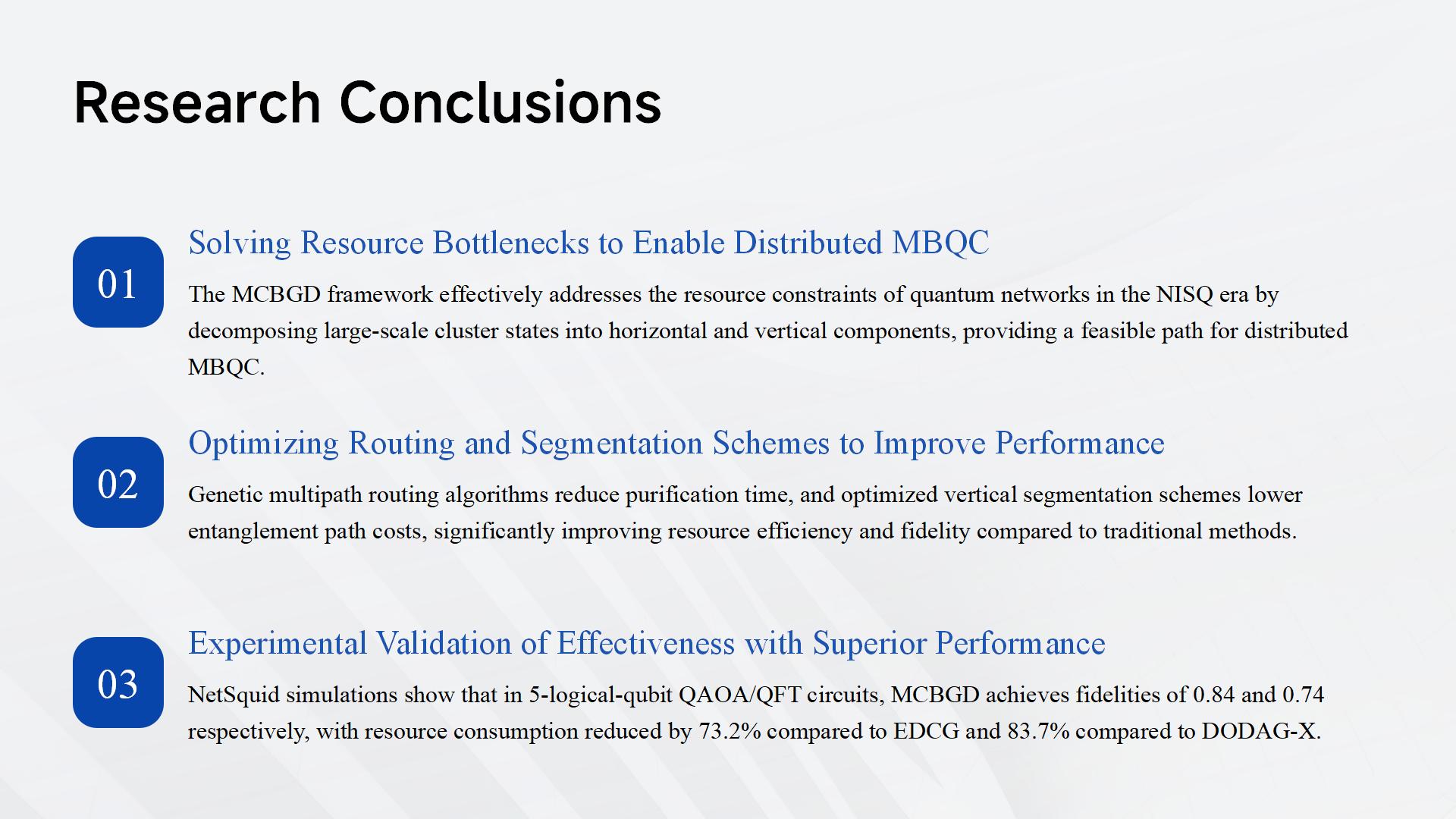 |
Three key conclusions emerge:
MCBGD solves resource bottlenecks via hybrid cluster state decomposition.
Optimized routing and segmentation significantly enhance performance.
Experiments validate superior fidelity (0.84 in QAOA) and resource efficiency (73.2% reduction vs EDCG).
|
|
ICACT20260022 Slide.27
[Big slide for presentation]
|
Chrome Text-to-Speach Click!! |
 |
We now conclude with research summaries and future directions, highlighting the frameworks value in distributed quantum computing.
|
|
ICACT20260022 Slide.26
[Big slide for presentation]
|
Chrome Text-to-Speach Click!! |
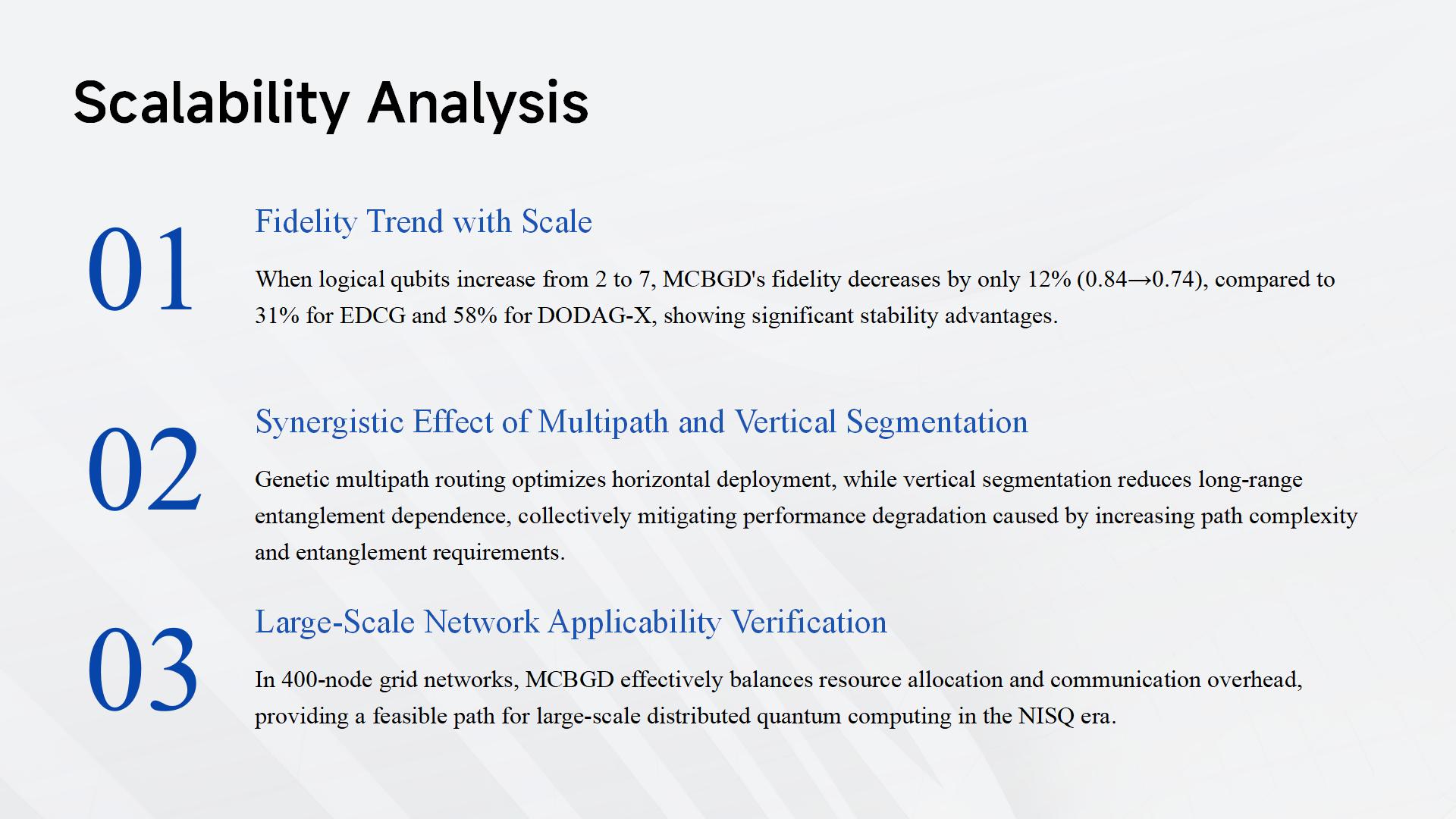 |
Scalability analysis shows MCBGDs fidelity degrades only 12% when scaling from 2 to 7 logical qubits, versus 31% for EDCG. Genetic multipath routing and vertical segmentation synergistically mitigate performance degradation from increased complexity.
|
|
ICACT20260022 Slide.25
[Big slide for presentation]
|
Chrome Text-to-Speach Click!! |
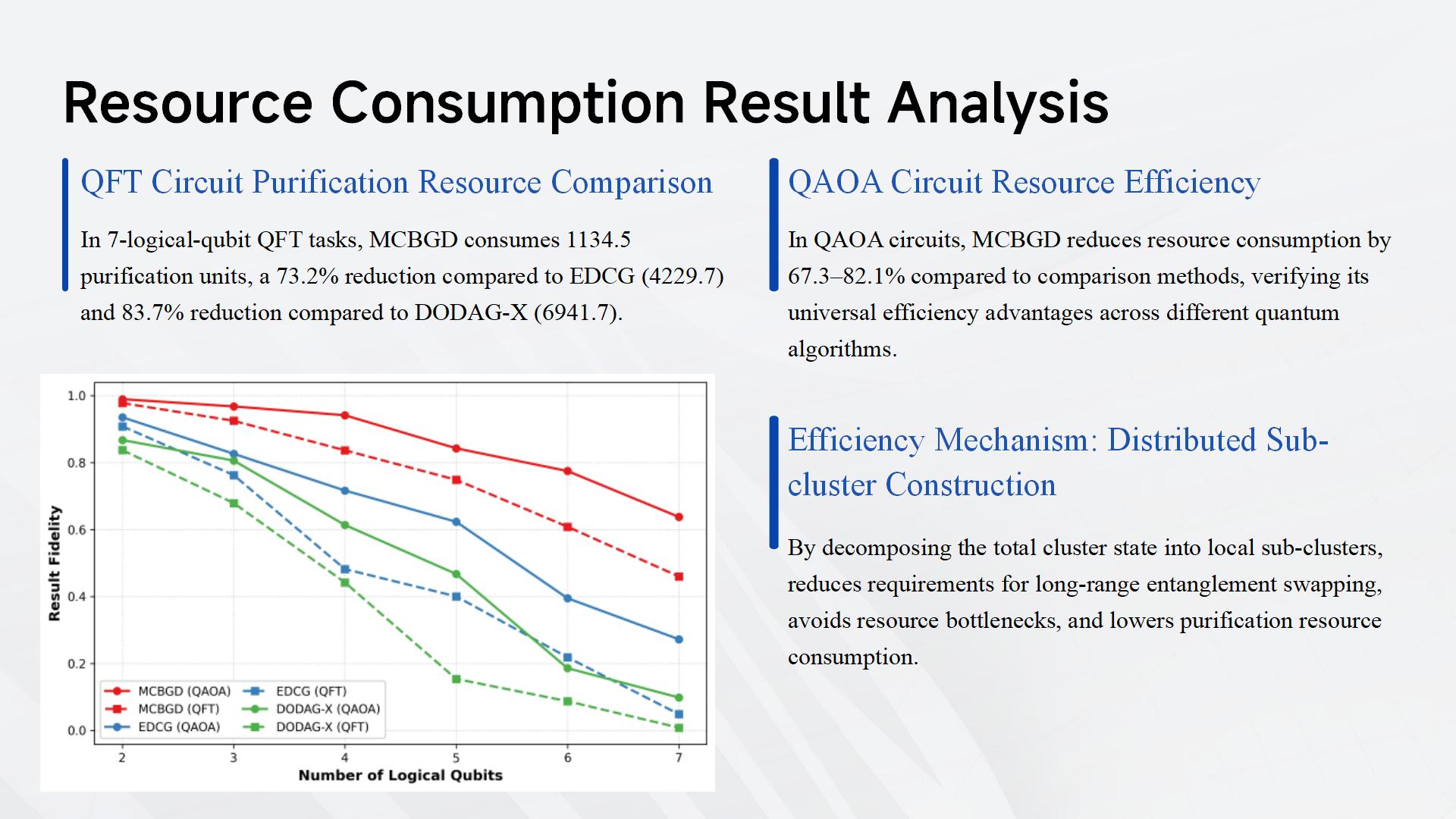 |
Resource consumption analysis reveals MCBGD using only 1134.5 purification units in 7-qubit QFT tasks (73.2% reduction vs EDCG). The distributed sub-cluster construction mechanism reduces long-range entanglement demands, minimizing purification overhead.
|
|
ICACT20260022 Slide.24
[Big slide for presentation]
|
Chrome Text-to-Speach Click!! |
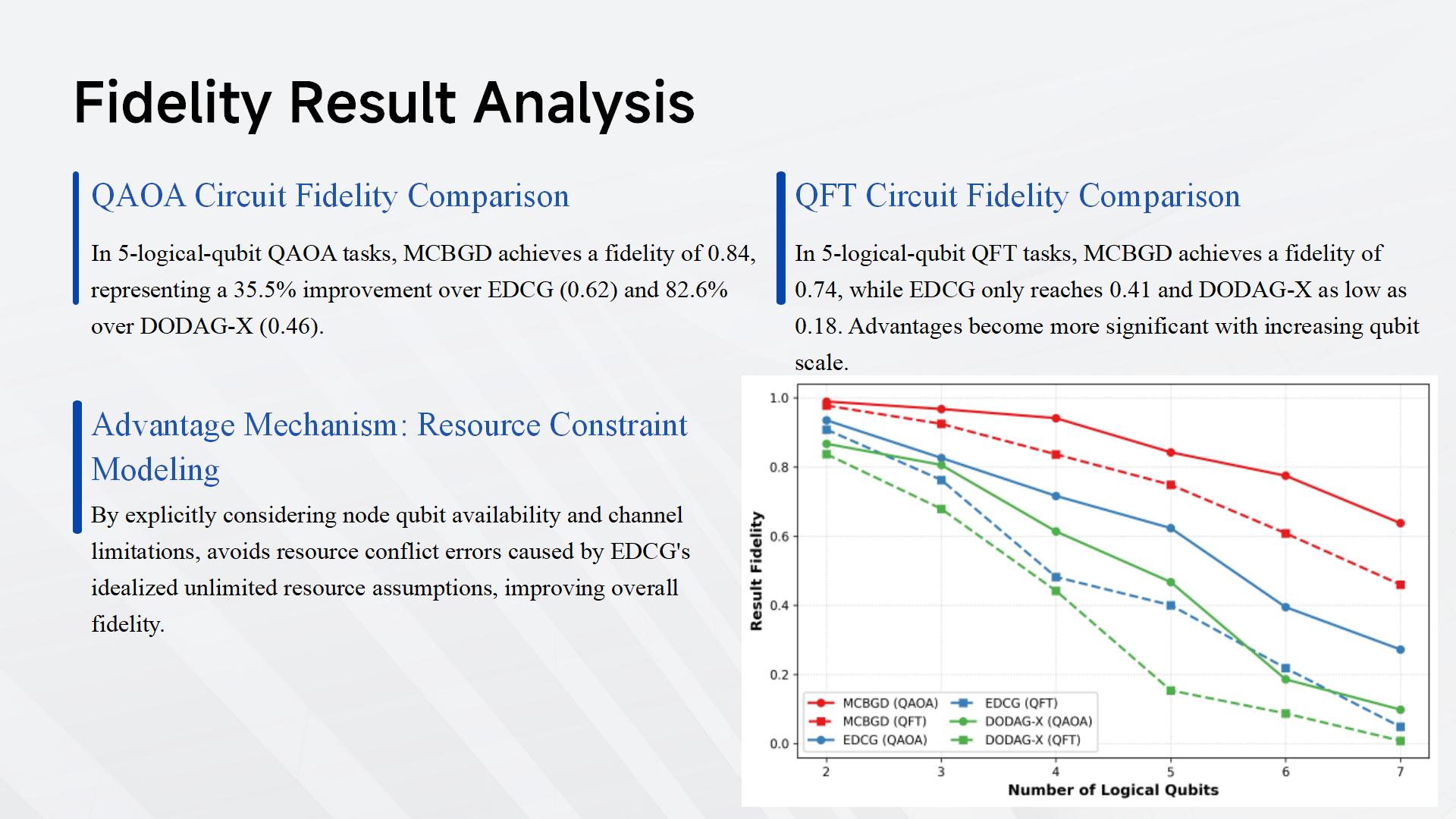 |
Fidelity results show MCBGD achieving 0.84 fidelity in 5-logical-qubit QAOA tasks (35.5% improvement over EDCG). In QFT circuits, MCBGD reaches 0.74 fidelity versus 0.41 for EDCG. Advantages stem from explicit resource constraint modeling, avoiding idealized assumptions.
|
|
ICACT20260022 Slide.23
[Big slide for presentation]
|
Chrome Text-to-Speach Click!! |
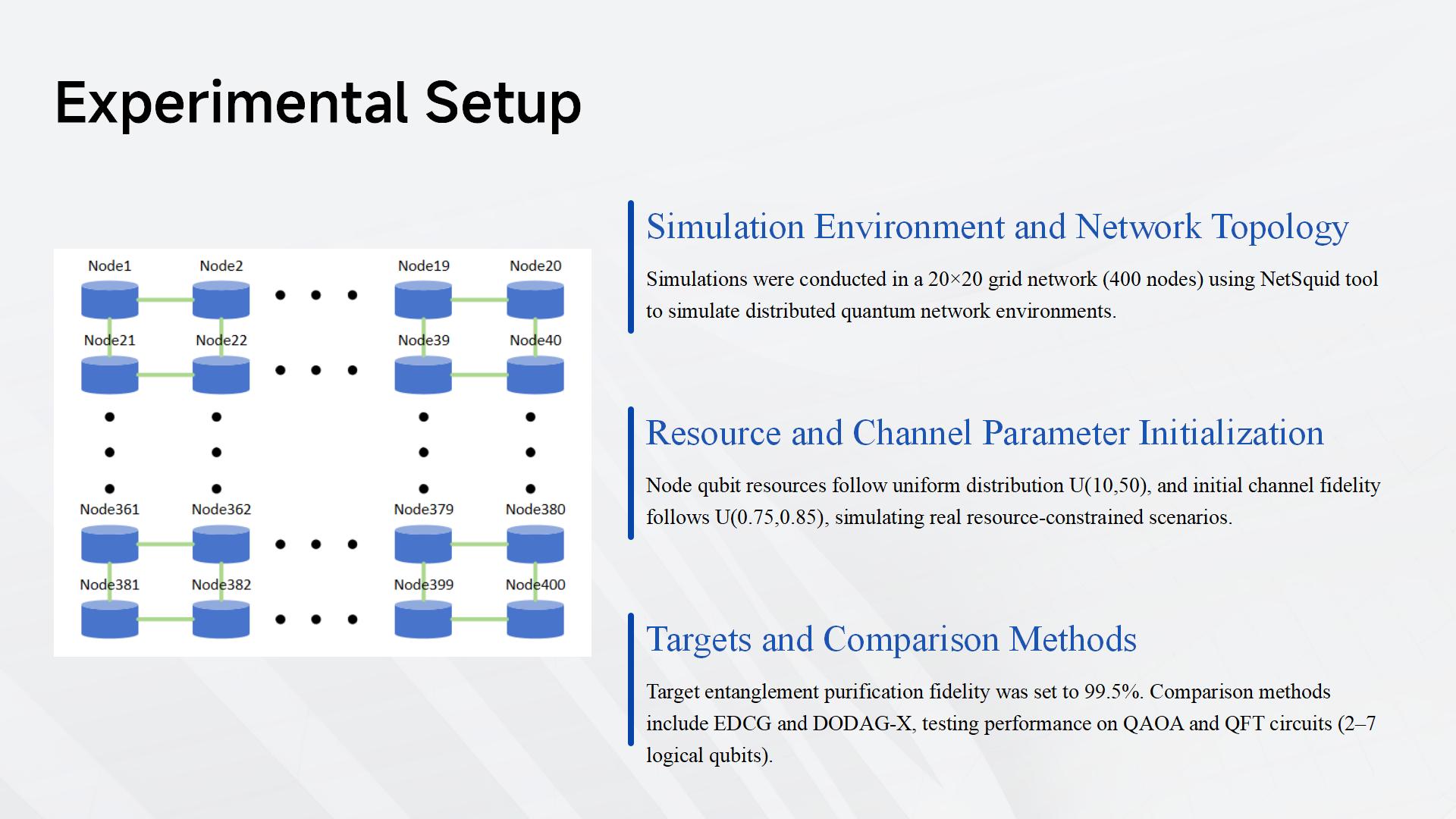 |
Experiments were conducted using NetSquid simulations in a 400-node grid network. Node qubit resources followed U(10,50) distribution, initial channel fidelity U(0.75,0.85). Target entanglement purification fidelity was set at 99.5%, with comparisons against EDCG and DODAG-X on 2-7 logical qubit QAOA/QFT circuits.
|
|
ICACT20260022 Slide.22
[Big slide for presentation]
|
Chrome Text-to-Speach Click!! |
 |
Experimental validation demonstrates the algorithms performance in simulated environments. We now analyze fidelity, resource consumption, and scalability results.
|
|
ICACT20260022 Slide.21
[Big slide for presentation]
|
Chrome Text-to-Speach Click!! |
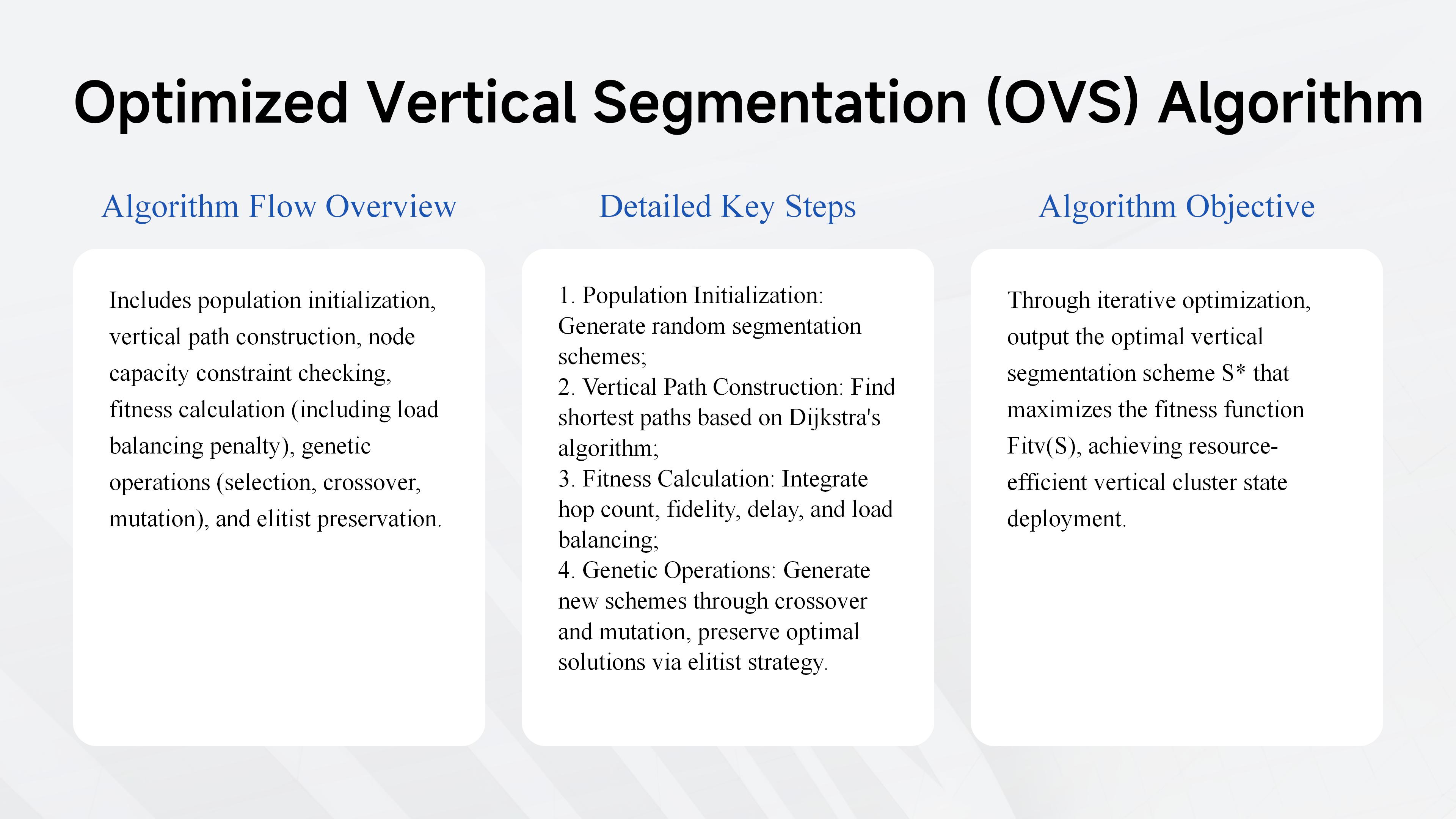 |
The Optimized Vertical Segmentation (OVS) algorithm achieves resource-efficient deployment through:
Population initialization with random segmentation schemes.
Vertical path construction via Dijkstras algorithm.
Fitness calculation incorporating hop count, fidelity, delay, and load balancing.
Genetic operations and elitist preservation to output optimal scheme S* maximizing Fitv(S).
|
|
ICACT20260022 Slide.20
[Big slide for presentation]
|
Chrome Text-to-Speach Click!! |
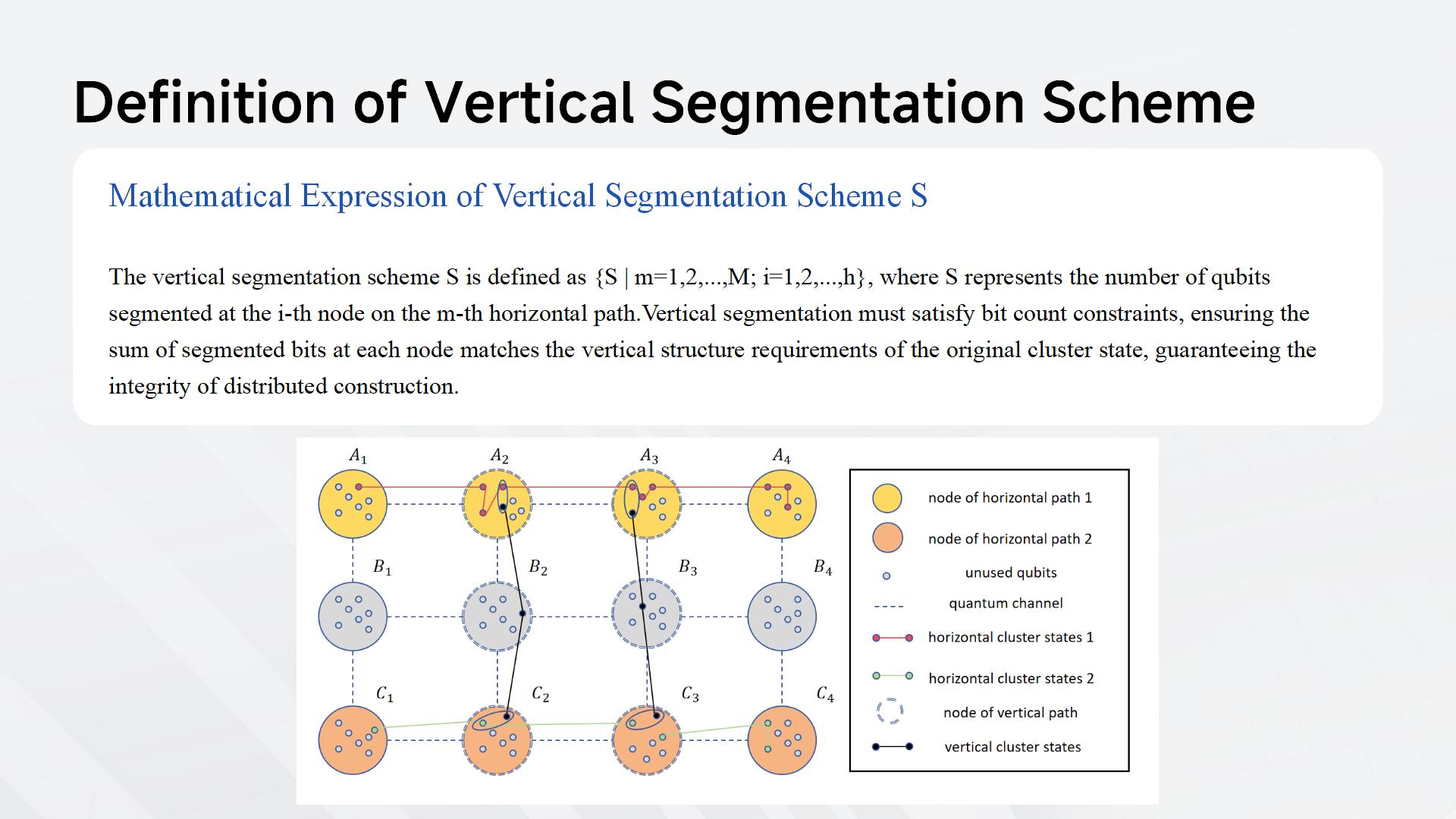 |
The vertical segmentation scheme S is defined as {S∣m=1,2,…,M; i=1,2,…,h}, where S represents qubit counts segmented at the i-th node on the m-th horizontal path. Bit-count constraints ensure distributed construction integrity by matching the original cluster states vertical structure requirements.
|
|
ICACT20260022 Slide.19
[Big slide for presentation]
|
Chrome Text-to-Speach Click!! |
 |
We now shift to the vertical cluster state segmentation method based on entangled pair deployment cost, which optimizes vertical construction through cost-effective strategies.
|
|
ICACT20260022 Slide.18
[Big slide for presentation]
|
Chrome Text-to-Speach Click!! |
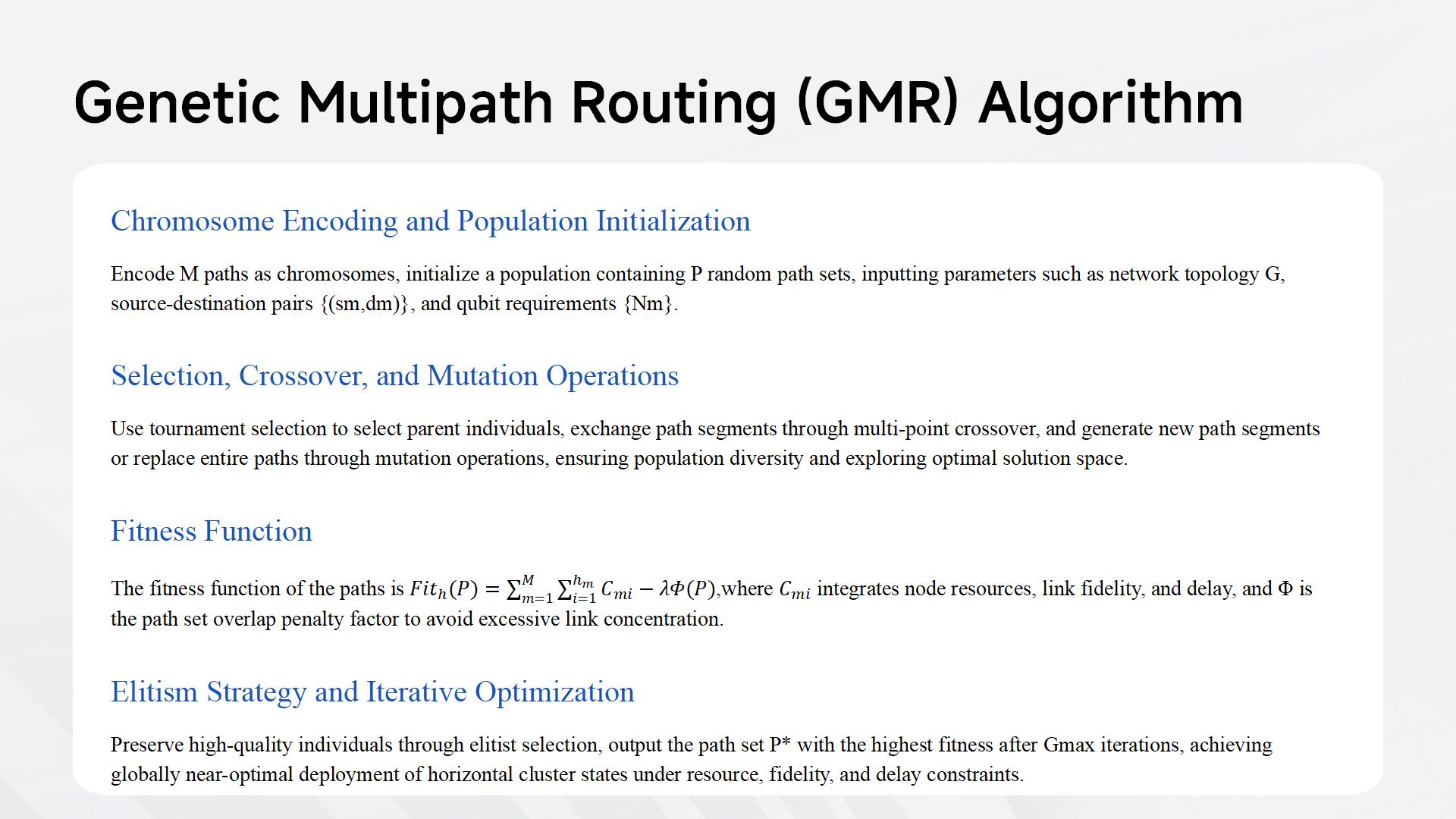 |
The Genetic Multipath Routing (GMR) algorithm optimizes deployment through:
Chromosome encoding of M paths with population initialization.
Tournament selection, multi-point crossover, and mutation operations.
Fitness function integrating resources, fidelity, delay, and overlap penalties.
Elitist strategy and iterative optimization for near-optimal solutions.
|
|
ICACT20260022 Slide.17
[Big slide for presentation]
|
Chrome Text-to-Speach Click!! |
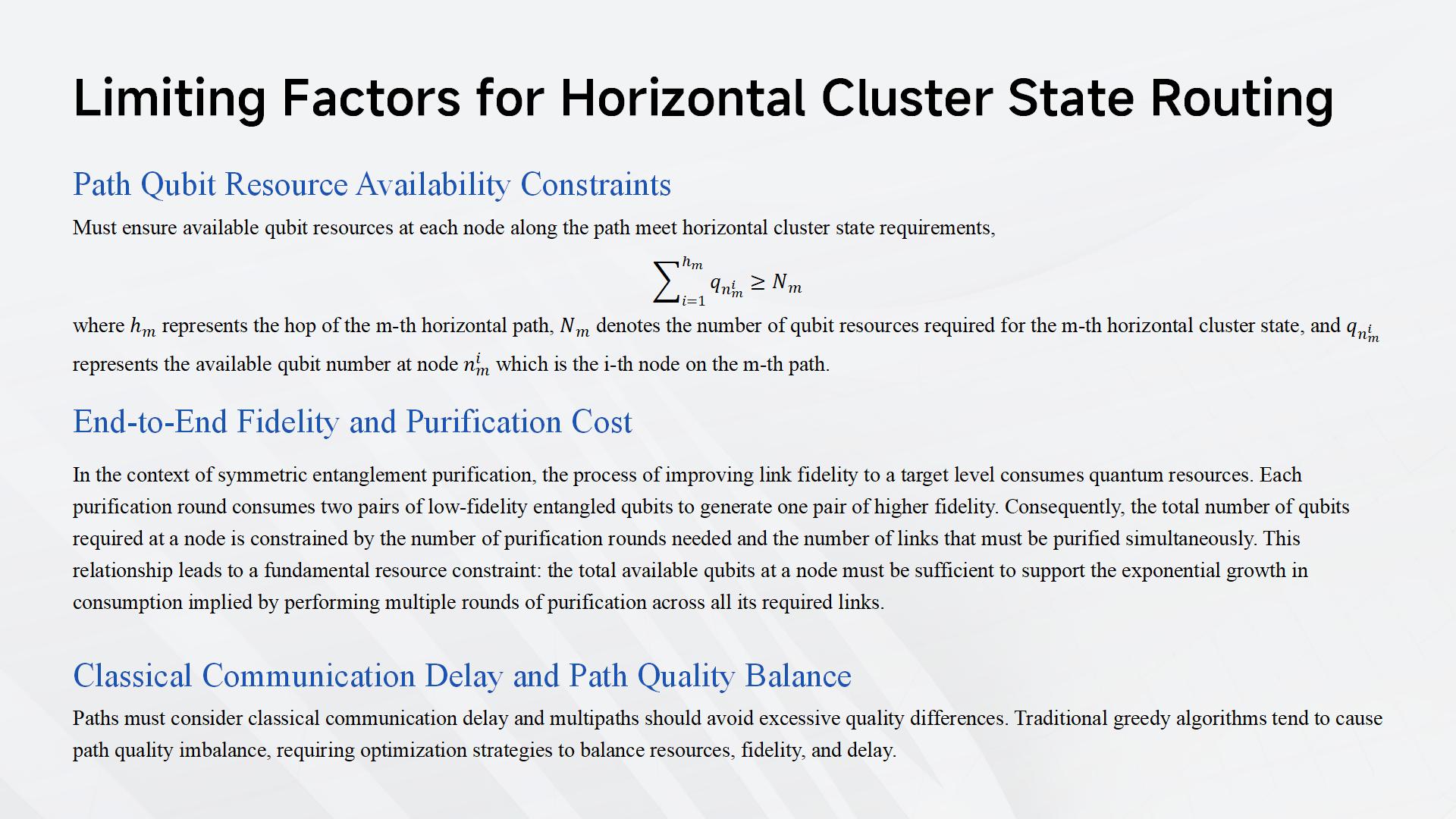 |
Horizontal cluster state routing faces three constraints:
Path qubit resource availability must satisfy the equation above.
End-to-end fidelity and purification costs exhibit exponential resource growth with purification rounds.
Classical communication delay and path quality balance require optimization beyond greedy algorithms.
|
|
ICACT20260022 Slide.16
[Big slide for presentation]
|
Chrome Text-to-Speach Click!! |
 |
We now examine the horizontal cluster state routing method based on qubit resource availability, crucial for effective cluster state deployment in quantum networks.
|
|
ICACT20260022 Slide.15
[Big slide for presentation]
|
Chrome Text-to-Speach Click!! |
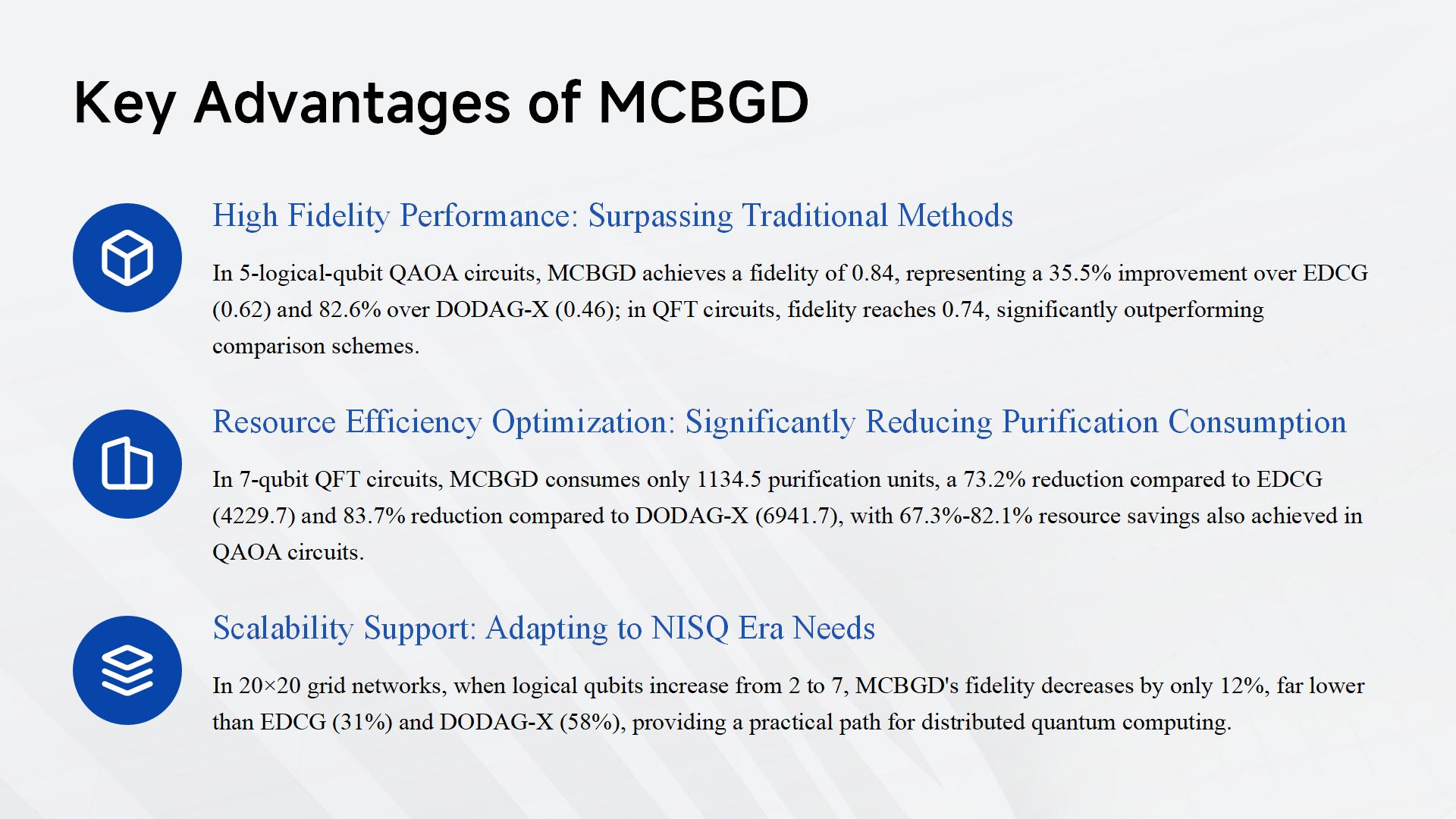 |
MCBGD demonstrates three key advantages:
High fidelity: Achieves 0.84 fidelity in 5-logical-qubit QAOA circuits (35.5% improvement over EDCG).
Resource efficiency: Reduces purification consumption by 73.2% in 7-qubit QFT circuits compared to EDCG.
Scalability: Maintains only 12% fidelity degradation when scaling from 2 to 7 logical qubits in grid networks.
|
|
ICACT20260022 Slide.14
[Big slide for presentation]
|
Chrome Text-to-Speach Click!! |
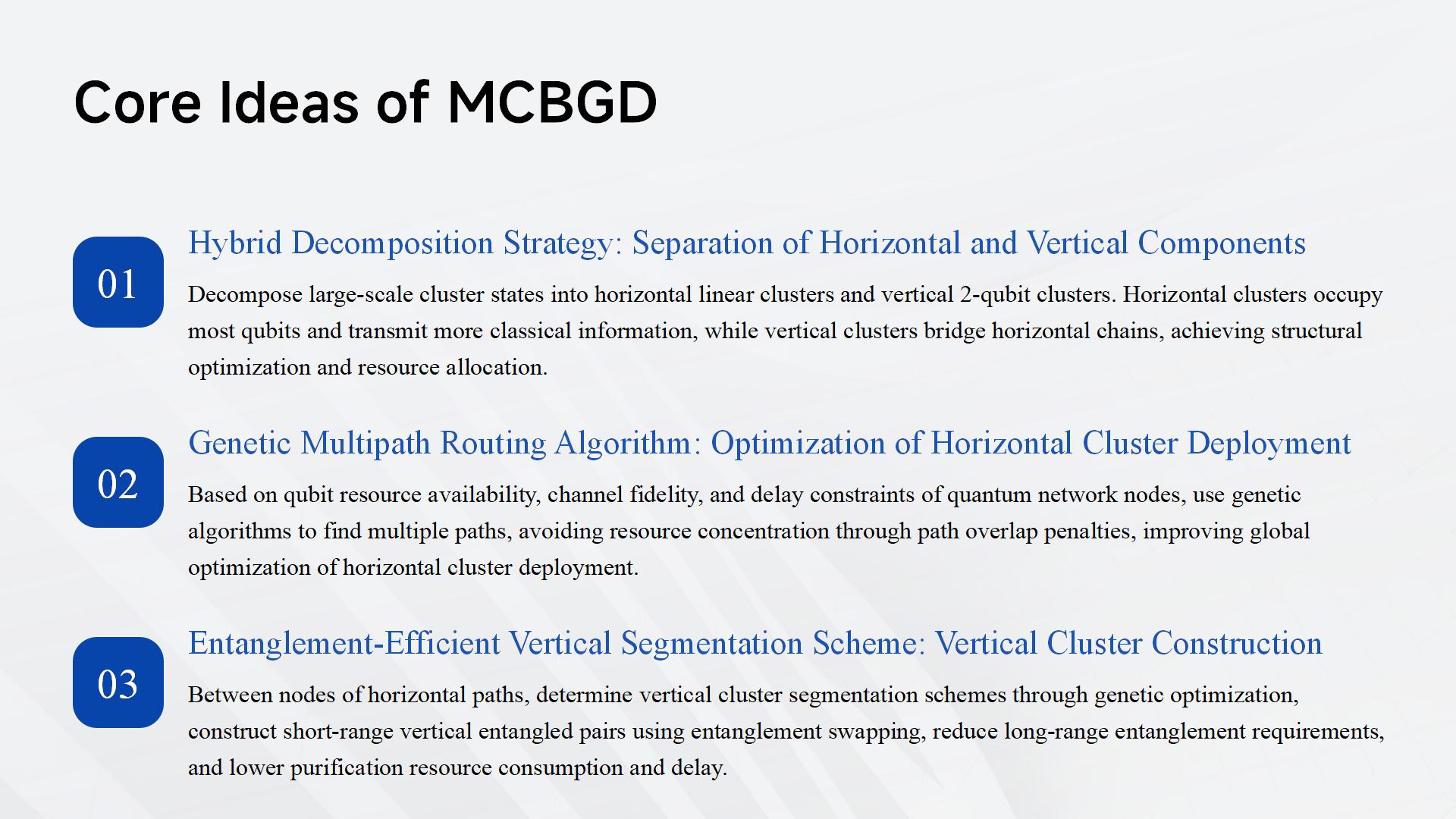 |
MCBGD employs three core strategies:
Hybrid decomposition: Separates large cluster states into horizontal linear clusters and vertical 2-qubit clusters for structural optimization.
Genetic multipath routing: Optimizes horizontal cluster deployment under resource and fidelity constraints using overlap penalty mechanisms.
Entanglement-efficient vertical segmentation: Constructs vertical clusters via genetic optimization and entanglement swapping to reduce long-distance entanglement requirements.
|
|
ICACT20260022 Slide.13
[Big slide for presentation]
|
Chrome Text-to-Speach Click!! |
 |
Quantum networks comprise nodes and channels. Nodes contain quantum processors (for qubit preparation, storage, measurement, and correction) and channel ports (for classical/quantum communication).
Horizontal cluster states are generated by qubits at specific nodes (e.g., red qubits on yellow nodes forming horizontal cluster 1), subject to node resource and channel fidelity constraints.
Vertical cluster states (black qubits on dashed-border nodes) connect horizontal clusters through qubit fusion, ultimately constructing complete MBQC resource states like the 2-qubit QFT cluster state.
|
|
ICACT20260022 Slide.12
[Big slide for presentation]
|
Chrome Text-to-Speach Click!! |
 |
Following the review of related work, we now focus on the MCBGD framework. This solution addresses quantum computing resource challenges through innovative approaches to cluster state construction in quantum networks.
|
|
ICACT20260022 Slide.11
[Big slide for presentation]
|
Chrome Text-to-Speach Click!! |
 |
Other graph state distribution methods include:
Cuquet et al.s 1D linear cluster state distribution using entanglement purification.
Meignant et al.s GHZ-state-based graph state transfer protocol.
Fischer et al.s connection transfer method via state teleportation.
The DODAG-X protocol utilizing Directed Acyclic Graphs for efficient multi-party entanglement distribution.
|
|
ICACT20260022 Slide.10
[Big slide for presentation]
|
Chrome Text-to-Speach Click!! |
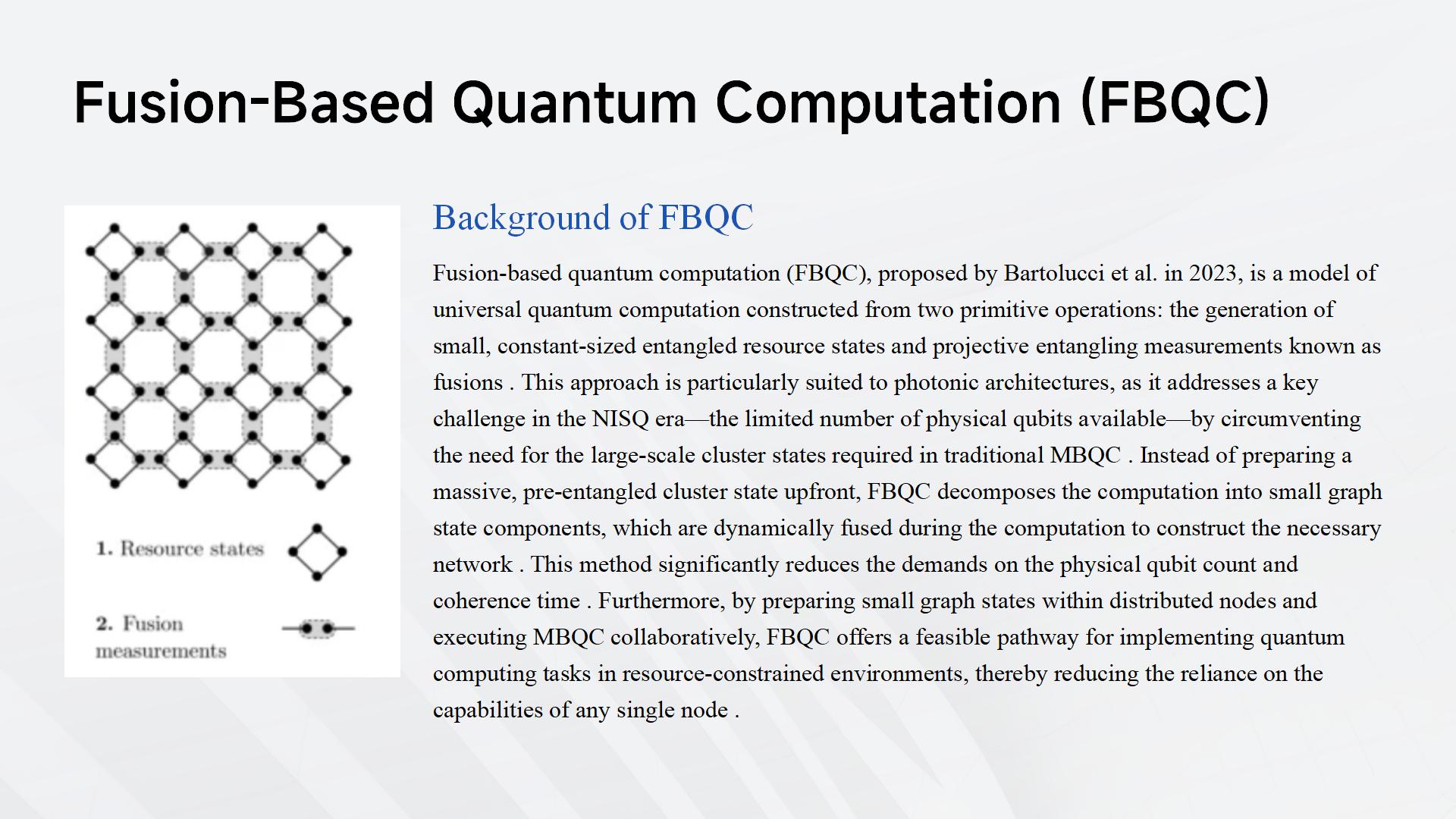 |
In 2023, Bartolucci et al. proposed Fusion-Based Quantum Computing (FBQC), a universal quantum computation model constructed from two primitive operations: generating small-scale entangled resource states and performing projective entangling measurements ("fusions").
FBQC is particularly suitable for photonic architectures, addressing the limited physical qubit availability in the NISQ era. Unlike traditional MBQC requiring large cluster states, FBQC dynamically fuses small graph state components during computation, reducing demands on physical qubit count and coherence time.
By preparing small graph states across distributed nodes and executing MBQC collaboratively, FBQC provides a viable pathway for quantum computation in resource-constrained environments.
|
|
ICACT20260022 Slide.09
[Big slide for presentation]
|
Chrome Text-to-Speach Click!! |
 |
Having analyzed MBQCs resource challenges and existing methodological limitations, we now proceed to Related Work. This section introduces relevant research advancements to contextualize our proposed solutions.
|
|
ICACT20260022 Slide.08
[Big slide for presentation]
|
Chrome Text-to-Speach Click!! |
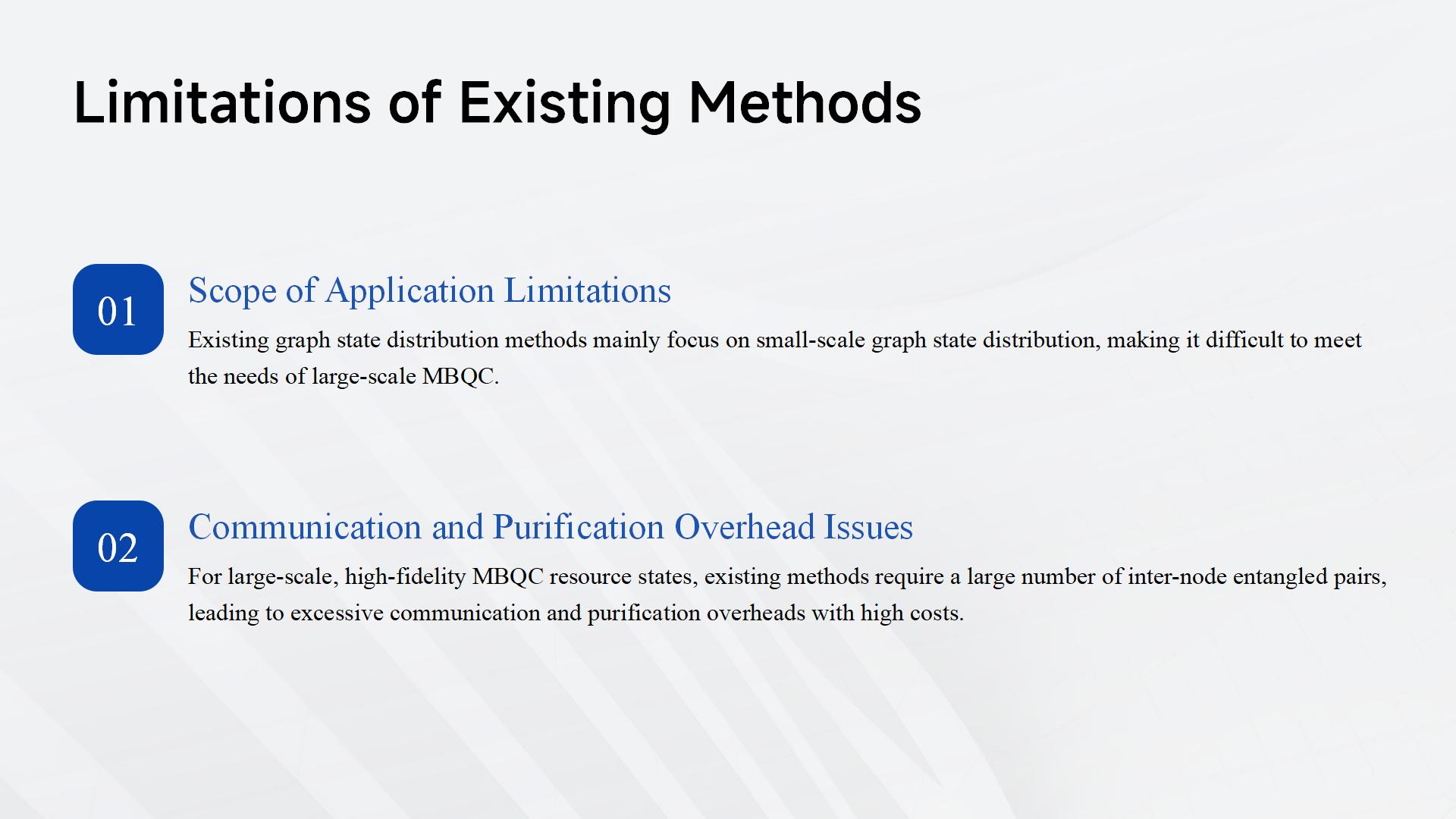 |
Existing methods exhibit two major limitations:
Limited applicability: Current graph state distribution methods focus primarily on small-scale states, inadequate for large-scale MBQC requirements.
High communication and purification costs: Large-scale, high-fidelity MBQC resource states necessitate numerous inter-node entangled pairs, leading to prohibitive overhead in communication and purification processes.
|
|
ICACT20260022 Slide.07
[Big slide for presentation]
|
Chrome Text-to-Speach Click!! |
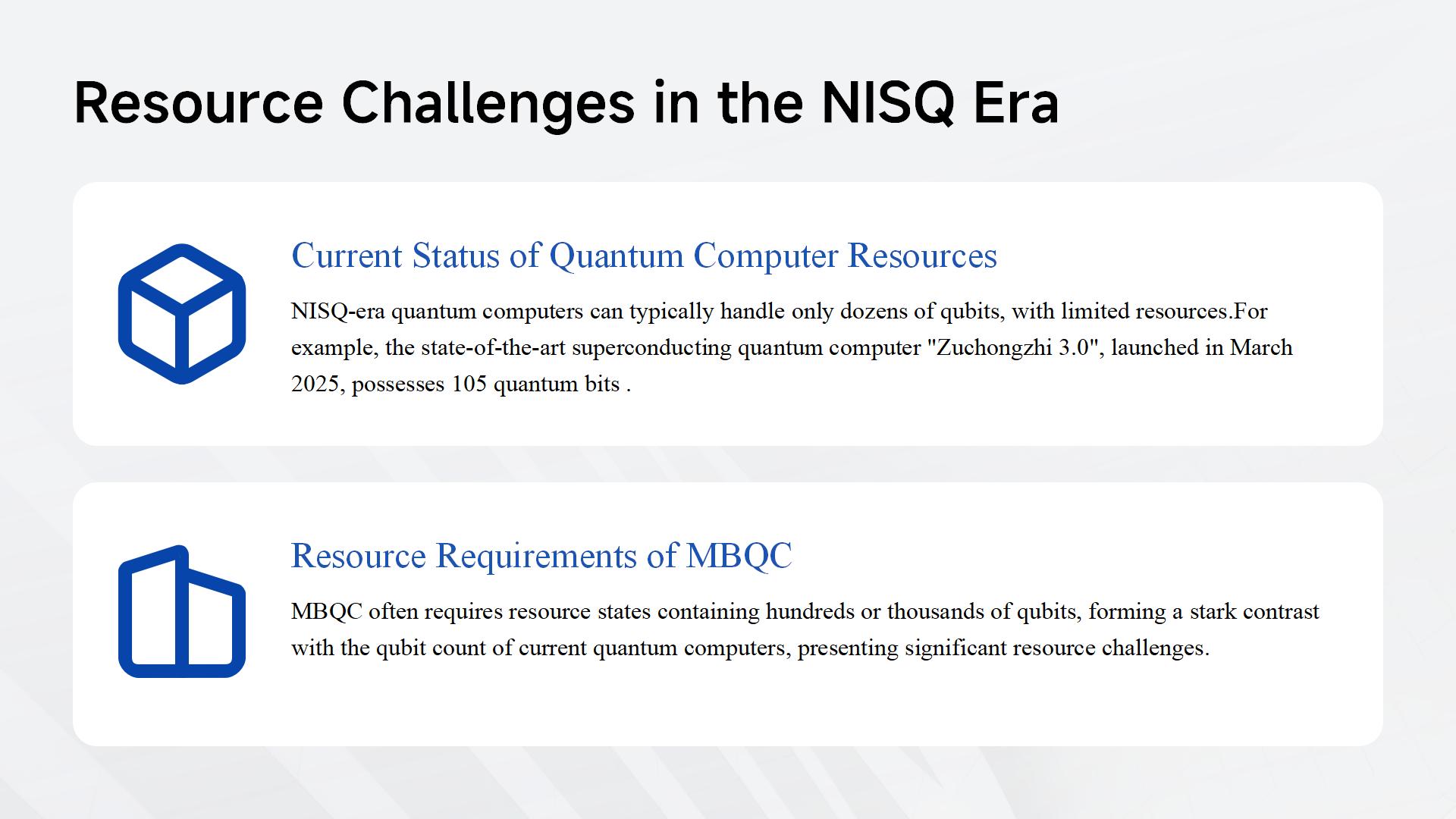 |
Quantum computers in the NISQ era face severe resource constraints. Current devices typically handle only dozens to hundreds of qubits—for instance, the state-of-the-art superconducting quantum computer "Zuchongzhi 3.0" launched in March 2025 possesses 105 qubits.
In contrast, MBQC often requires resource states comprising hundreds or thousands of qubits. This disparity creates a significant resource bottleneck, limiting MBQCs practical implementation in the NISQ era and imposing higher demands on quantum hardware development.
|
|
ICACT20260022 Slide.06
[Big slide for presentation]
|
Chrome Text-to-Speach Click!! |
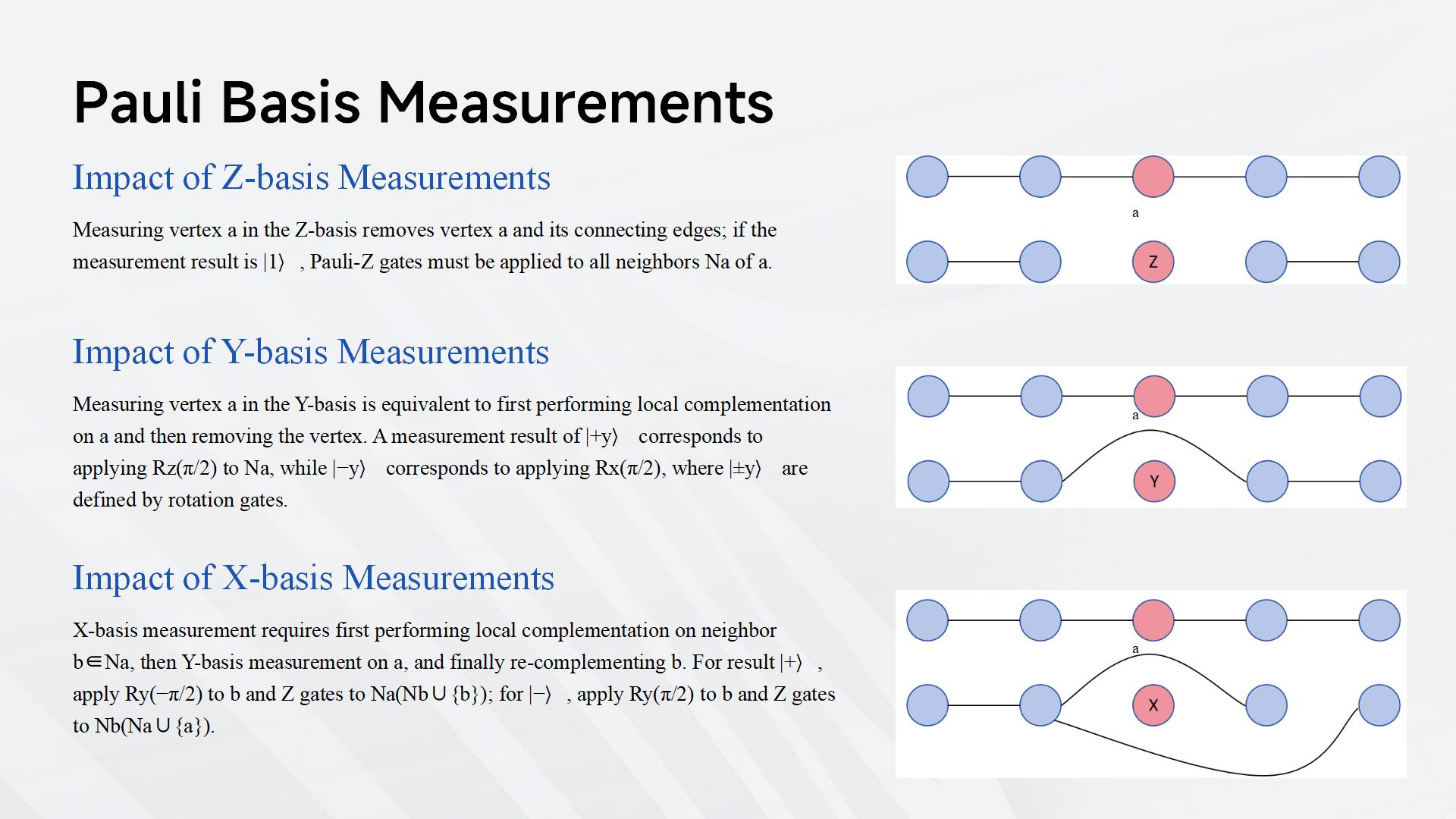 |
Pauli basis measurements significantly impact MBQC execution:
Z-basis measurement: Removes the measured vertex and its edges. If the outcome is |1⟩, Pauli-Z gates are applied to all neighboring qubits.
Y-basis measurement: Equivalent to performing local complementation on the vertex before removal. Outcomes |+y⟩ and |-y⟩ require applying Rz(π/2) and Rx(π/2) to neighbors, respectively.
X-basis measurement: Requires local complementation on a neighbor, followed by Y-basis measurement on the vertex, and re-complementation on the neighbor. Specific outcome-dependent operations involve Ry(±π/2) and Z-gate applications.
These operations demonstrate the precision and complexity of Pauli measurements in quantum computation.
|
|
ICACT20260022 Slide.05
[Big slide for presentation]
|
Chrome Text-to-Speach Click!! |
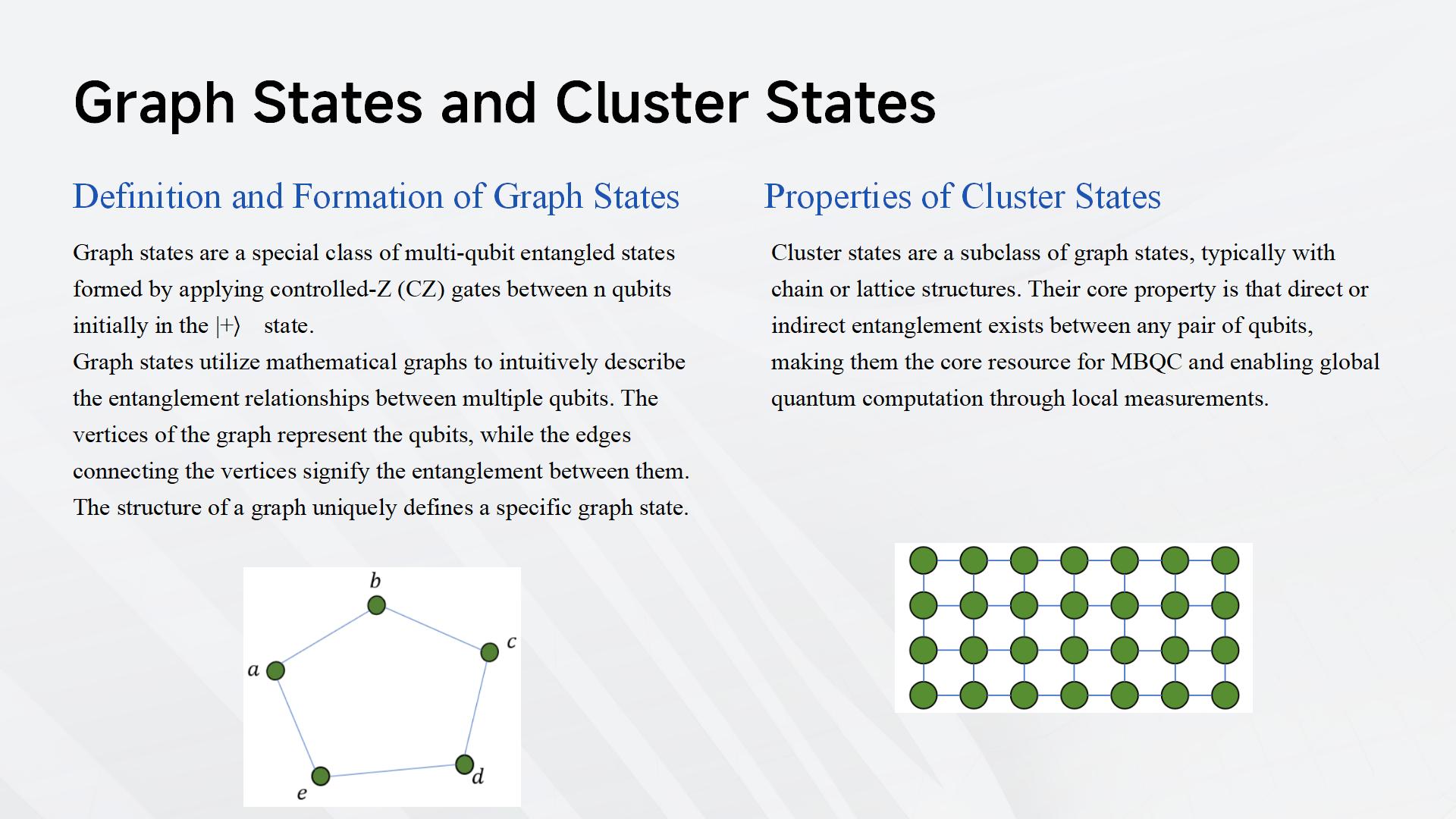 |
Graph states and cluster states play critical roles in quantum computing. Graph states are a class of multi-qubit entangled states formed by applying controlled-Z gates to n qubits initialized in the |+⟩ state. They use mathematical graphs to intuitively represent multi-qubit entanglement relationships, where the graph structure uniquely defines a specific graph state.
Cluster states, a subset of graph states, typically exhibit chain or lattice structures. Their key property is the existence of direct or indirect entanglement between any two qubits, making them the fundamental resource for MBQC by enabling global quantum computation through local measurements.
|
|
ICACT20260022 Slide.04
[Big slide for presentation]
|
Chrome Text-to-Speach Click!! |
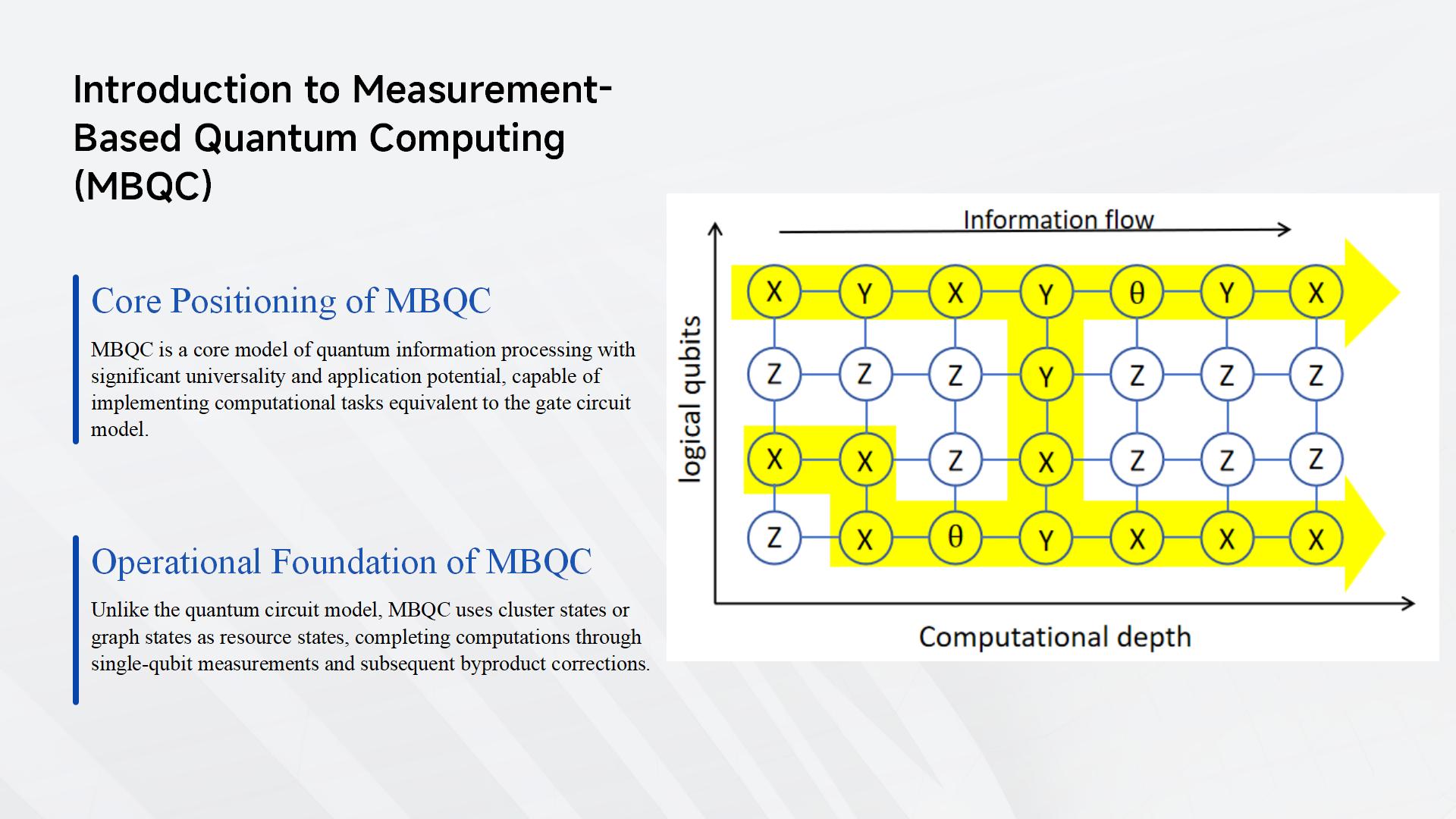 |
Measurement-Based Quantum Computing (MBQC) is a core model in quantum information processing, possessing universal applicability and the capability to perform computational tasks equivalent to the gate-based circuit model. This positions MBQC as a pivotal approach in quantum computing.
Unlike quantum circuit models, MBQC utilizes cluster states or graph states as resource states, executing computations through single-qubit measurements and subsequent byproduct corrections. This operational paradigm offers distinct advantages in resource utilization and computational methodology.
|
|
ICACT20260022 Slide.03
[Big slide for presentation]
|
Chrome Text-to-Speach Click!! |
 |
Having outlined the report structure, we now begin with Part 1: Research Background and Challenges. Clarifying these aspects is essential for understanding the necessity of our research. We will now examine the background of Measurement-Based Quantum Computing and its associated resource challenges.
|
|
ICACT20260022 Slide.02
[Big slide for presentation]
|
Chrome Text-to-Speach Click!! |
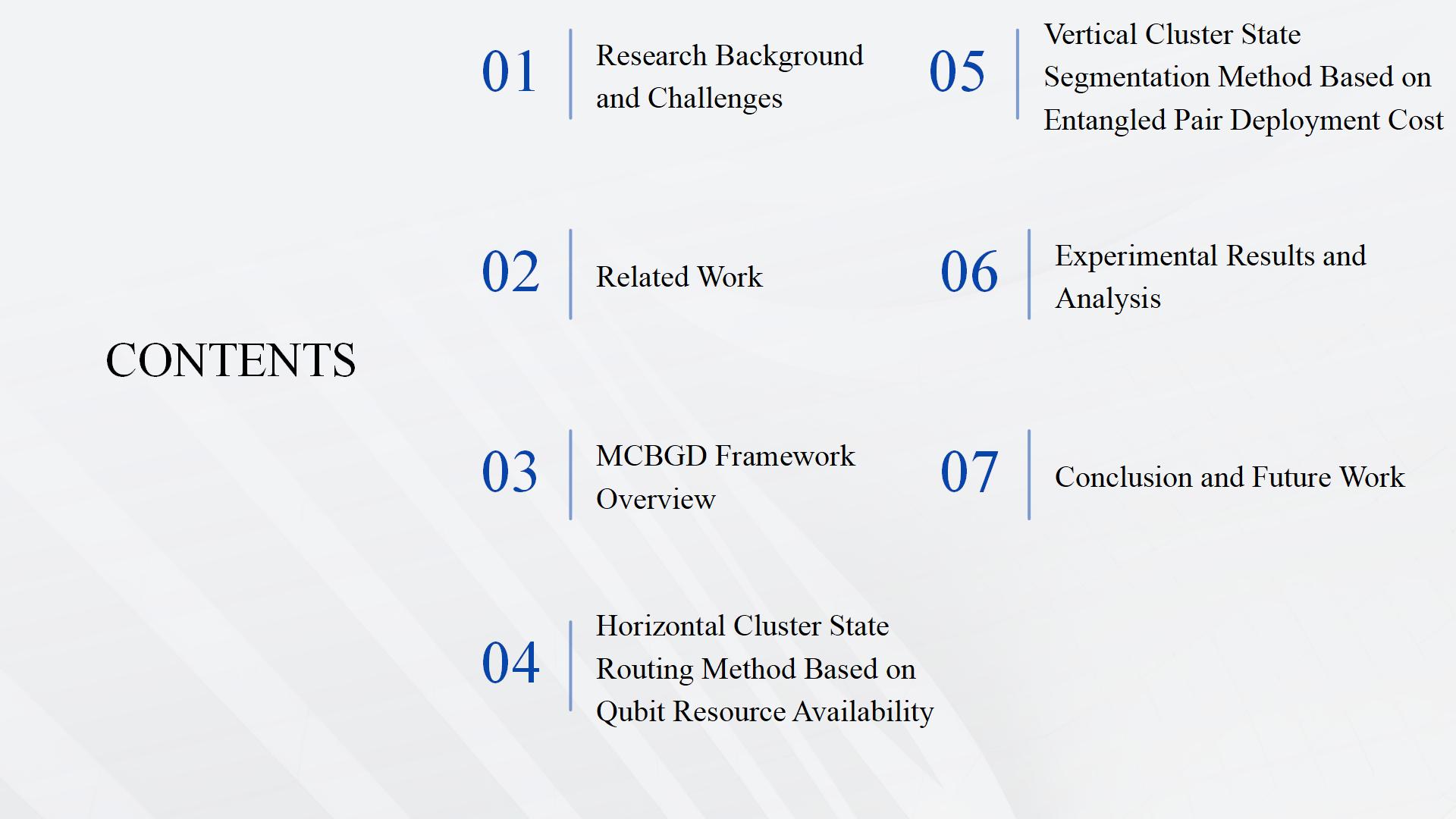 |
This presentation is structured into seven sections. First, I will introduce the research background and challenges, highlighting resource constraints. Next, I will review related work to establish context. Then, I will provide an overview of the MCBGD framework as a foundation for subsequent sections. Following that, I will elaborate on horizontal routing and vertical segmentation methods separately. Experimental results will then be presented, followed by conclusions and future work. The logical flow will progress coherently from fundamentals to advanced topics.
|
|
ICACT20260022 Slide.01
[Big slide for presentation]
[YouTube] |
Chrome Text-to-Speach Click!! |
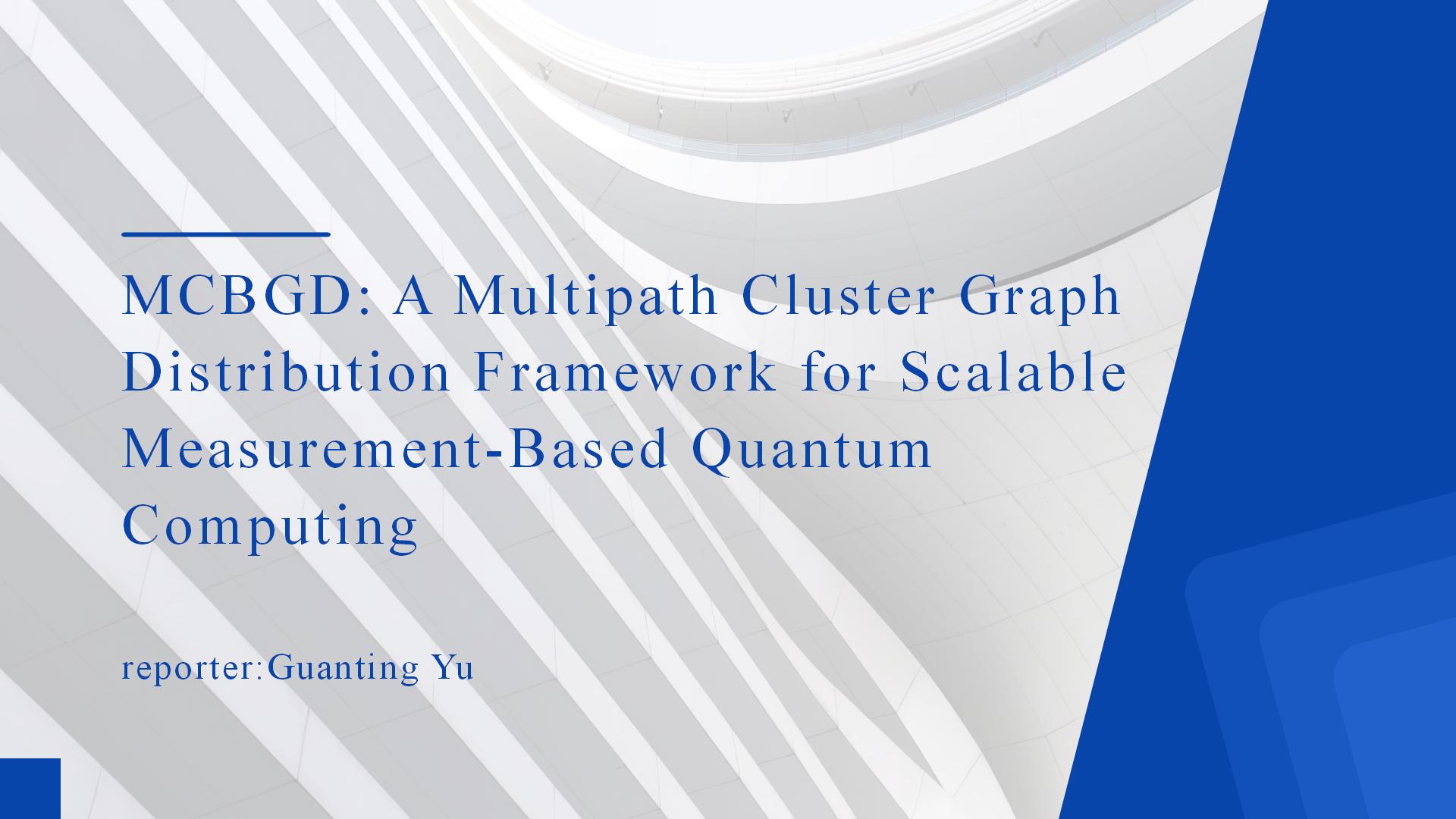 |
Good morning, esteemed experts and colleagues. I am the presenter, Guanting Yu. It is a great honor to present our research—MCBGD: A Multipath Cluster Graph Distribution Framework for Scalable Measurement-Based Quantum Computing.
Measurement-Based Quantum Computing (MBQC) holds significant application potential but currently faces challenges in resources and methodology. Our MCBGD framework aims to address these issues by providing novel solutions for scalable MBQC implementation.
Through this presentation, I hope to deepen your understanding of the MCBGD framework, and I welcome further discussions afterward. I will now proceed with detailed explanations.
|