ICACT20250020 Slide.25
[Big slide for presentation]
ICACT20250020 Slide.25
[Big slide for presentation]
|
Chrome Text-to-Speach Click!! Click!! |
 |
Thank you for your attention. If you have any questions or need further clarification. I'm happy to assist you.
|
|
ICACT20250020 Slide.24
[Big slide for presentation]
|
Chrome Text-to-Speach Click!! |
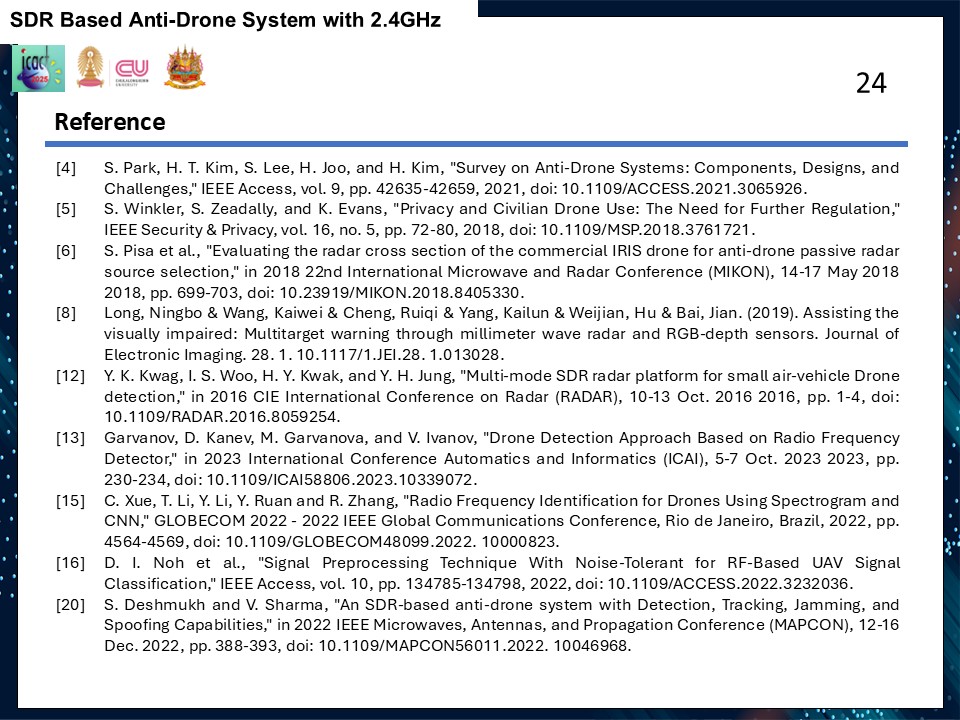 |
Here is our reference that has been used in this presentation and the part of our paper.
|
|
ICACT20250020 Slide.23
[Big slide for presentation]
|
Chrome Text-to-Speach Click!! |
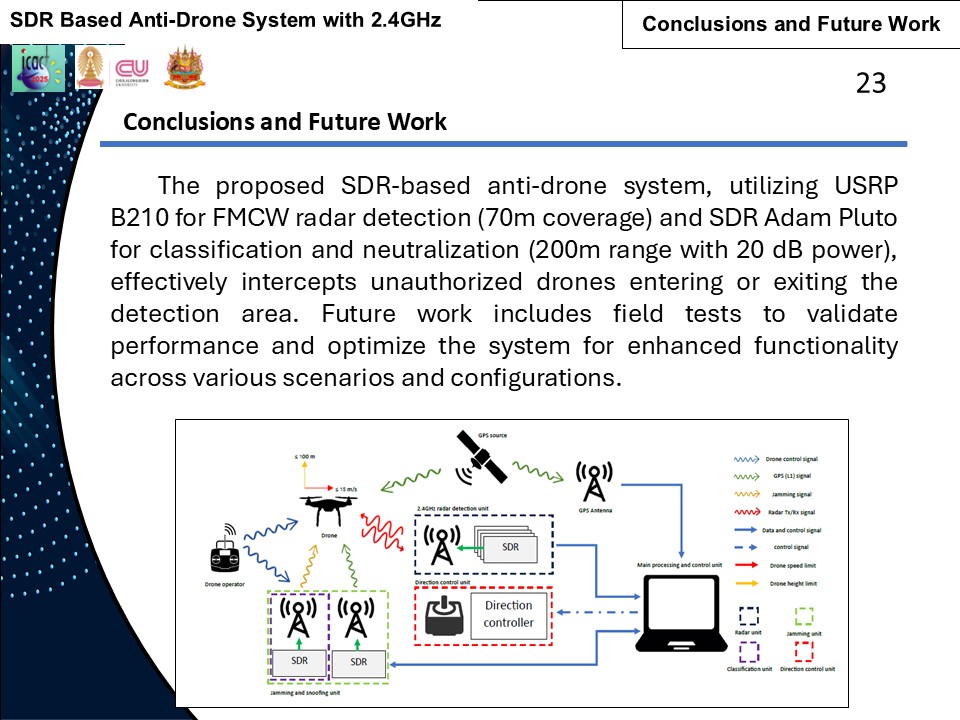 |
The SDR-based anti-drone system employs USRP B210 for 70m FMCW radar detection and SDR Adam Pluto for 200m range classification and neutralization, effectively intercepting unauthorized drones. Future work involves field tests to validate and optimize performance across various scenarios.
|
|
ICACT20250020 Slide.22
[Big slide for presentation]
|
Chrome Text-to-Speach Click!! |
 |
Last, Conclusions and Future Work
|
|
ICACT20250020 Slide.21
[Big slide for presentation]
|
Chrome Text-to-Speach Click!! |
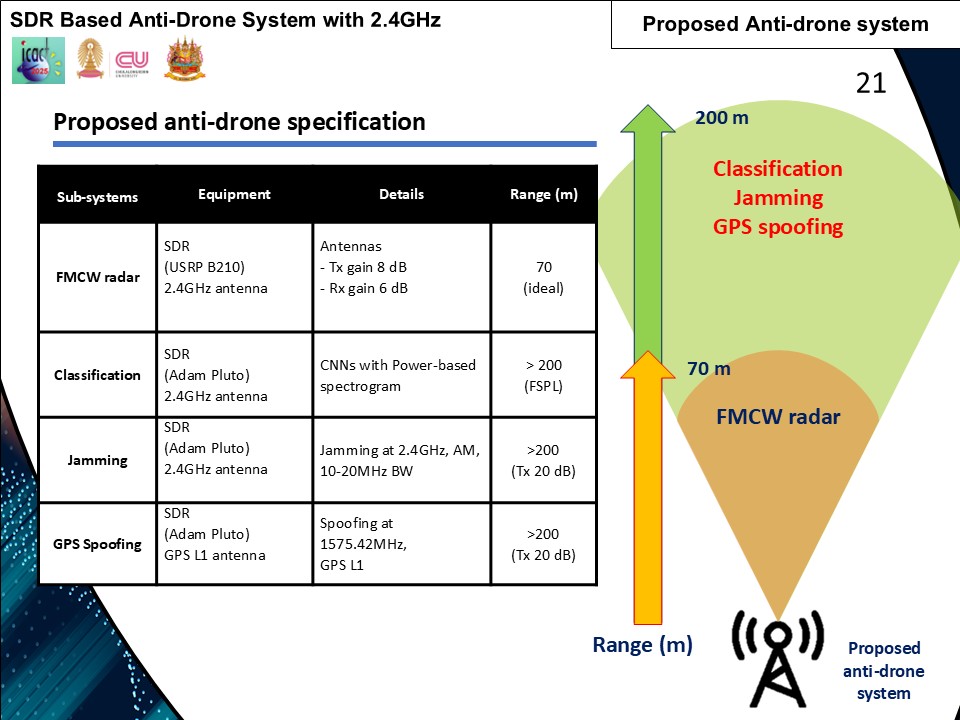 |
This proposed anti-drone has simulated specification in the left table.
FMCW radar use SDR USRP B210 with 2 Tx and 2 Rx channel with antenna 2.4GHz gain of 8 db Tx and 6 db Rx can operate cover range of 70m in ideal conditions. Radio classification use SDR Adam pluto operated with CNN model with power-based spectrogram, it can receive signal more than 200m. Jamming system use the same SDR adam pluto with transmit signal at 2.4GHz 10-20MHz BW enough for 1 communication channel expect range at 200m with Tx power of 20db. and GPS spoofing use SDR adam pluto with range at 200m. Therefore, this proposed system can be used to counter incoming and outgoing drone within coverage area.
|
|
ICACT20250020 Slide.20
[Big slide for presentation]
|
Chrome Text-to-Speach Click!! |
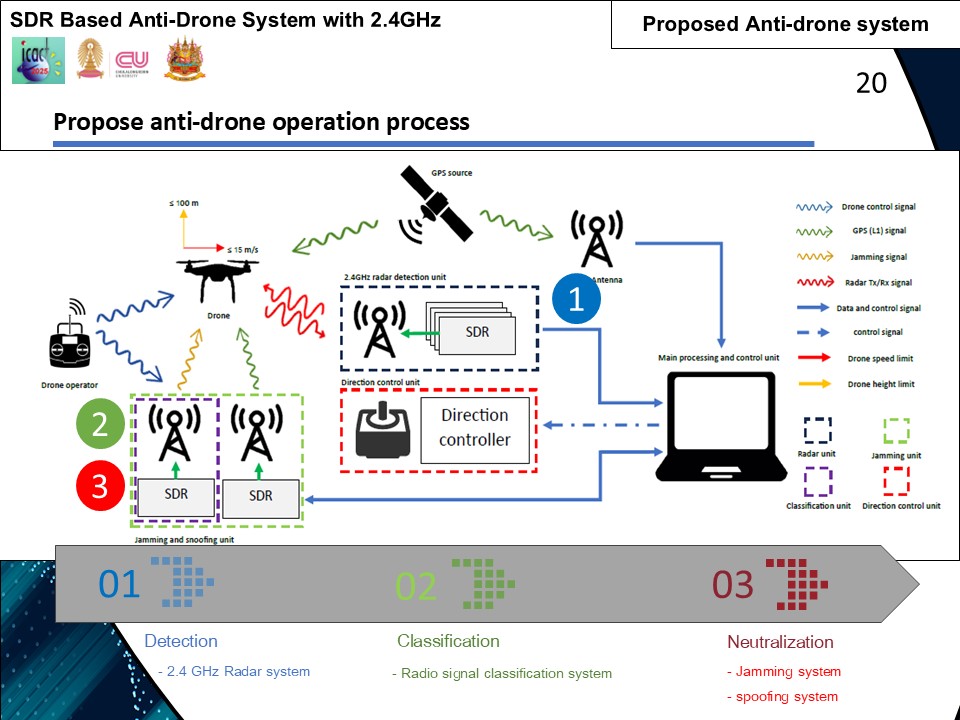 |
Process of proposed anti-drone system is first detecting an incoming object within radar range(~70m) and then RF classification with determine is it a drone and last if drone to confirmed jamming and spoofing sub-system will transmit it signal to try to interrupt the drone, as shown in figure above.
|
|
ICACT20250020 Slide.19
[Big slide for presentation]
|
Chrome Text-to-Speach Click!! |
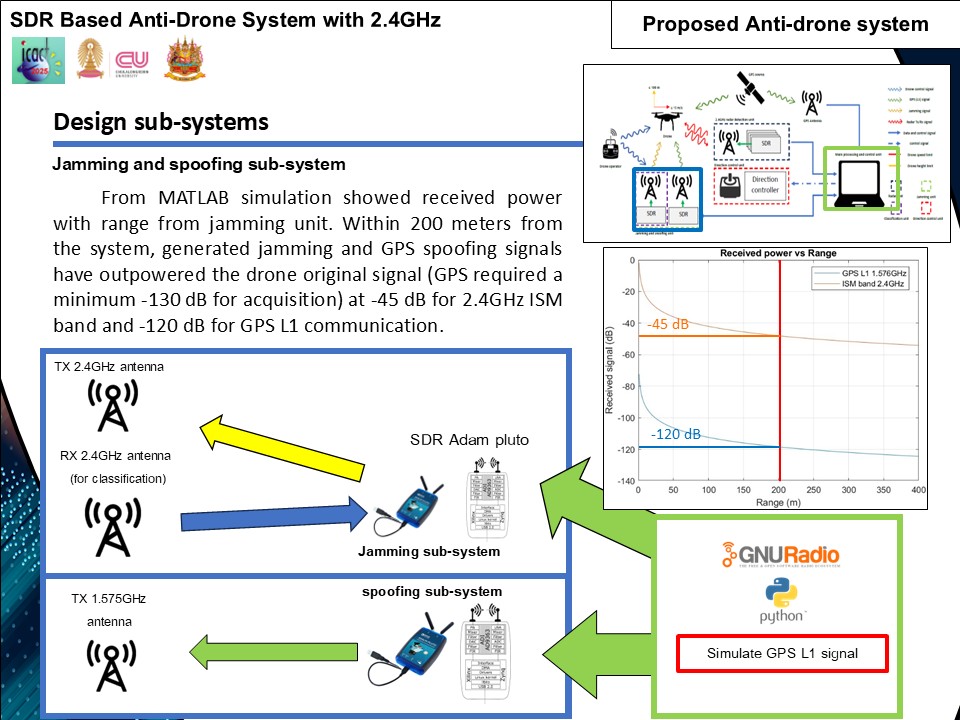 |
After classifying, if detected object is drone. Jamming and spoofing sub-system with sent jamming signal in 2.4GHz range with 20dbi transmit power and GPS L1 spoofing signal by transmit false position to the drone, and from free space loss and equipment loss simulation in MATLAB shown range of both is estimate at 200m with -45db for minimum 2.4GHz and -120db minimum for GPS L1.
|
|
ICACT20250020 Slide.18
[Big slide for presentation]
|
Chrome Text-to-Speach Click!! |
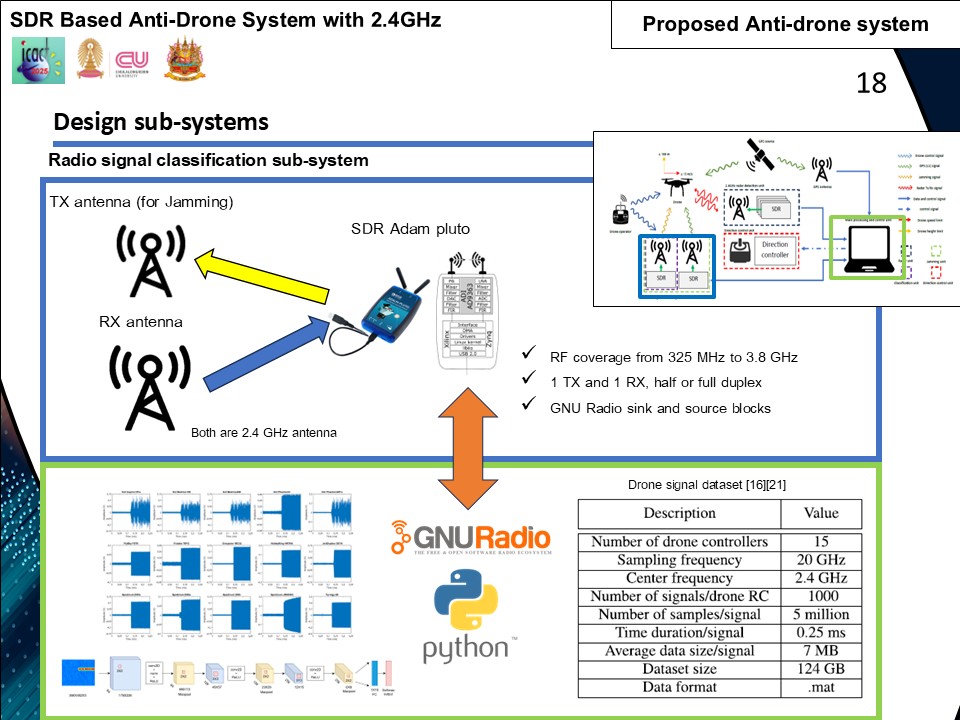 |
Radio signal classification sub-system will use SDR (Adam pluto) to receives RF control signal of drones in 2.4GHz range and sent to main processing unit to transform data to power-based spectrogram and put in CNN model that has been trained with dataset with many of drone model as below.
|
|
ICACT20250020 Slide.17
[Big slide for presentation]
|
Chrome Text-to-Speach Click!! |
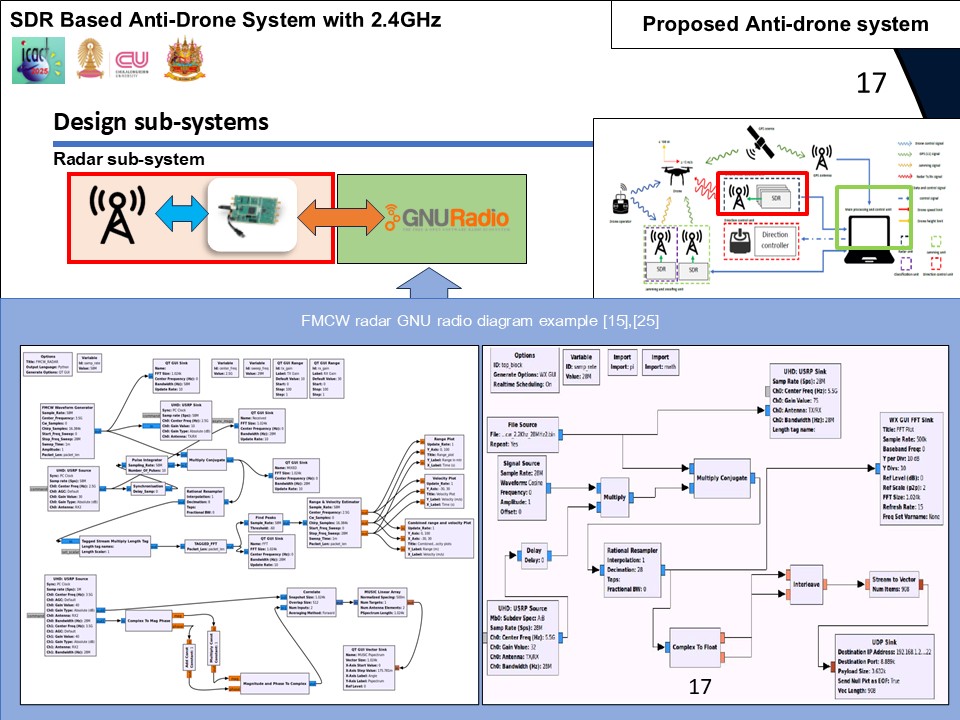 |
This is some GNU diagram examples from related research.
|
|
ICACT20250020 Slide.16
[Big slide for presentation]
|
Chrome Text-to-Speach Click!! |
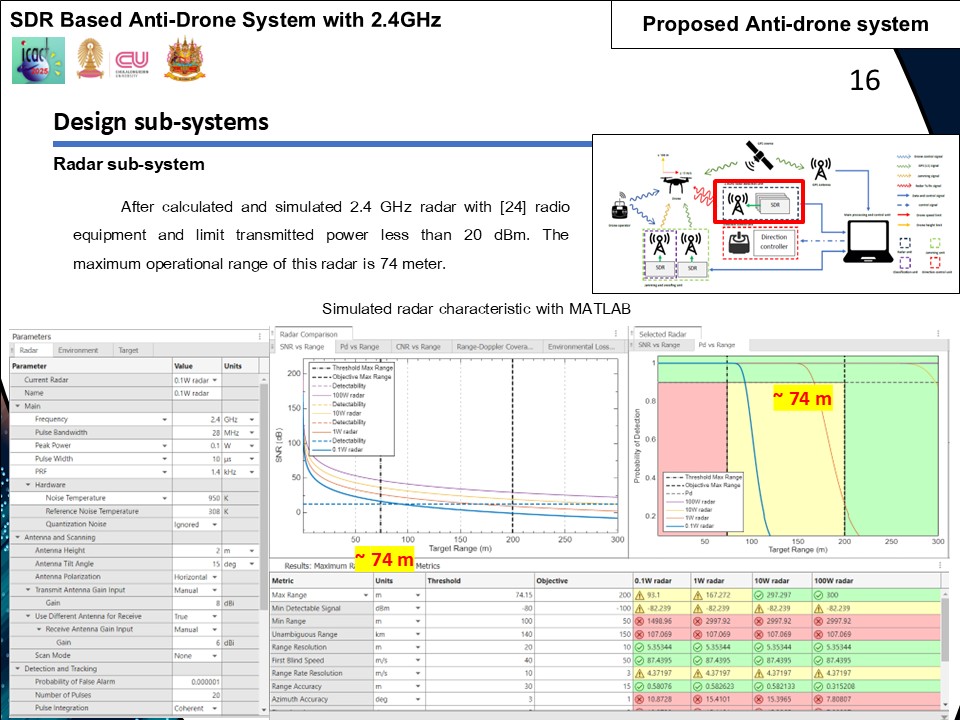 |
After calculated and simulated with MATLAB 2.4 GHz radar with radio equipment (Tx antenna gain 8 dbi and Rx gain 6 dbi) and limit transmitted power less than 20 dBm on SDR USRP B210. The maximum operational range of this radar is 74 meters with detection of RCS 0.1 sqm drone.
|
|
ICACT20250020 Slide.15
[Big slide for presentation]
|
Chrome Text-to-Speach Click!! |
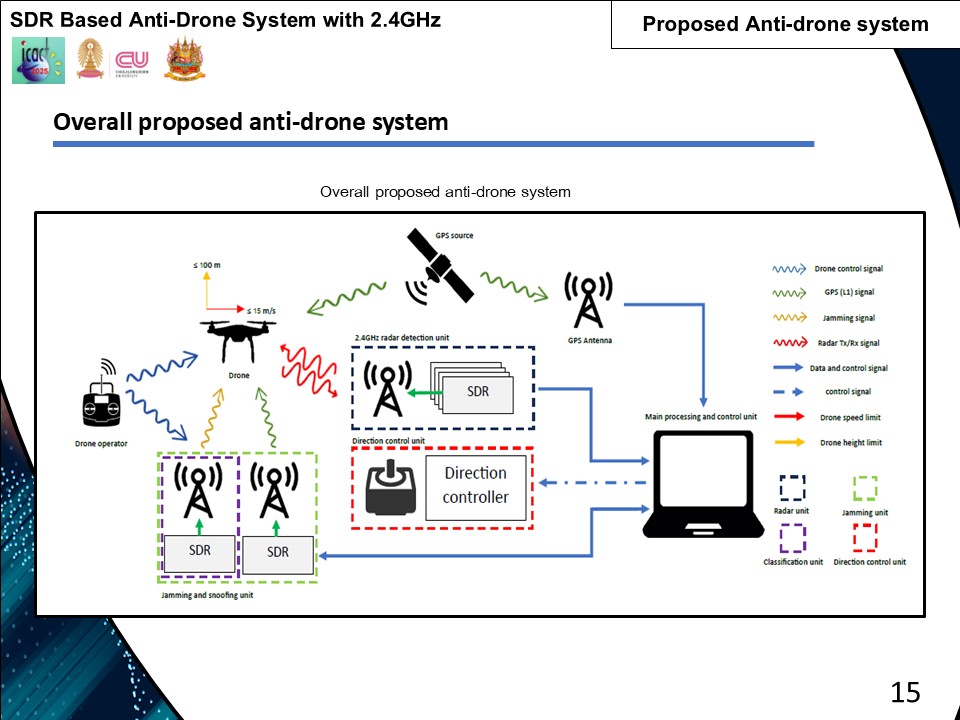 |
This is overall diagram of proposed anti-drone system. It comprises of radar sub-system, radio classification sub-sytem and jamming/spoofing sub-system. All of them will propose with main processing unit with both python and GNU radio.
|
|
ICACT20250020 Slide.14
[Big slide for presentation]
|
Chrome Text-to-Speach Click!! |
 |
Third, Proposed Anti-drone system.
This part will explain more details in proposed anti-drone system with simulation resulted.
|
|
ICACT20250020 Slide.13
[Big slide for presentation]
|
Chrome Text-to-Speach Click!! |
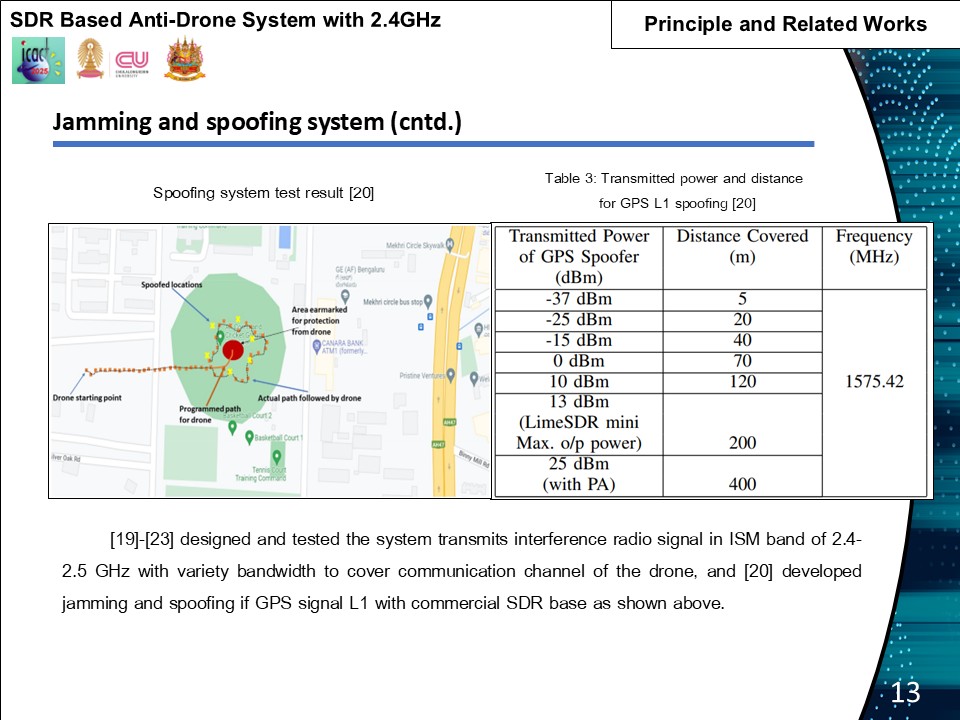 |
Recently research successfully designed and tested the system transmits interference radio signal in ISM band of 2.4-2.5 GHz, and another developed jamming and spoofing if GPS signal L1 with commercial SDR base as shown above.
|
|
ICACT20250020 Slide.12
[Big slide for presentation]
|
Chrome Text-to-Speach Click!! |
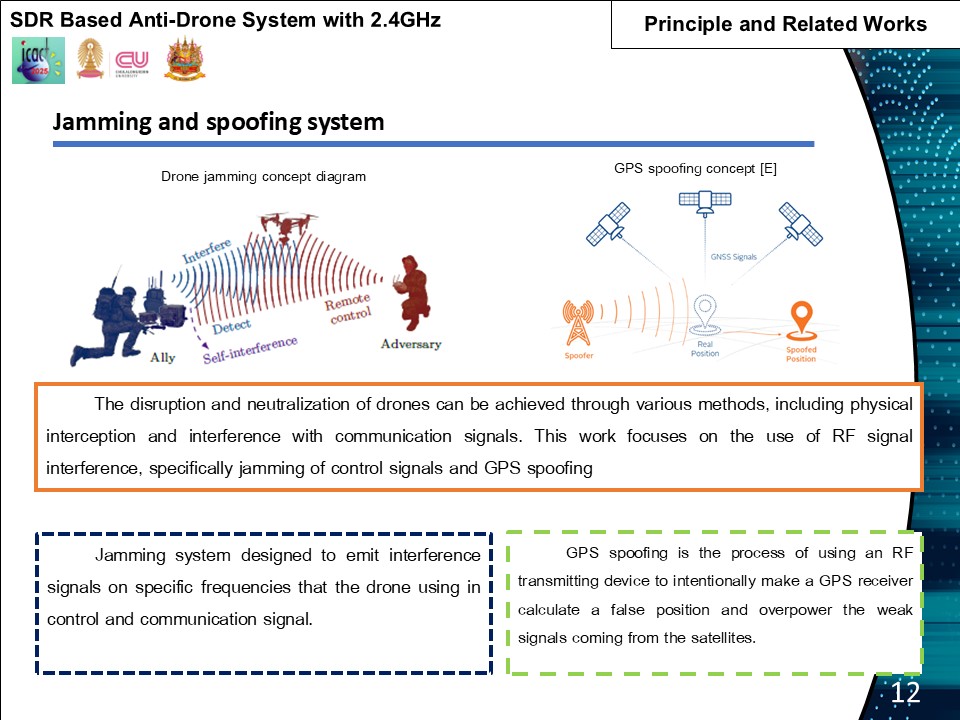 |
Disrupting and neutralizing drones can be achieved through various methods, such as physical interception and communication signal interference. This research focuses on RF signal interference, specifically jamming control signals and GPS spoofing. The jamming system emits interference signals on frequencies used by drones for control and communication. GPS spoofing involves using an RF transmitting device to make a GPS receiver calculate a false position by overpowering the weak satellite signals.
|
|
ICACT20250020 Slide.11
[Big slide for presentation]
|
Chrome Text-to-Speach Click!! |
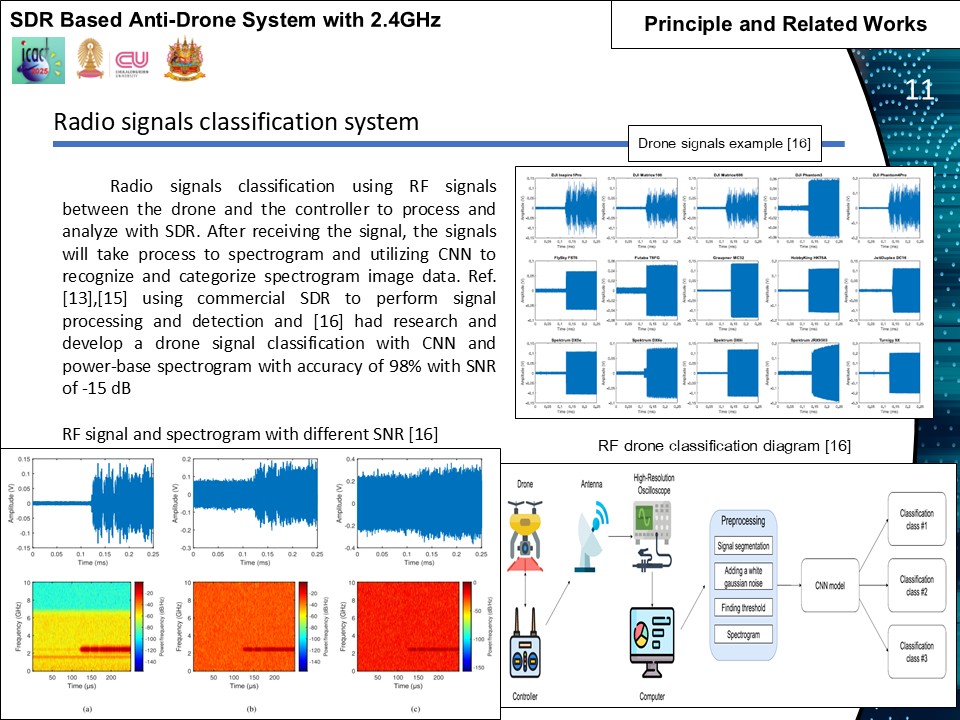 |
Recent research classifies radio signals between drones and controllers using RF signals processed with SDR. The signals are converted into spectrograms and analyzed with CNNs to categorize them. One study [16] achieved 98% accuracy in drone signal classification with CNN and power-based spectrograms at an SNR of -15 dB. The top right picture shows distinct signal patterns for each drone model, enabling effective classification. Below is the result when noise is added to simulate a real-world environment.
|
|
ICACT20250020 Slide.10
[Big slide for presentation]
|
Chrome Text-to-Speach Click!! |
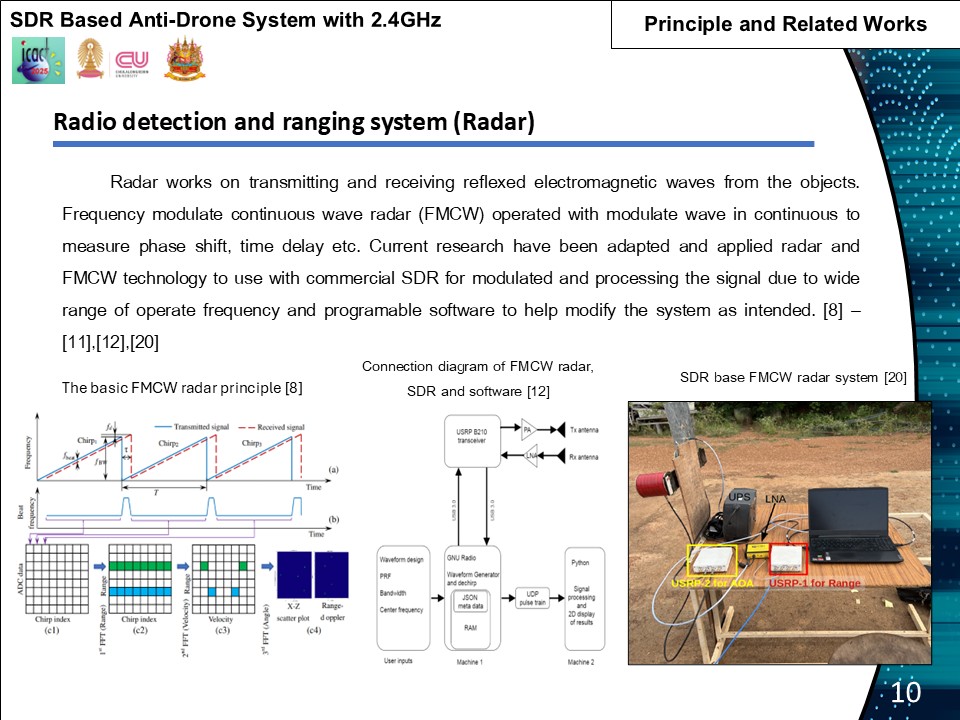 |
Radar functions by transmitting and receiving reflected electromagnetic waves from objects. Recent research has adapted radar and FMCW technology with commercial Software-Defined Radio (SDR) for signal modulation and processing. SDR's wide operating frequencies and programmable software facilitate system modifications as needed. The left picture illustrates the basic concept of FMCW radar, while the middle and right pictures show SDR-based radar from related work.
|
|
ICACT20250020 Slide.09
[Big slide for presentation]
|
Chrome Text-to-Speach Click!! |
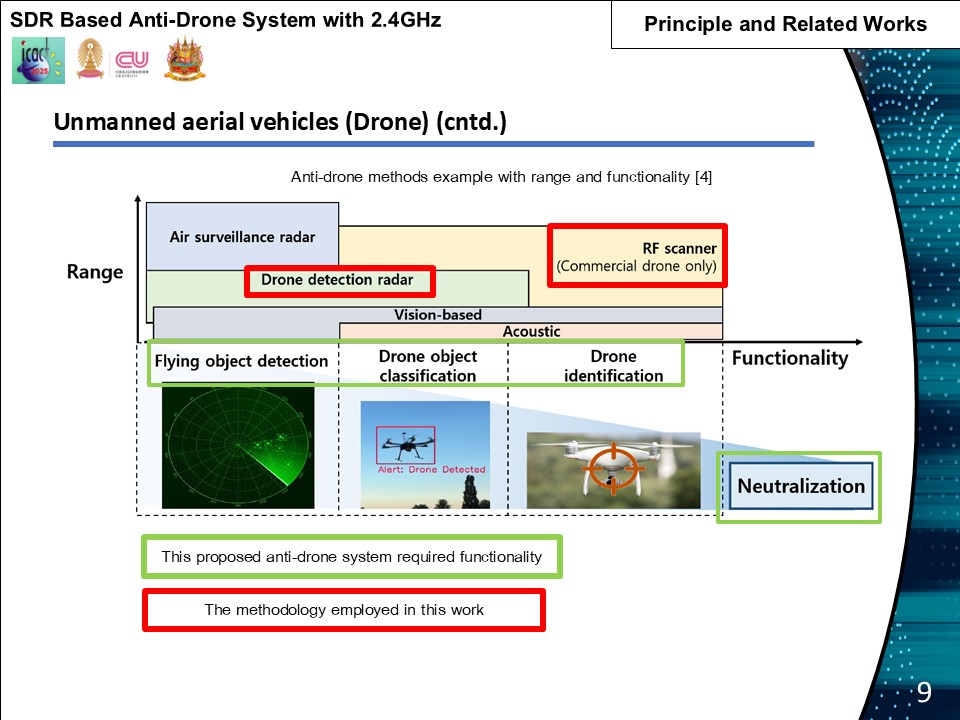 |
Here is example of anti-drone methods and functionality with 4 main functions as detection, classification, identification and neutralization. and in this work will design to cover all 4 of the main functions.
|
|
ICACT20250020 Slide.08
[Big slide for presentation]
|
Chrome Text-to-Speach Click!! |
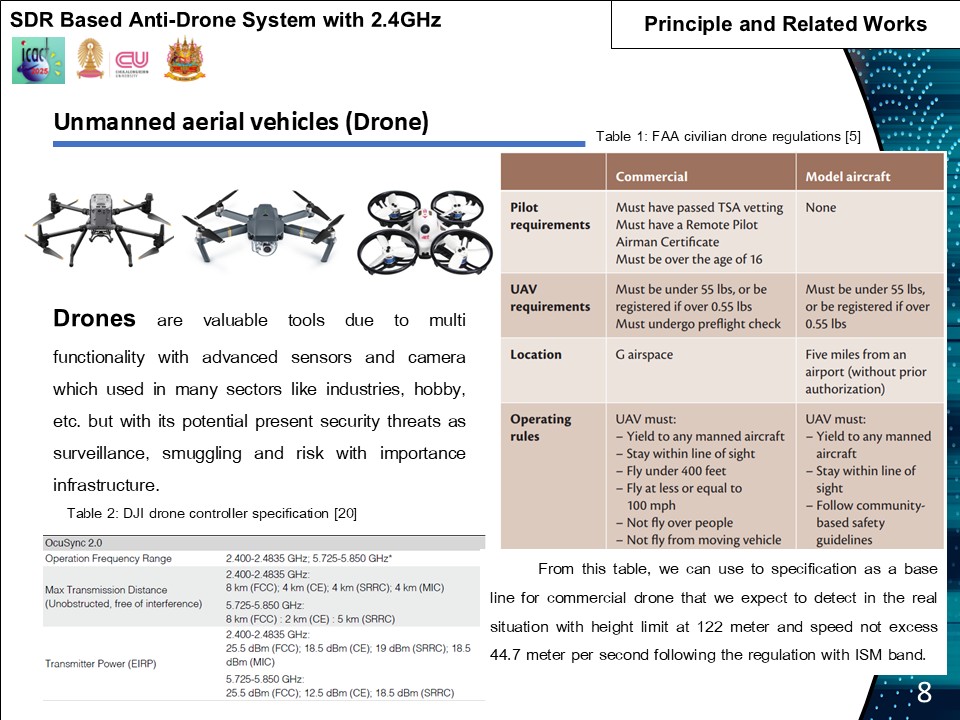 |
Drones are equipped with various sensors and control frequencies that enable successful navigation. Popular frequencies include the 2.4 GHz and 5.6 GHz ranges (ISM band), combined with GPS L1. Current regulations set speed and altitude limits for drones at 45 meters per second and 122 meters, respectively. Research indicates that the average radar cross-section (RCS) of a commercial drone is approximately 0.1 square meters. Therefore, an effective anti-drone system should operate within these parameters to counter commercially modified drones.
|
|
ICACT20250020 Slide.07
[Big slide for presentation]
|
Chrome Text-to-Speach Click!! |
 |
Second, Principle and Related Works.
|
|
ICACT20250020 Slide.06
[Big slide for presentation]
|
Chrome Text-to-Speach Click!! |
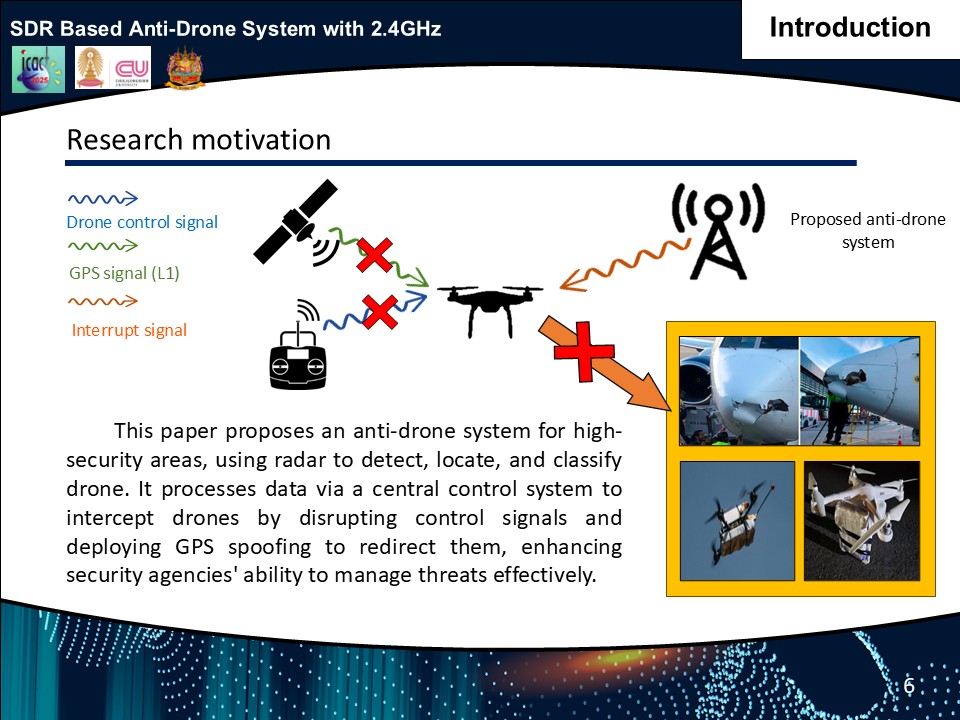 |
This paper proposes an anti-drone system for high-security areas, utilizing commercially available components and software. The system is designed to be capable of modification and adjustment for future requirements. It employs radar technology to detect, locate, and classify drones. The data is processed by a central control system, which intercepts drones by disrupting their control signals and deploying GPS spoofing.
|
|
ICACT20250020 Slide.05
[Big slide for presentation]
|
Chrome Text-to-Speach Click!! |
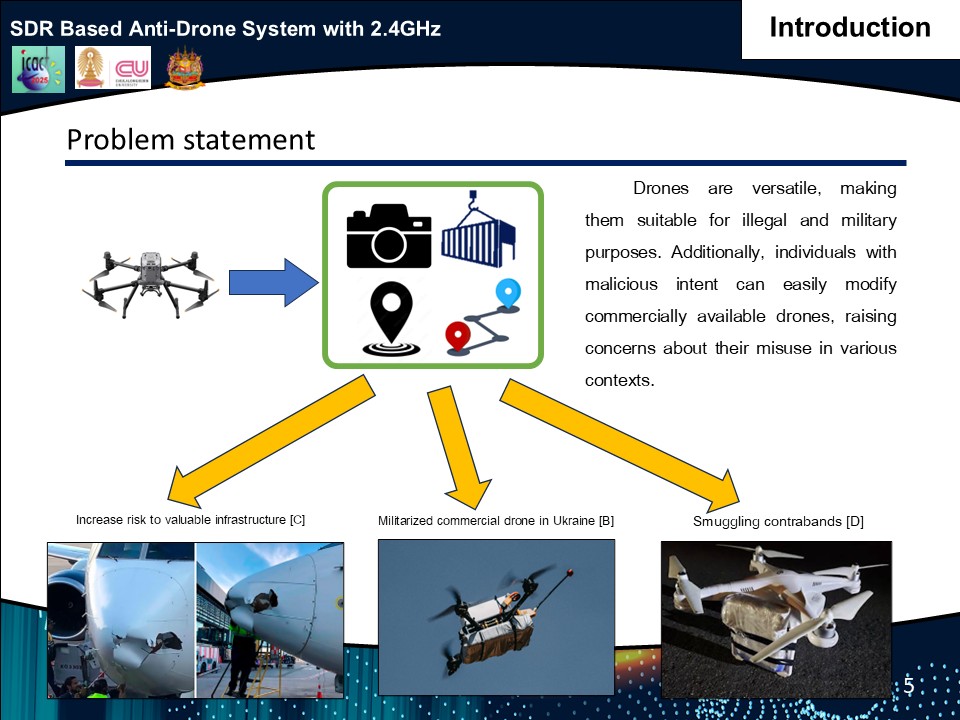 |
Drones are highly versatile, which makes them suitable for various illegal and military applications. Moreover, commercially available drones can be easily modified by individuals with malicious intent, as demonstrated by recent events. This raises significant concerns about their misuse in various contexts. Additionally, specialized equipment to counter such threats remains expensive, posing further challenges in addressing these issues.
|
|
ICACT20250020 Slide.04
[Big slide for presentation]
|
Chrome Text-to-Speach Click!! |
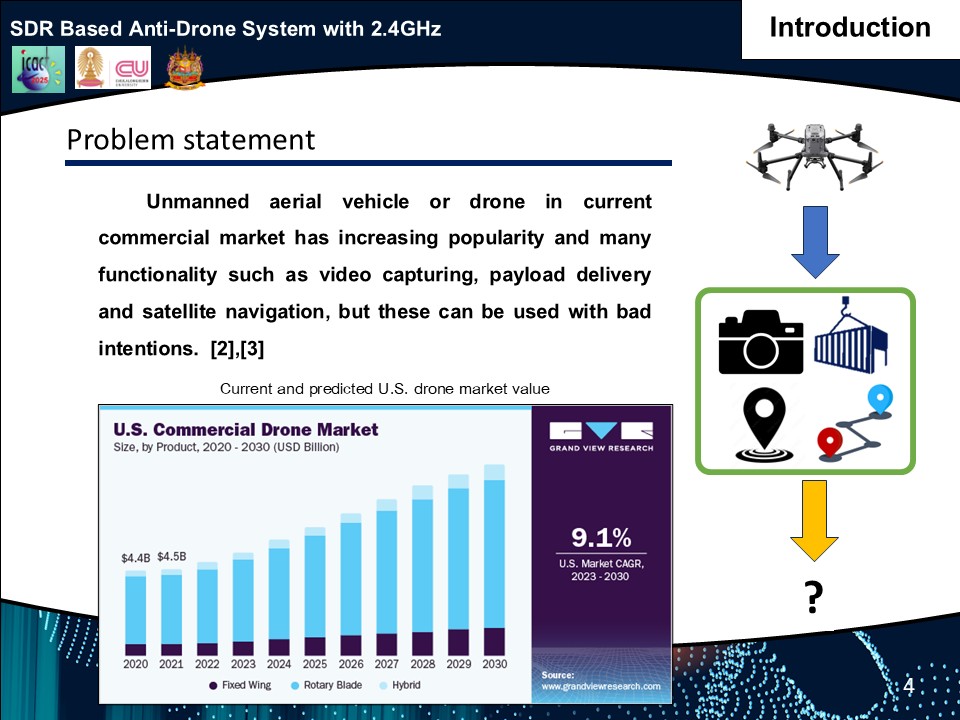 |
Unmanned Aerial Vehicles (UAVs) or drones have gained significant popularity in the current commercial market, as evidenced by the projected growth of the drone market in the United States, shown in the figure below. Drones offer a variety of functionalities, including video capturing, payload delivery, and satellite navigation. However, these capabilities can also be misused for malicious purposes.
|
|
ICACT20250020 Slide.03
[Big slide for presentation]
|
Chrome Text-to-Speach Click!! |
 |
First section, introduction.
|
|
ICACT20250020 Slide.02
[Big slide for presentation]
|
Chrome Text-to-Speach Click!! |
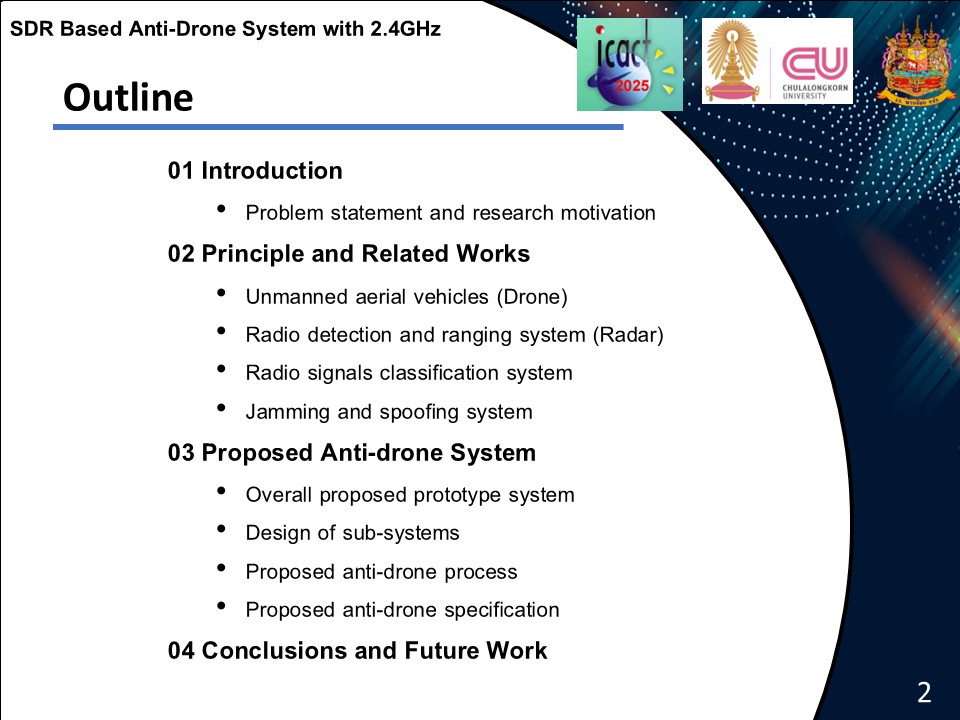 |
First, I will outline the sections of our research presentation.
We will begin with an introduction to the problem and the motivation for this research, highlighting why it matters. Following that, we will discuss the principles and related works, describing and evaluating each component that factors into the anti-drone system. The third section will present the proposed anti-drone system, including simulation results and specifications. Finally, we will conclude with a summary of our findings and potential future works.
|
|
ICACT20250020 Slide.01
[Big slide for presentation]
|
Chrome Text-to-Speach Click!! |
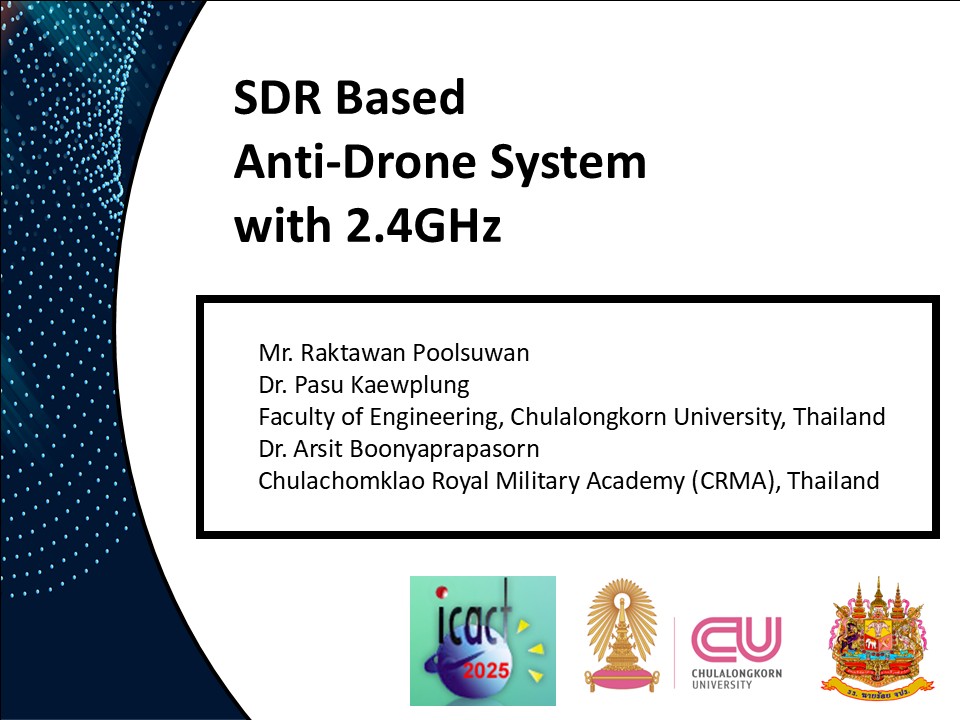 |
Good morning, everyone. My name is Raktawan Poolsuwan from Chulalongkorn University, Thailand. It is a great honor to be here today. I am here to present our research in title of 'SDR Based Anti-Drone System with 2.4GHz' conducted in collaboration with Dr. Pasu and Dr. Arsit.
|