ICACT20210147 Slide.17
[Big slide for presentation]
ICACT20210147 Slide.17
[Big slide for presentation]
|
Chrome Text-to-Speach Click!! Click!! |
 |
Thank you for your attention.
|
|
ICACT20210147 Slide.16
[Big slide for presentation]
|
Chrome Text-to-Speach Click!! |
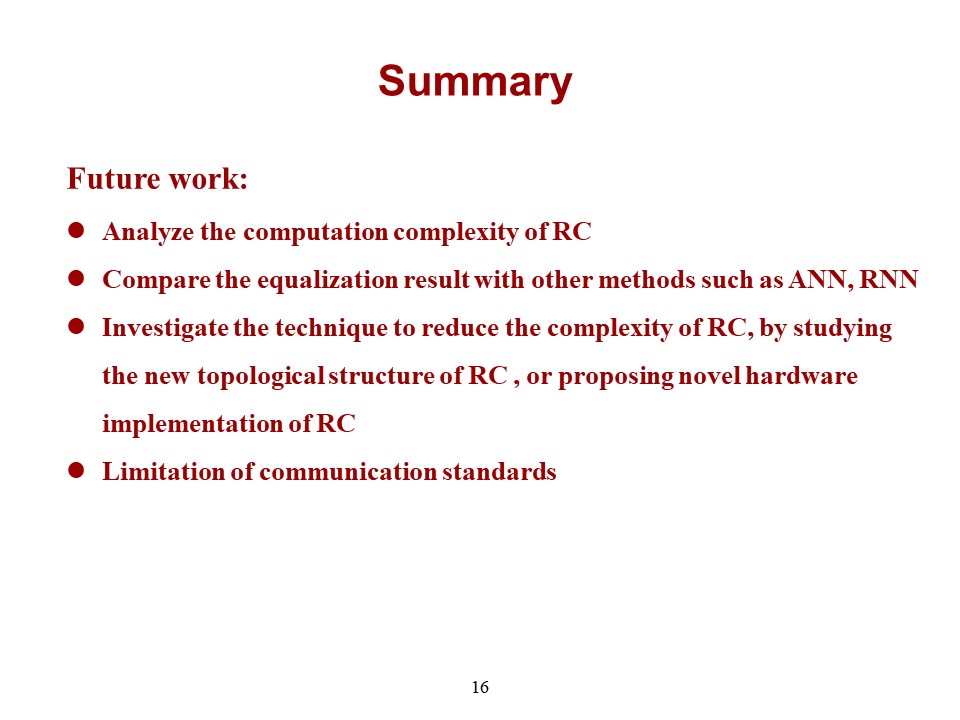 |
In our future work, we will analyze the computation complexity of RC, and compare the equalization result with other methods such as ANN, RNN. Besides, investigate the technique to reduce the complexity of RC, by studying the new topological structure of RC, or proposing novel hardware implementation of RC. Limitation of communication standards will also be taken into consideration.
|
|
ICACT20210147 Slide.15
[Big slide for presentation]
|
Chrome Text-to-Speach Click!! |
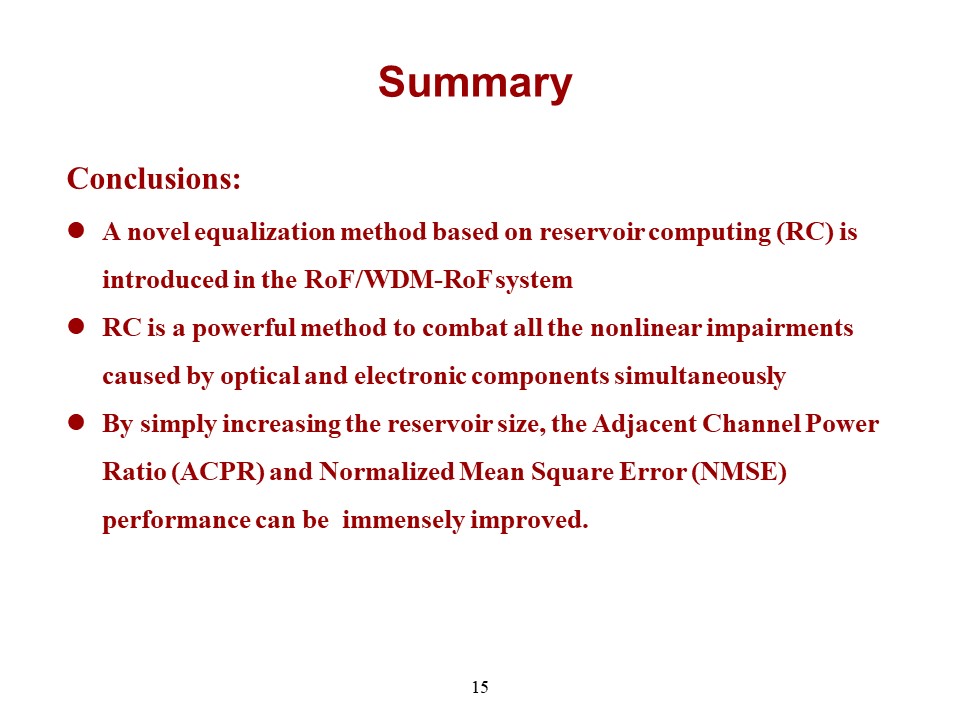 |
So finally I will summarize my talk. Firstly, a novel equalization method based on reservoir computing (RC) is introduced in the RoF/WDM-RoF system. Secondly, RC is a powerful method to combat all the nonlinear impairments caused by optical and electronic components simultaneously. Thirdly, by simply increasing the reservoir size, the Adjacent Channel Power Ratio (ACPR) and Normalized Mean Square Error (NMSE) performance can be immensely improved.
|
|
ICACT20210147 Slide.14
[Big slide for presentation]
|
Chrome Text-to-Speach Click!! |
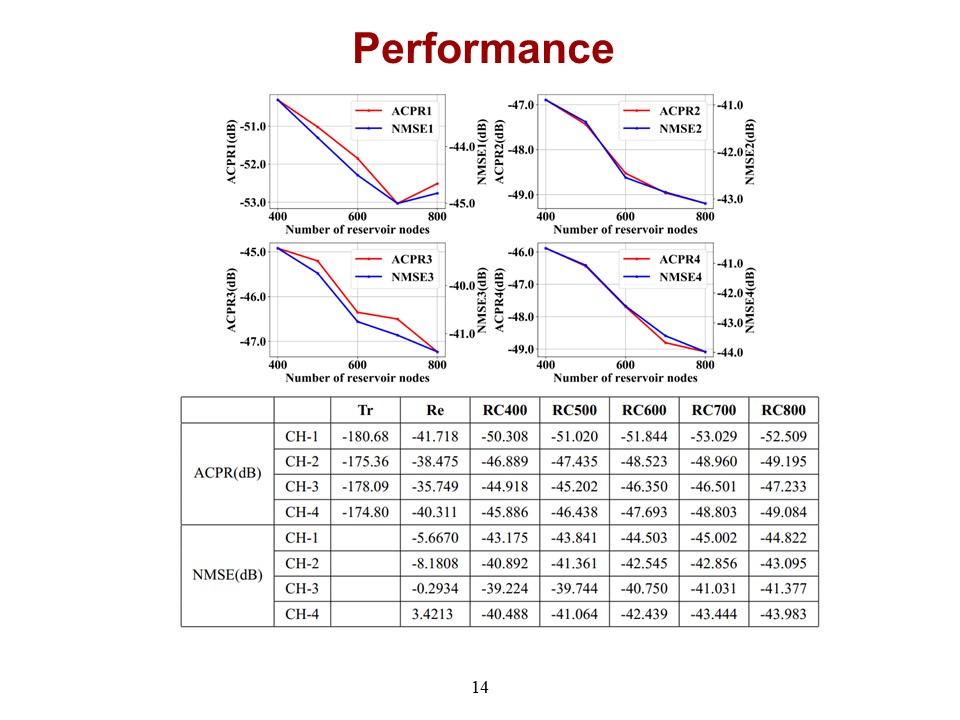 |
We also study the influence that reservoir size makes on the equalization performance. We can see the ACPR has roughly positive relationship with NMSE. When ranging from 400 to 700, ACPR/NMSE of each channel is positively related with the reservoir size.
|
|
ICACT20210147 Slide.13
[Big slide for presentation]
|
Chrome Text-to-Speach Click!! |
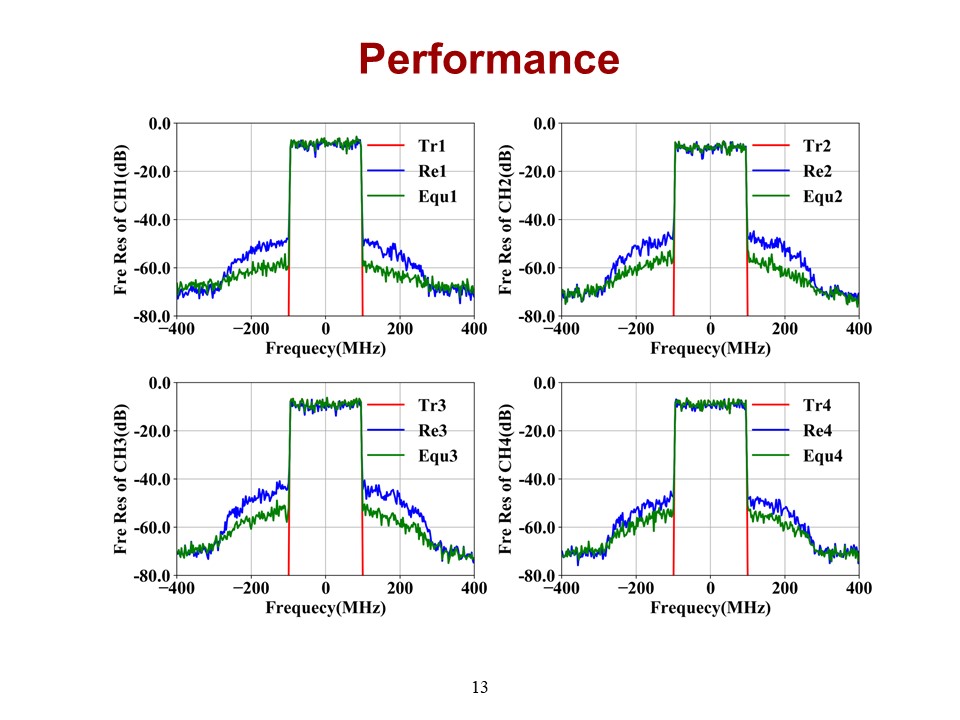 |
For the WDM-RoF system with four wavelength, for each carrier, the ACPR gains are about 9.3 dB, 9 dB, 9.4 dB, 6 dB, respectively after the equalization by RC with 500 reservoir nodes.
|
|
ICACT20210147 Slide.12
[Big slide for presentation]
|
Chrome Text-to-Speach Click!! |
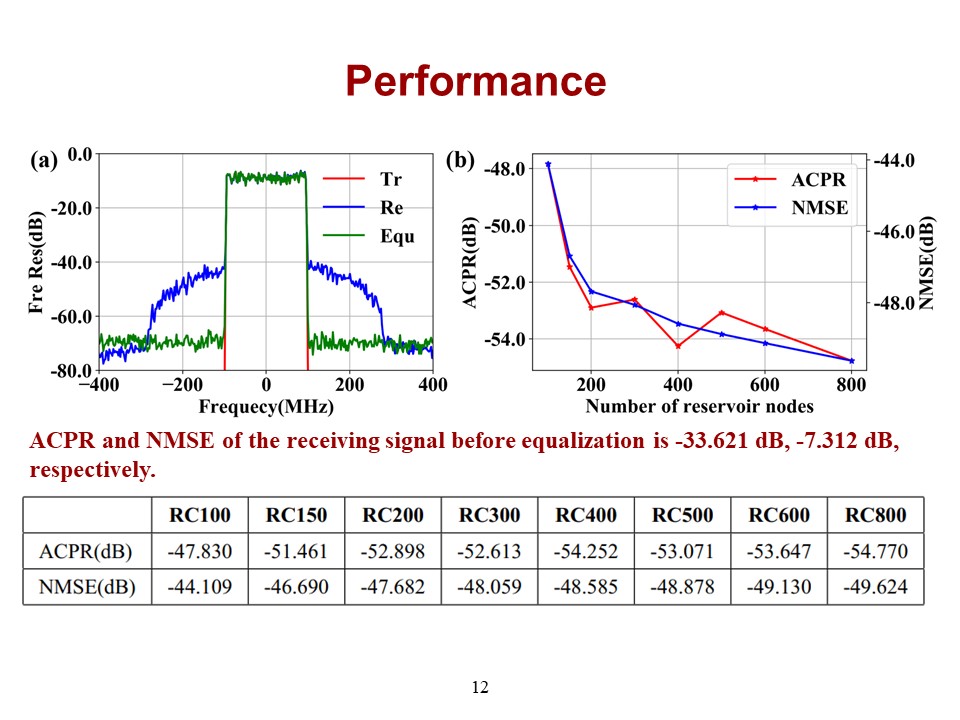 |
For the RoF system, the RC with 200 nodes is used to perform the equalization. The ACPR and NMSE value of the transmitting data before equalization is -33.62 dB, -7.31 dB, respectively. After equalization, ACPR and NMSE decreases to 42.898 dB and 47.682 dB, obtaining 9.277 dB gain and 40.377 dB gain separately. We also investigate the performance of the equalization on the size of the reservoir, while keeping other hyper parameters fixed. We can see that by simple increasing the reservoir size, the ACPR/NMSE gain performance can be adjusted easily. Here, Tr means transmitting signal, Re means receiving signal, Equ means transmitting signal after equalization by RC.
|
|
ICACT20210147 Slide.11
[Big slide for presentation]
|
Chrome Text-to-Speach Click!! |
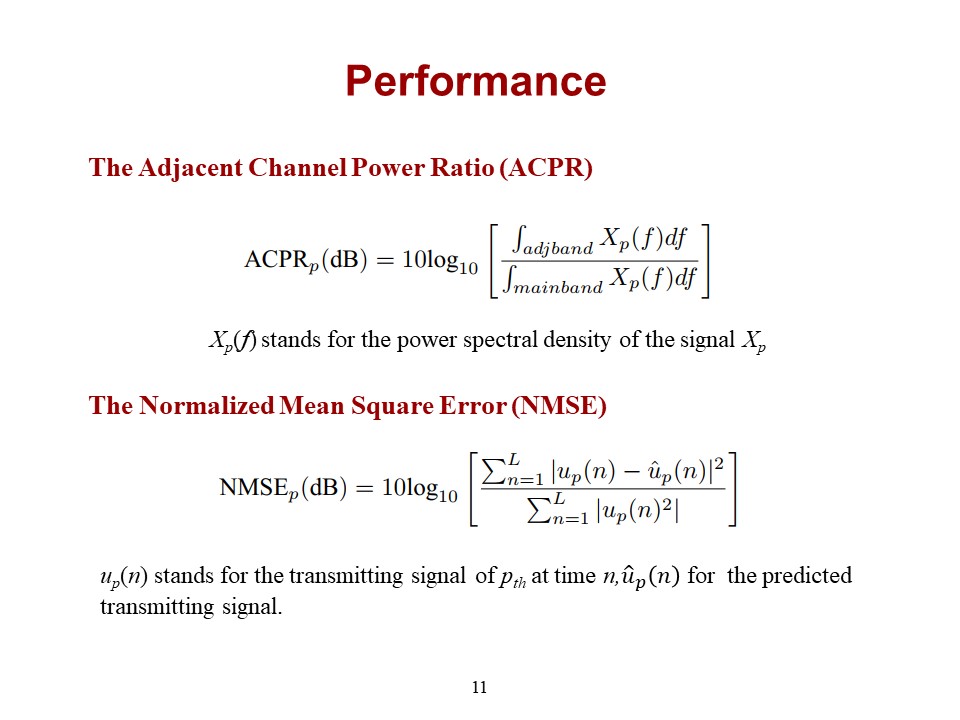 |
In order to evaluate the equalization performance, the adjacent channel power ratio, namely ACPR, and Normalized Mean Square Error, namely NMSE, are used as evaluation criteria.
|
|
ICACT20210147 Slide.10
[Big slide for presentation]
|
Chrome Text-to-Speach Click!! |
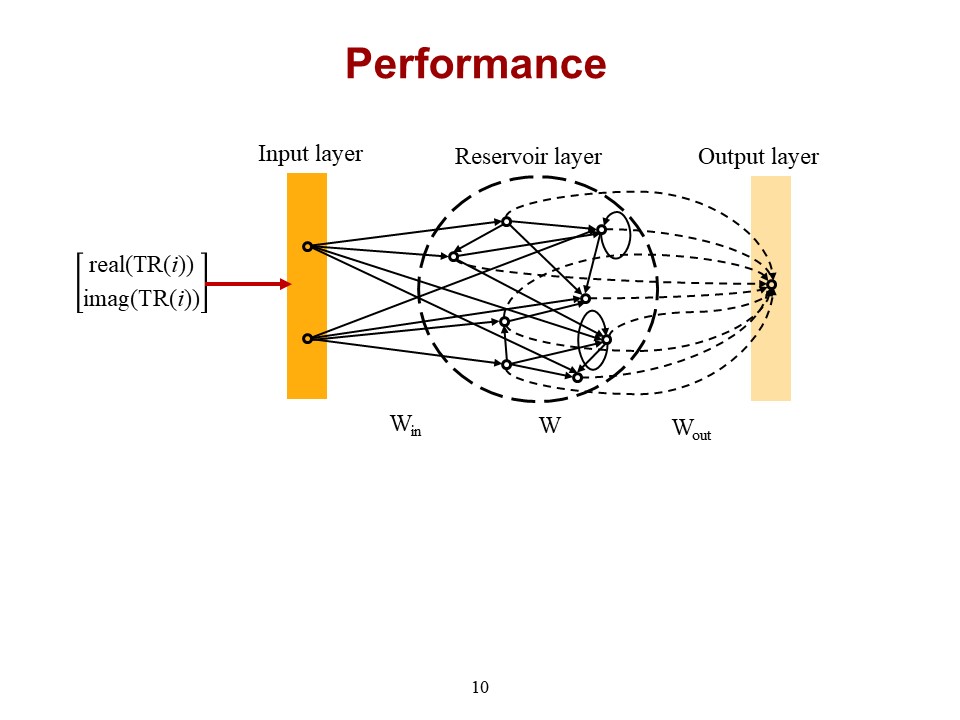 |
Using the VPI verification system, we can get the transmitting data and the receiving data. For the proposed RC equalization method, transmitting data is regarded as the ground truth, while the receiving data is regarded as the distorted signal. In the training phase, RC works as a black box to find the relationship between the transmitting data and the receiving data. For RC can only handle the real number, each complex receiving data is divided into a column vector by concatenating its real part and imaginary part. These operation is also used in the transmitting data. Half of the transmitting data are utilized in the training phase. Input scaling of Win, spectral radius of W, and leaking rate α, and the regularization coefficient are four main hyper parameters to optimize the performance of the RC, thus these parameters are finely tuned in the train process of RC by using the grid search. In the test phase, transmitting data is injected to the state upgrade equation stepwise to get the corresponding reservoir state. By multiplying the Wout obtained in the training phase, we can get the predicted transmitting signal.
|
|
ICACT20210147 Slide.09
[Big slide for presentation]
|
Chrome Text-to-Speach Click!! |
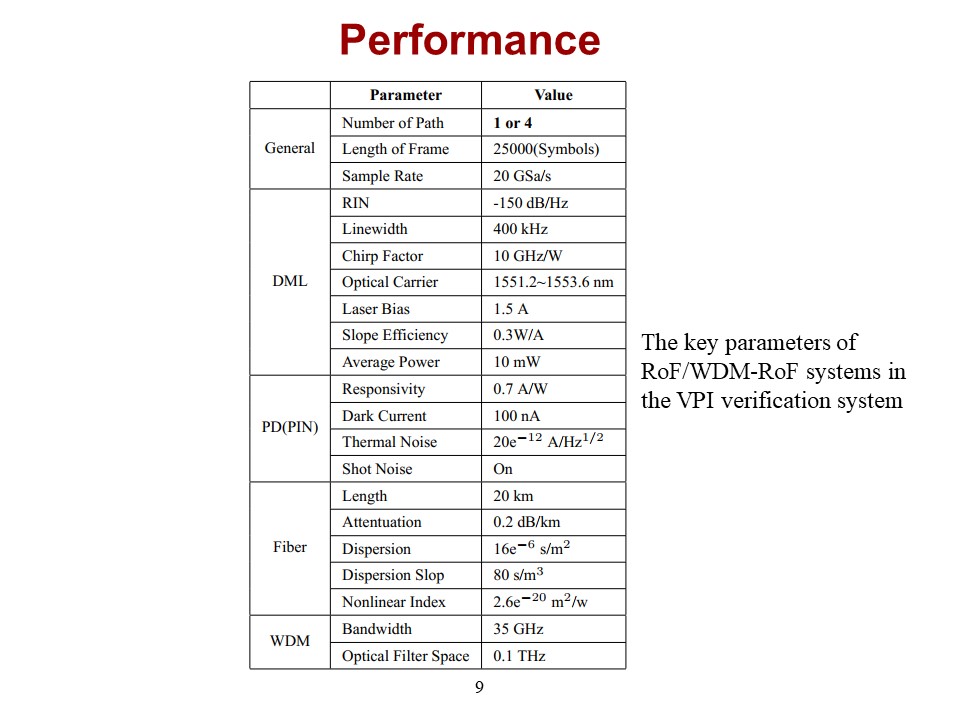 |
The key parameters of the VPI verification systems are presented in this table.
|
|
ICACT20210147 Slide.08
[Big slide for presentation]
|
Chrome Text-to-Speach Click!! |
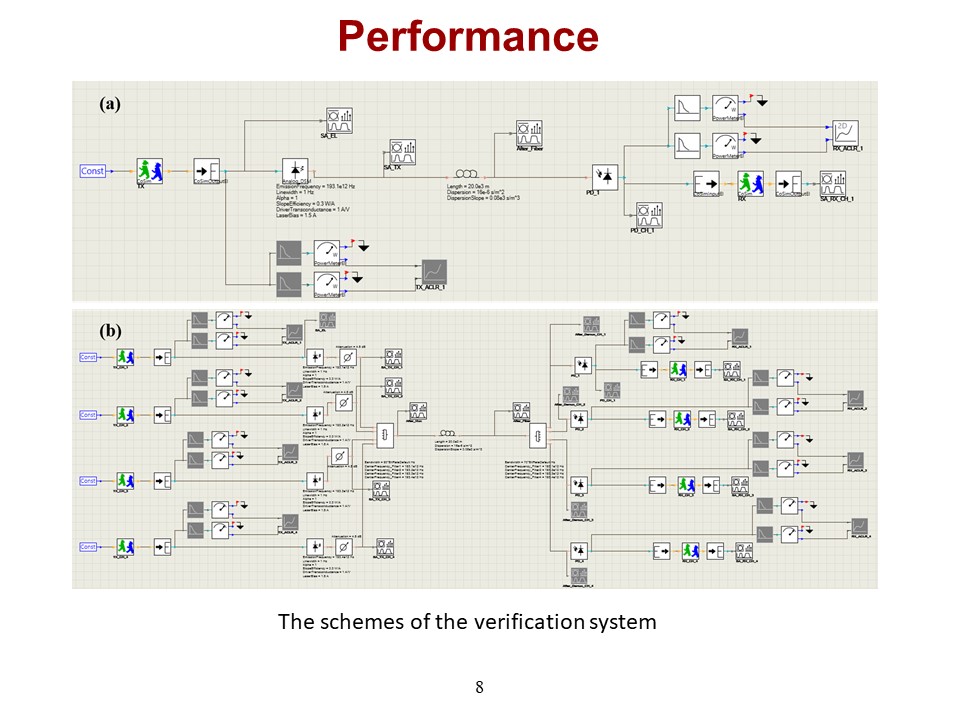 |
In order to demonstrate the proposed equalization method, we build a verification system based on VPI photonics design suite. The directly modulated laser, namely DML, fiber, PD and so on, are simulated by the VPI. The wavelength of the optical carrier is between 1551.2 nm and 1553.6 nm. For the RoF system, one wavelength is used. For the WDM-RoF system, four wavelengths are used. The Orthogonal Frequency Division Multiplexing signal, namely OFDM signals are generated by using the Octave.
|
|
ICACT20210147 Slide.07
[Big slide for presentation]
|
Chrome Text-to-Speach Click!! |
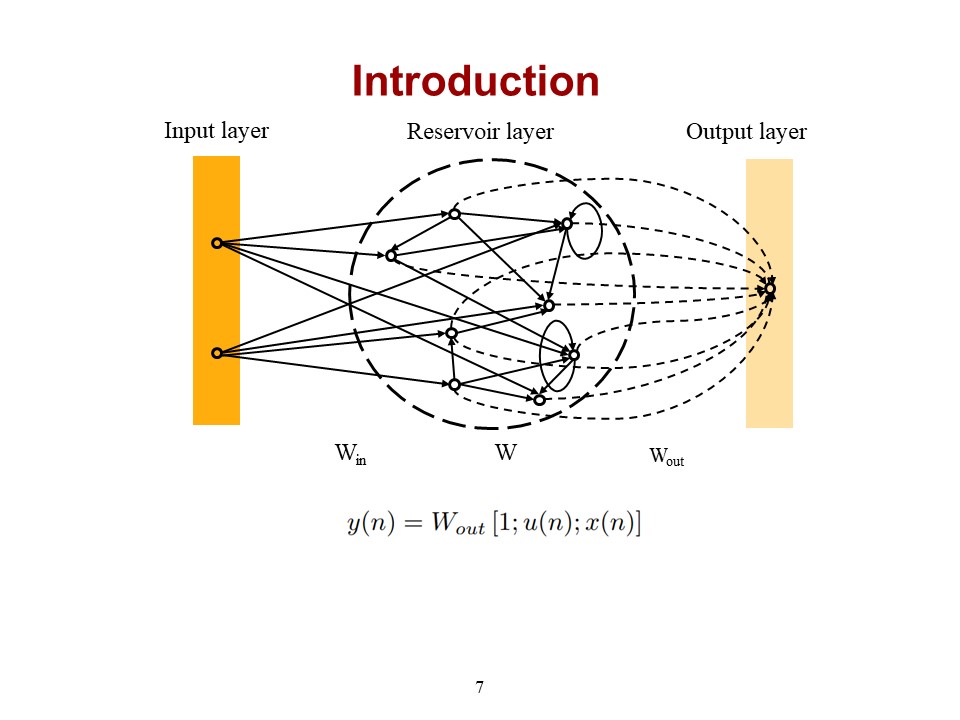 |
In the test phase of RC, test temporal data is injected into the state update equation, and acquire the corresponding state. Then using the Wout obtained in the training phase, we can get the predicted output.
|
|
ICACT20210147 Slide.06
[Big slide for presentation]
|
Chrome Text-to-Speach Click!! |
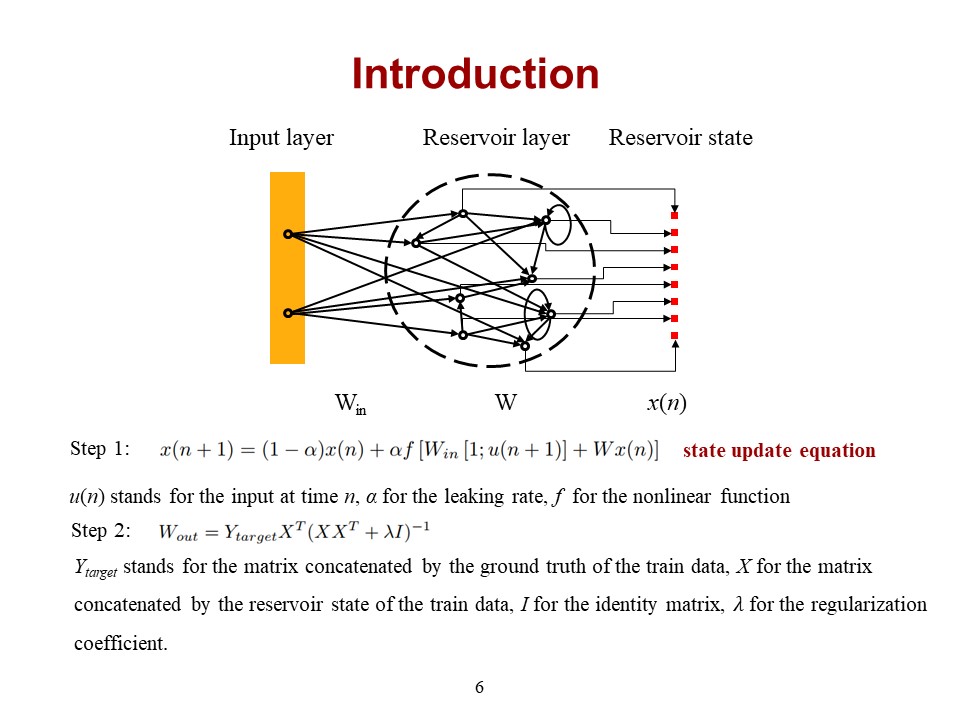 |
The training phase of RC can be divided into two steps. In step 1, temporal training data is injected into the state update equation to obtain the corresponding reservoir state stepwise. In the state update equation, u(n) stands for the input at time n, α for the leaking rate, f for the nonlinear function, x(n) for the reservoir state. In step 2, we use the reservoir state collected in step 1 and the corresponding ground truth to calculate the weights between the reservoir layer and the output layer. Ridge regression is used here to avoid over fitting.
|
|
ICACT20210147 Slide.05
[Big slide for presentation]
|
Chrome Text-to-Speach Click!! |
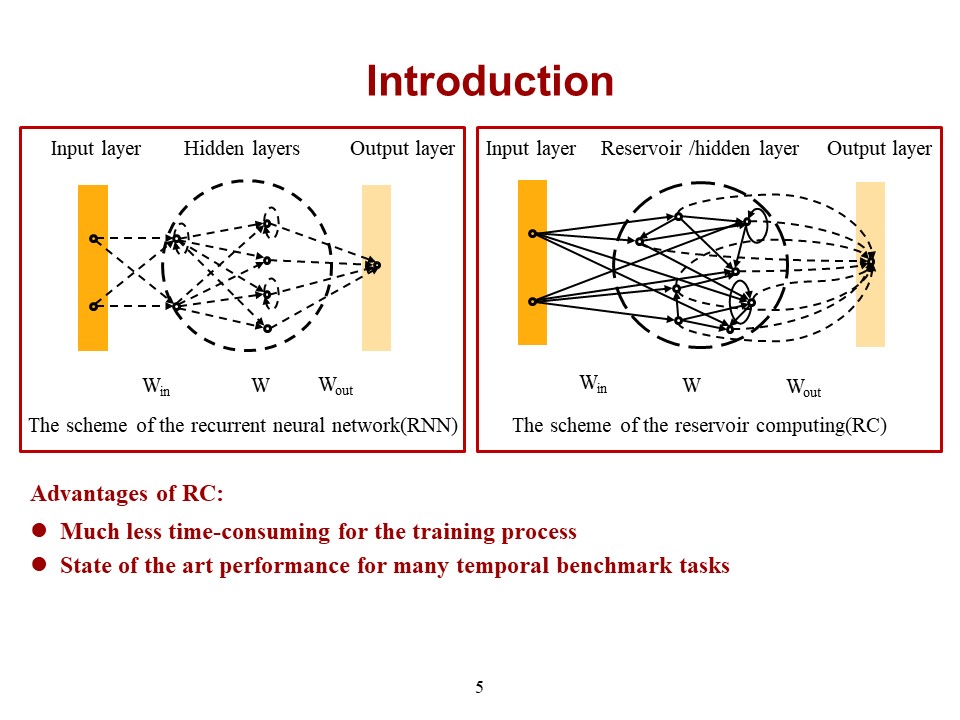 |
Recently, recurrent neural network, namely RNN, is used to mitigate the nonlinear impairment of channel, and achieve good performance. However, the training process of RNN is always time-consuming and inherently difficult though with high performance computing devices like field programmable gate arrays (FPGAs) and graphics processing units (GPUs), which may hinder it application in on site use. Reservoir computing, namely RC, is a novel computational framework, which can be regarded as a special RNN. RC consists of three layers: input layer, reservoir layer, and output layer. Different from traditional RNN, the weights between the input layer and reservoir layer, and the weights inside the reservoir layer are fixed. Only the weights between the reservoir layer and the output layer need to be trained in the training process, which greatly reduce the difficulty and time cost of training phase. More importantly, RC has achieved the state of the art performance for many temporal benchmark tasks.
|
|
ICACT20210147 Slide.04
[Big slide for presentation]
|
Chrome Text-to-Speach Click!! |
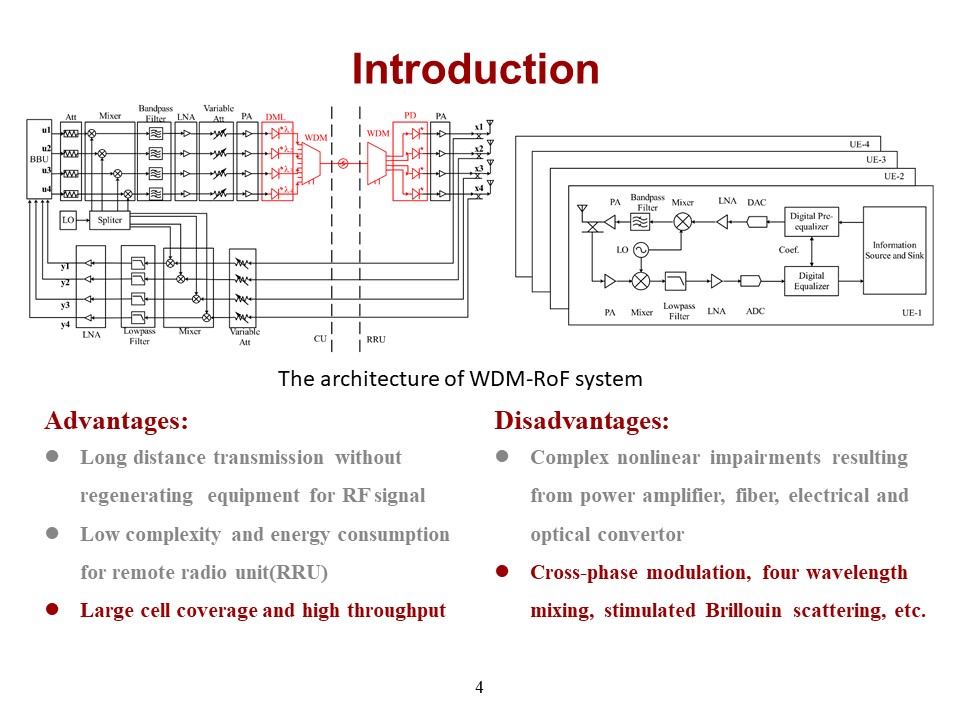 |
Wavelength division multiplexing technique is combined with RoF system, to further enhance the cell coverage and throughput. However, this also result in more complex nonlinear impairment, such as cross-phase modulation, four wavelength mixing, and so on.
|
|
ICACT20210147 Slide.03
[Big slide for presentation]
|
Chrome Text-to-Speach Click!! |
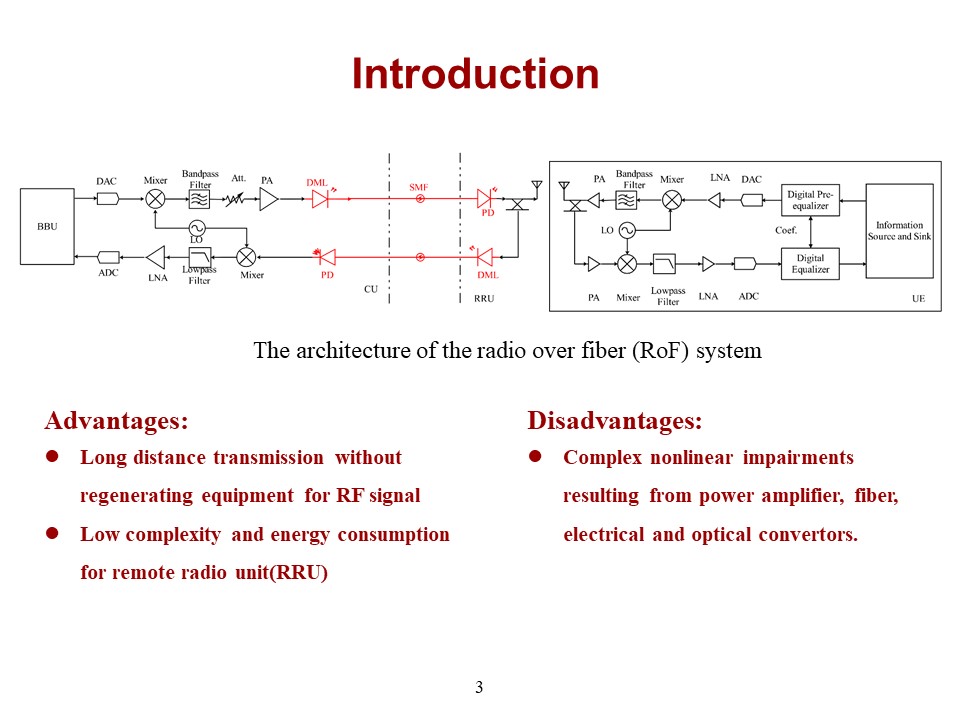 |
The radio over fiber network is a promising technique for providing broadband and high capacity wireless communication services. Due to the low attenuation of fiber, the radio frequency signals can be delivered from the central unit, namely CU, to the remote radio unit, namely RRU over long distance without using regenerating equipment. Meanwhile, the complexity and energy consumption are greatly reduced in the RRU. However, the radio over fiber system suffers from complex nonlinear impairments resulting from power amplifier, fiber, electrical and optical convertors, which should be mitigated.
|
|
ICACT20210147 Slide.02
[Big slide for presentation]
|
Chrome Text-to-Speach Click!! |
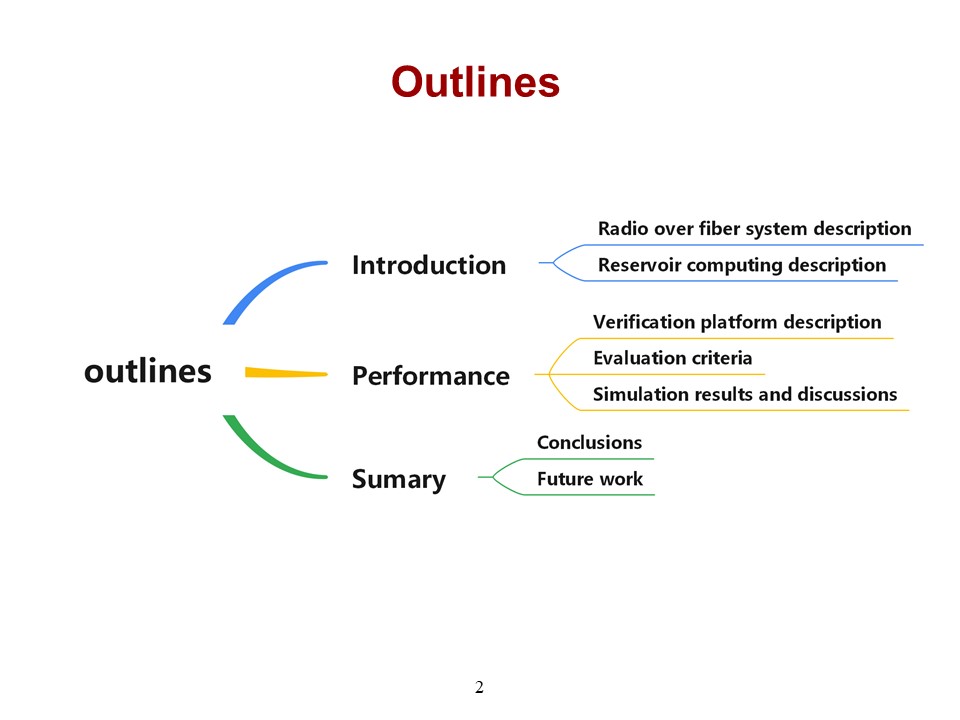 |
This presentation consists of three sections. In the Introduction section, we will describe the radio over fiber system, that is, RoF system and the reservoir computing. In the Performance section, we firstly depict the verification platform based on VPI photonics design suite. And then we explain the proposed RC equalization method and the evaluation criteria of the equalization result. Finally, we show the simulation results of the RC equalization and corresponding discussions. In the summary section, we draw the conclusions and talk about the future work.
|
|
ICACT20210147 Slide.01
[Big slide for presentation]
|
Chrome Text-to-Speach Click!! |
 |
Hello, everyone, I am Jingwei Li, a senior engineer in Central Research Institute of Huawei. Today I will talk about Reservoir Computing Based Equalization for Radio over Fiber System. In this work, we try to mitigate the nonlinear impairments of the wavelength division multiplexing (WDM) radio over fiber system by using reservoir computing.
|