ICACT20240469 Slide.00
[Big Slide]
[YouTube] ICACT20240469 Slide.00
[Big Slide]
[YouTube] |
Chrome  Click!! Click!! |
 |
Hello everyone, I am Suya Li, a graduate student from Henan University in China. My research focuses on reviewing the multi-target tracking related to detection in recent years. Below, I will briefly introduce multi-target tracking and introduce our paper from the aspects of object detection, multi-target tracking algorithms, datasets, applications. |
| ICACT20240469 Slide.01
[Big Slide]
[YouTube] |
Chrome Click!! |
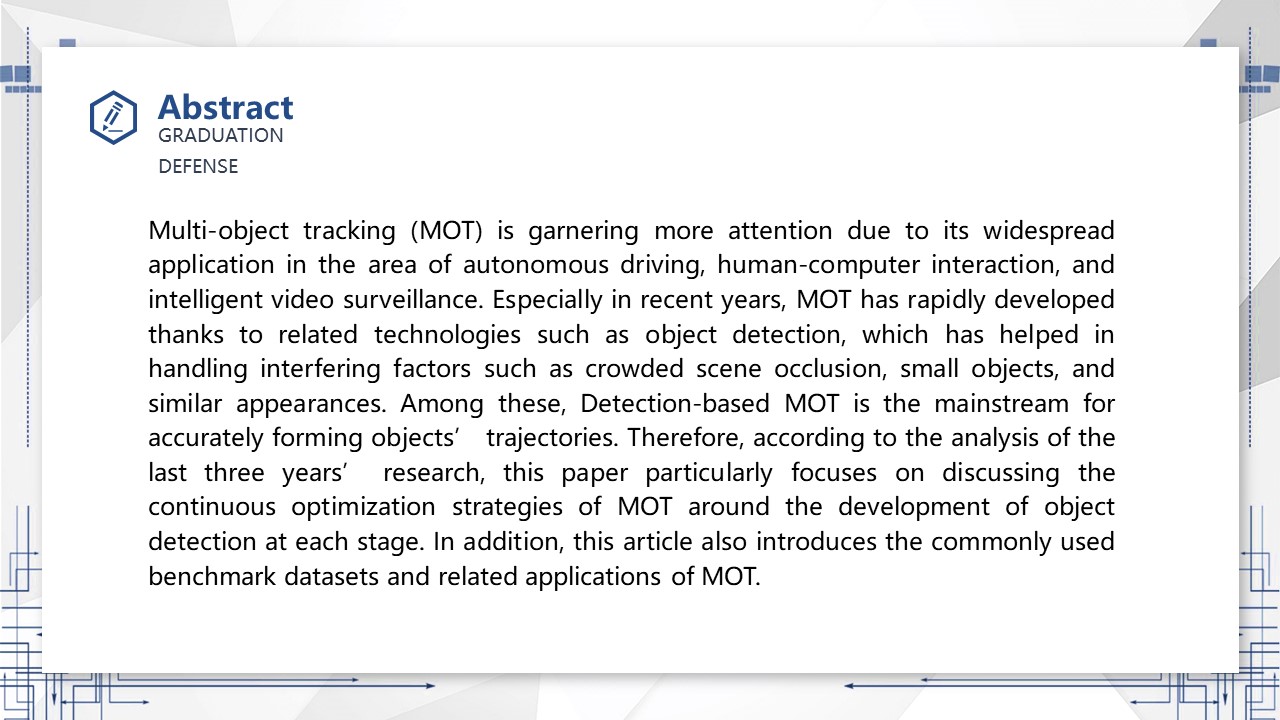 |
Multi-object tracking (MOT) is garnering more attention due to its widespread application in the area of autonomous driving, human-computer interaction, and intelligent video surveillance. Especially in recent years, MOT has rapidly developed thanks to related technologies such as object detection, which has helped in handling interfering factors such as crowded scene occlusion, small objects, and similar appearances. Among these, Detection-based MOT is the mainstream for accurately forming objects’ trajectories. Therefore, according to the analysis of the last three years’ research, this paper particularly focuses on discussing the continuous optimization strategies of MOT around the development of object detection at each stage. In addition, this article also introduces the commonly used benchmark datasets and related applications of MOT.
|
| ICACT20240469 Slide.02
[Big Slide]
[YouTube] |
Chrome Click!! |
 |
Our contributions are mainly divided into four categories:
1) The development summary of standard object detection algorithms used in MOT;
2) The list of tracking-by-detection and joint detection and tracking MOT approaches;
3) The overview of MOT datasets;
4) The exploration of various applications. |
| ICACT20240469 Slide.03
[Big Slide]
[YouTube] |
Chrome Click!! |
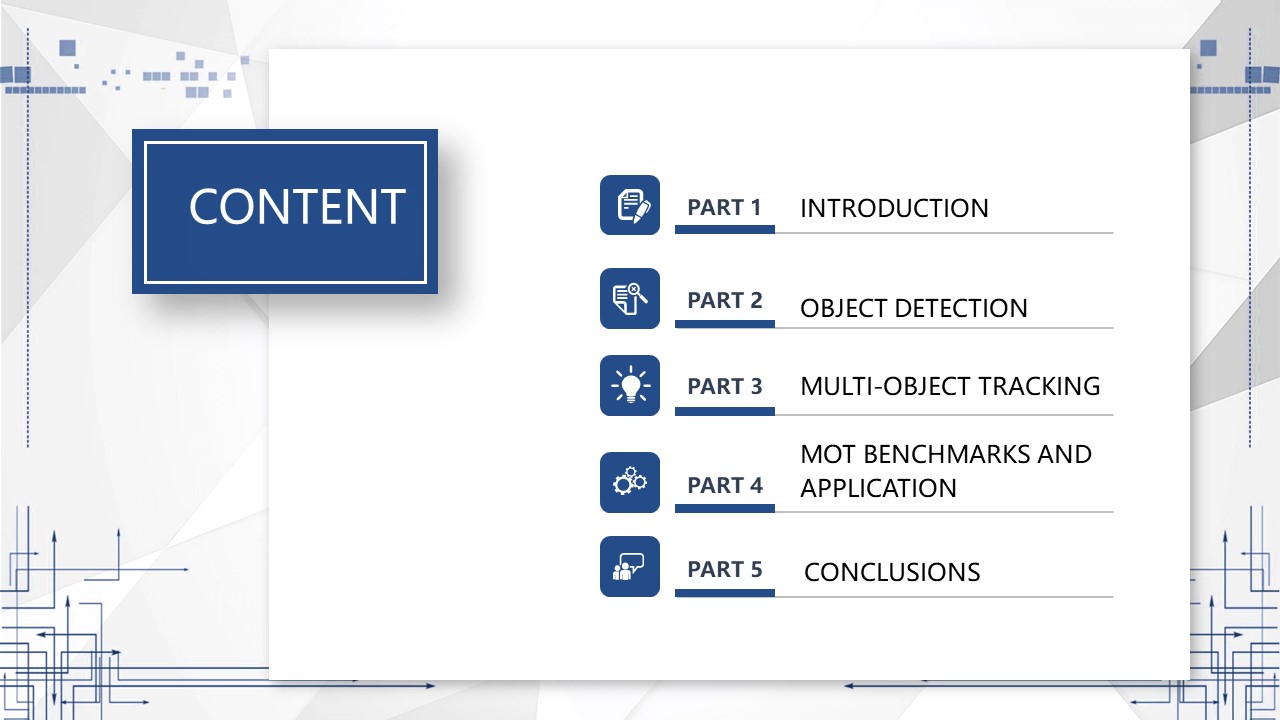 |
Below, I will introduce from the following aspects. |
| ICACT20240469 Slide.04
[Big Slide]
[YouTube] |
Chrome Click!! |
 |
Part 1:INTRODUCTION
|
| ICACT20240469 Slide.05
[Big Slide]
[YouTube] |
Chrome Click!! |
 |
With the development of Deep-learning(DL)-based Multi-object tracking (MOT), it has been widely utilized in many related real-life problems like Intelligent transportation, Video surveillance, autonomous driving, human-computer interaction. These applications also highlight the important academic significance of MOT. To accomplish the task of MOT, a common way is locating objects' position frame per frame first and associating them inter frames then. There, the tracking objects could be anything such as pedestrians, sports players, birds, dogs, vehicles, or all of the above. |
| ICACT20240469 Slide.06
[Big Slide]
[YouTube] |
Chrome Click!! |
 |
Part 2: OBJECT DETECTION
|
| ICACT20240469 Slide.07
[Big Slide]
[YouTube] |
Chrome Click!! |
 |
We illustrate the developmental timeline of object detection, dividing it into the traditional and deep learning eras. Within deep learning, object detection algorithms have evolved into two main technical approaches: Anchor-based methods and Anchor-free methods. Anchor-based methods further branch into one-stage and two-stage approaches. In the paper, I elaborate on the development and technical characteristics of these methods. Through this exploration of object detection methods, we gain a deeper understanding of detection-related multiple object tracking. |
| ICACT20240469 Slide.08
[Big Slide]
[YouTube] |
Chrome Click!! |
 |
Part 3: MULTI-OBJECT TRACKING
|
| ICACT20240469 Slide.09
[Big Slide]
[YouTube] |
Chrome Click!! |
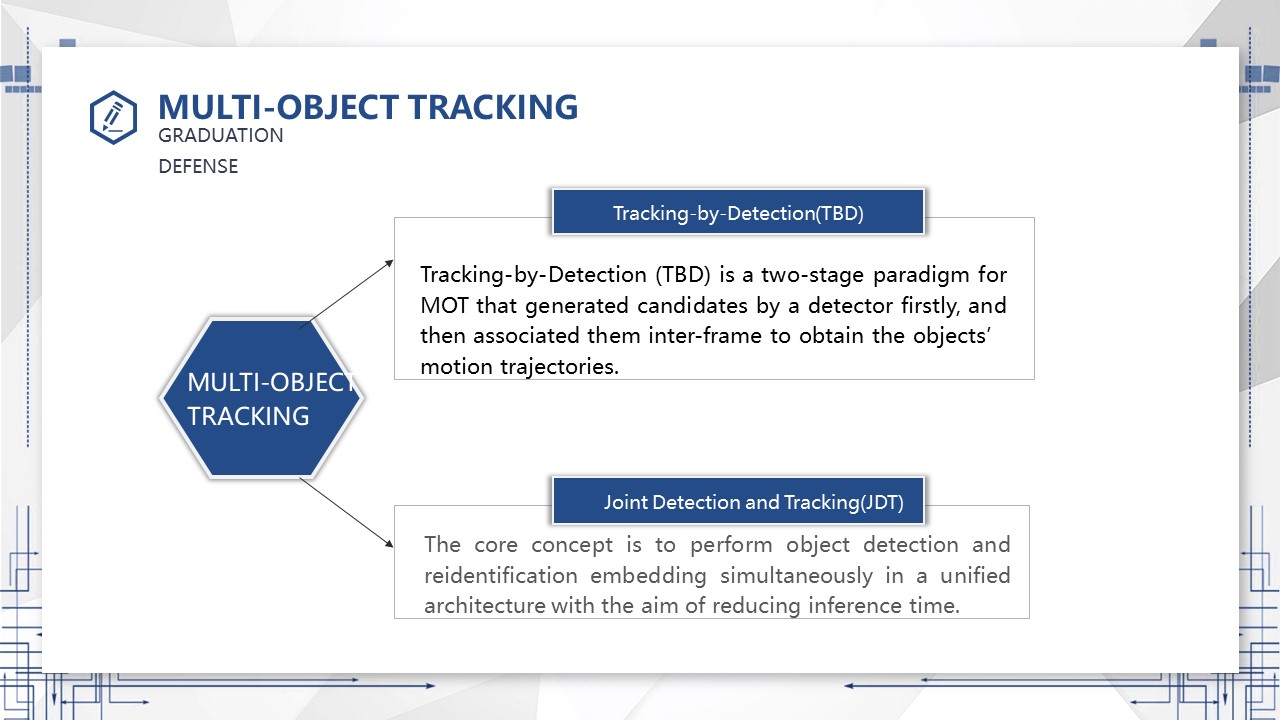 |
This part focuses on MULTI-OBJECT TRACKING, where we introduce algorithms related to multi-object tracking. We categorize multi-object tracking into Tracking-by-Detection and Joint Detection and Tracking. Tracking-by-Detection is a two-stage paradigm for MOT, where candidates are generated by a detector first and then associated inter-frame to obtain object motion trajectories. On the other hand, Joint Detection and Tracking aim to perform object detection and reidentification embedding simultaneously in a unified architecture to reduce inference time. |
| ICACT20240469 Slide.10
[Big Slide]
[YouTube] |
Chrome Click!! |
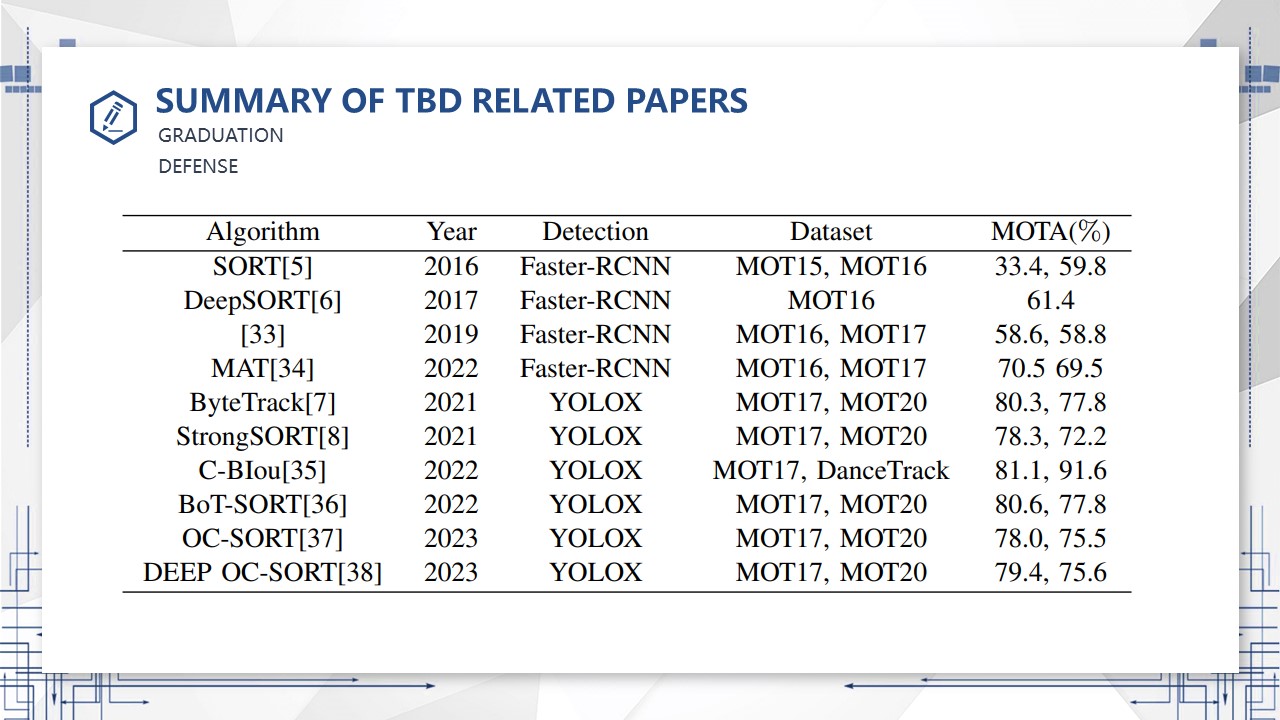 |
In the paper, we provide an overview and analysis of methods that have emerged in recent years for both approaches. Firstly, we will analyze the multi-target tracking methods of Tracking by Detection in recent years. The relevant algorithms we introduced include SORT, DeepSORT, MAT, ByteTrack, StrongSORT, C-BIOU, BoT SORT, OC SORT, DEEP OC SORT. We will sort out and analyze the characteristics of each method separately, and summarize and compare the detectors, datasets, and data indicators used by each method on the dataset. Furthermore, comprehensively analyze and compare the characteristics and effects of various methods. |
| ICACT20240469 Slide.11
[Big Slide]
[YouTube] |
Chrome Click!! |
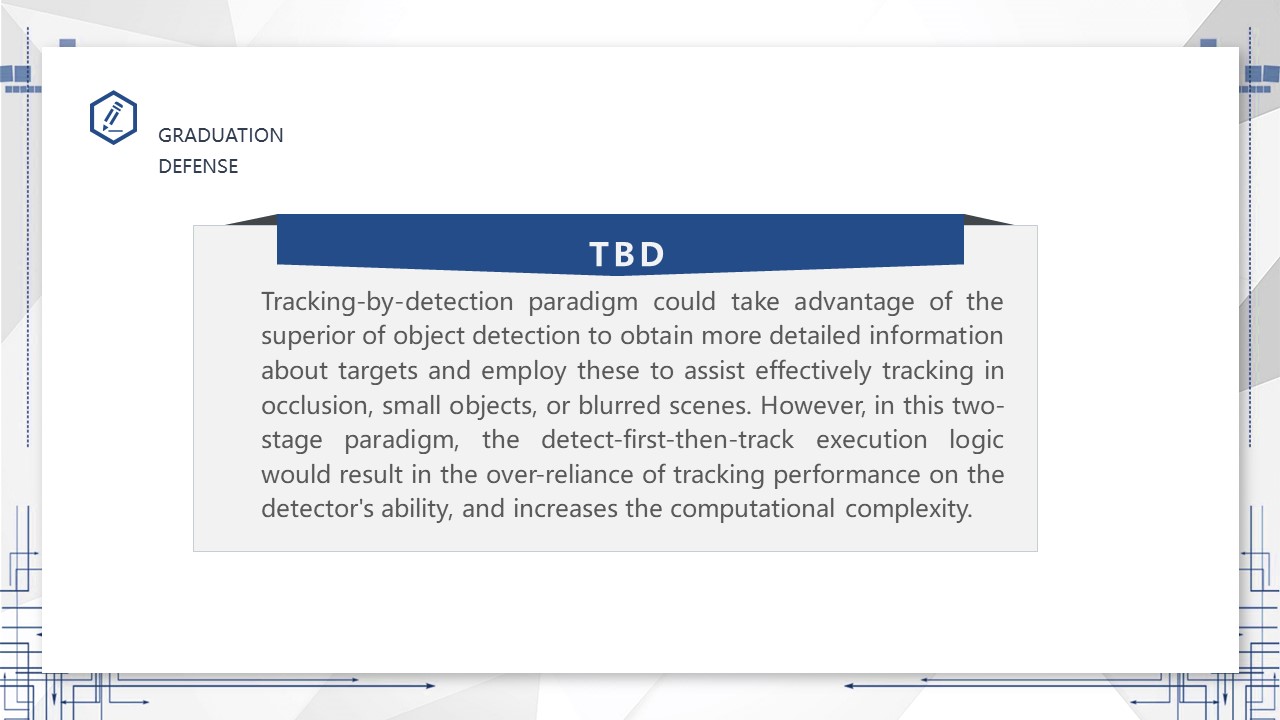 |
Tracking-by-detection paradigm could take advantage of the superior of object detection to obtain more detailed information about targets and employ these to assist effectively tracking in occlusion, small objects, or blurred scenes. However, in this two-stage paradigm, the detect-first-then-track execution logic would result in the over-reliance of tracking performance on the detector's ability, and increases the computational complexity. |
| ICACT20240469 Slide.12
[Big Slide]
[YouTube] |
Chrome Click!! |
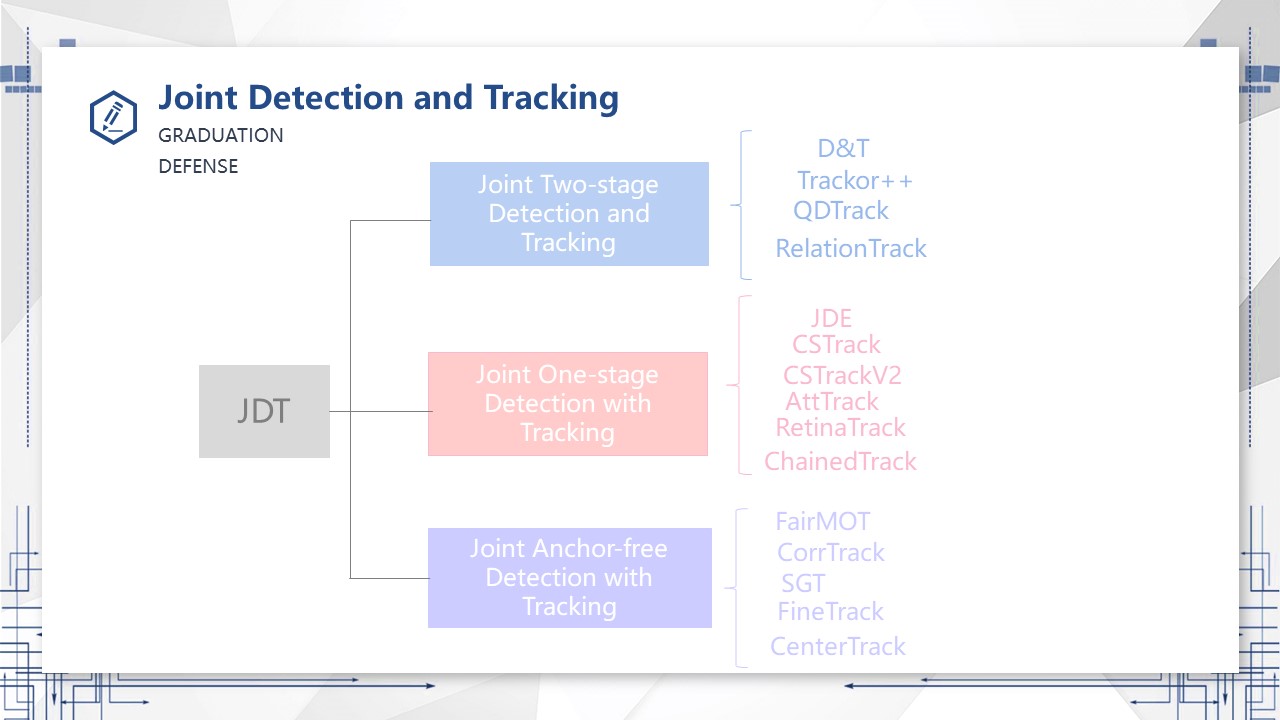 |
For the Joint Detection and Tracking method, we divided it into three types based on the different joint detectors: Joint Two stage Detection and Tracking, Joint One stage Detection with Tracking, and Joint Anchor free Detection with Tracking. We analyzed and summarized the relevant methods of each method. |
| ICACT20240469 Slide.13
[Big Slide]
[YouTube] |
Chrome Click!! |
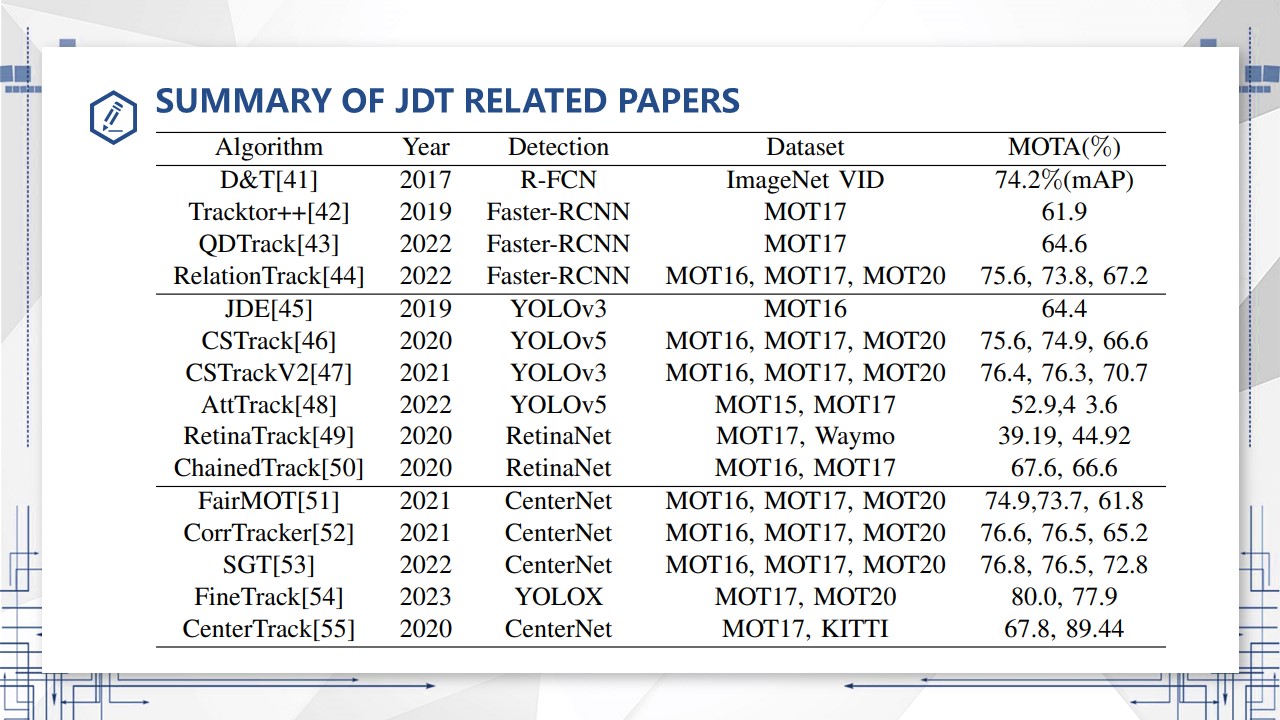 |
Similarly, we also analyzed the multi-target tracking methods of Joint Detection and Tracking in recent years. The relevant algorithms we introduced include D&T, Trackor++, QDTrack, RelationTrack, JDE, CSTrackV2, AttTrack, RetinaTrack, ChainedTrack, FairMOT, CorrTrack, SGT, FineTrack, CenterTrack. We also sorted out and analyzed the characteristics of each method separately, and summarized and compared the detectors, datasets, and data indicators used in each method on the dataset. |
| ICACT20240469 Slide.14
[Big Slide]
[YouTube] |
Chrome Click!! |
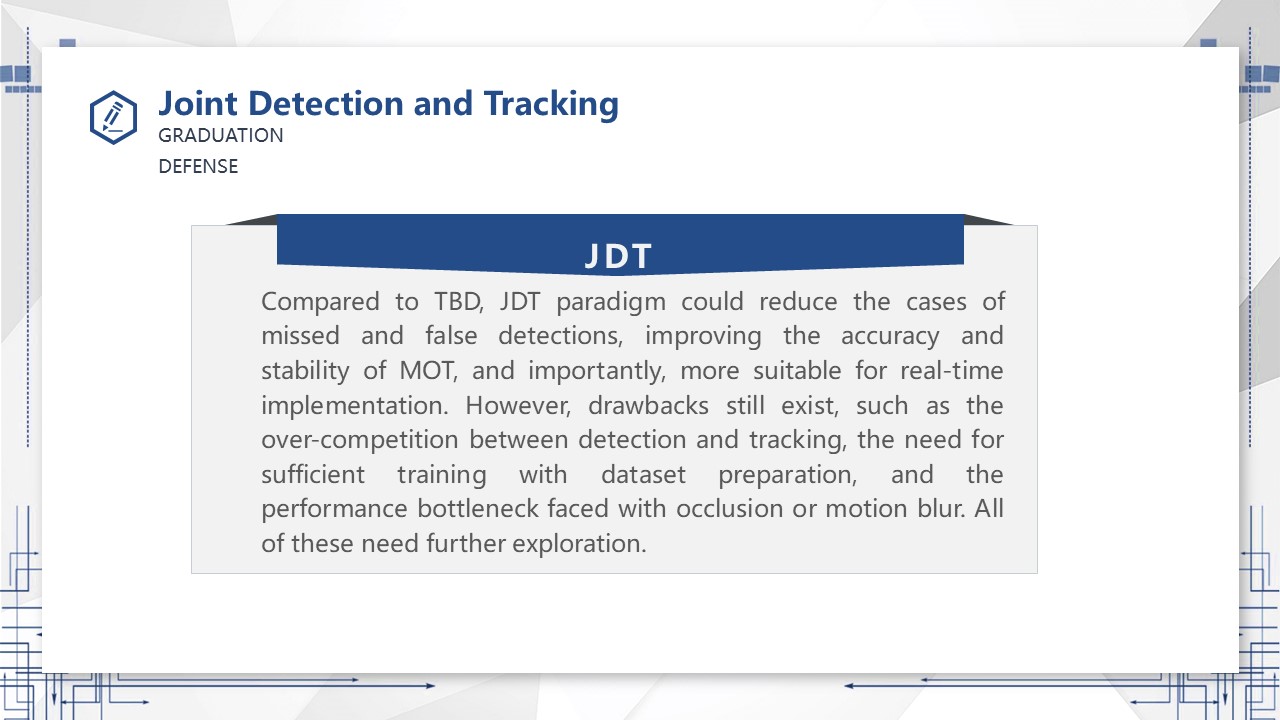 |
Compared to TBD, JDT paradigm could reduce the cases of missed and false detections, improving the accuracy and stability of MOT, and importantly, more suitable for real-time implementation. However, drawbacks still exist, such as the over-competition between detection and tracking, the need for sufficient training with dataset preparation, and the performance bottleneck faced with occlusion or motion blur. All of these need further exploration. |
| ICACT20240469 Slide.15
[Big Slide]
[YouTube] |
Chrome Click!! |
 |
Part4: MOT BENCHMARKS AND APPLICATION
|
| ICACT20240469 Slide.16
[Big Slide]
[YouTube] |
Chrome Click!! |
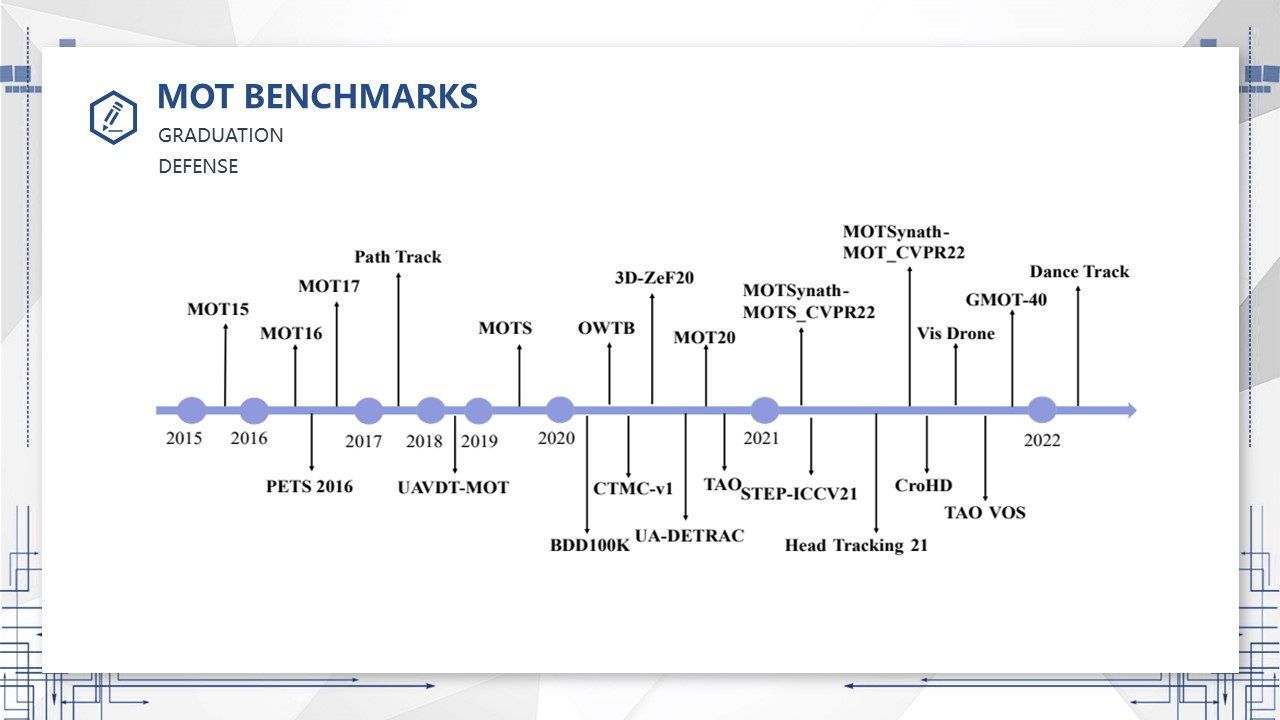 |
In recent years, numerous MOT public datasets have been released by universities, companies, and research teams, their published annotated videos along with unified hypotheses, annotations, and evaluation tools ensure the feasibility of validating MOT schemes and promote the development of MOT. we list the development history of the multi-objective tracking dataset in a timeline manner. |
| ICACT20240469 Slide.17
[Big Slide]
[YouTube] |
Chrome Click!! |
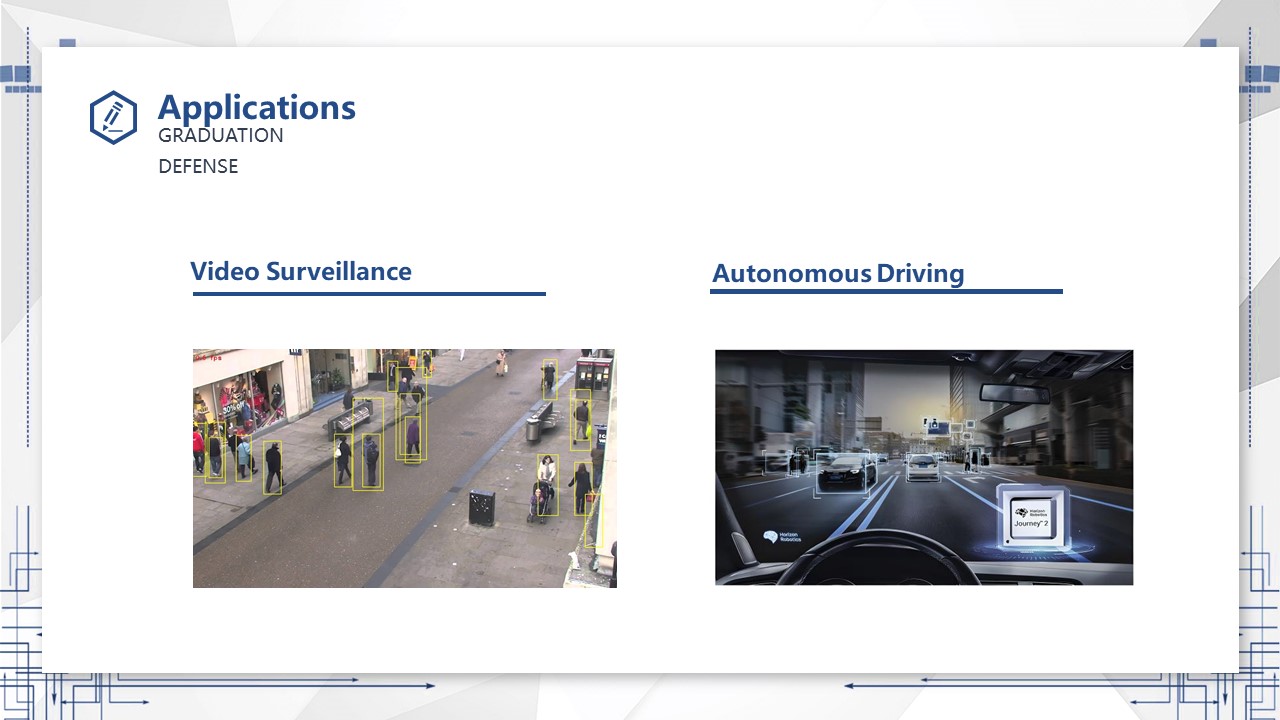 |
Video Surveillance
As one of the primary supporting technologies in video surveillance, MOT can track and analyze the trajectory of pedestrians, vehicles, and other objects in specific areas, providing various intelligent services such as monitoring abnormal behaviors of pedestrians or vehicles, and warning of safety hazards. This technology has played a significant role in enhancing the effectiveness of video surveillance.
Autonomous Driving
MOT is a critical component in the development of autonomous driving technology, it enables autonomous vehicles to effectively predict the subsequent movement of pedestrians, vehicles, or others based on their current trajectories and assist plan their driving paths accordingly. This allows for accurate avoidance of obstacles in the surroundings, preventing collisions and achieving safe, advanced autonomous driving.
|
| ICACT20240469 Slide.18
[Big Slide]
[YouTube] |
Chrome Click!! |
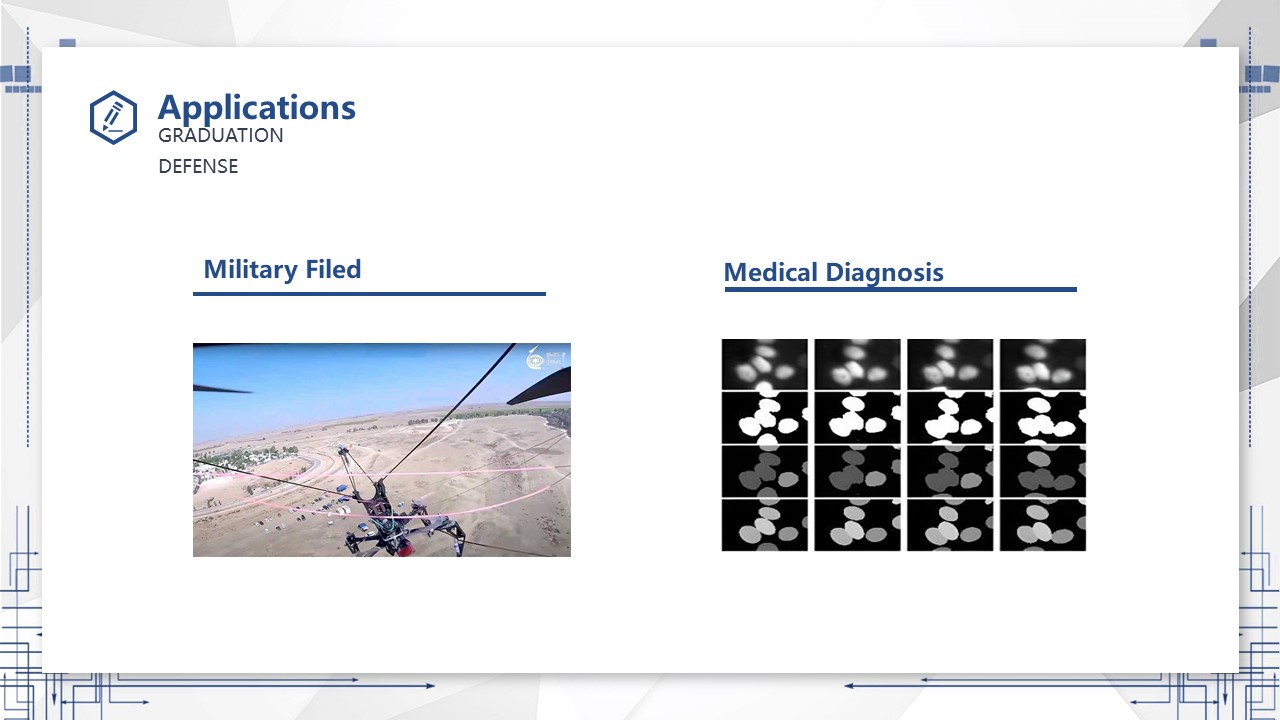 |
Military Filed
As the deployment of unmanned aerial systems (UAS) continues to rise, the demand for effective MOT in aerial surveillance is increasing. Leveraging MOT can enable precise positioning and tacking of enemies and military weapons, thereby significantly enhancing combat efficiency.
Medical Diagnosis MOT can also be used in medical image analysis to perform the tasks such as cell tracking, blood vessel tracking, neuron tracking, and more. This technology can assist doctors in tracking diseases such as tumors and vascular lesions, ultimately enhancing the accuracy of medical diagnoses.
|
| ICACT20240469 Slide.19
[Big Slide]
[YouTube] |
Chrome Click!! |
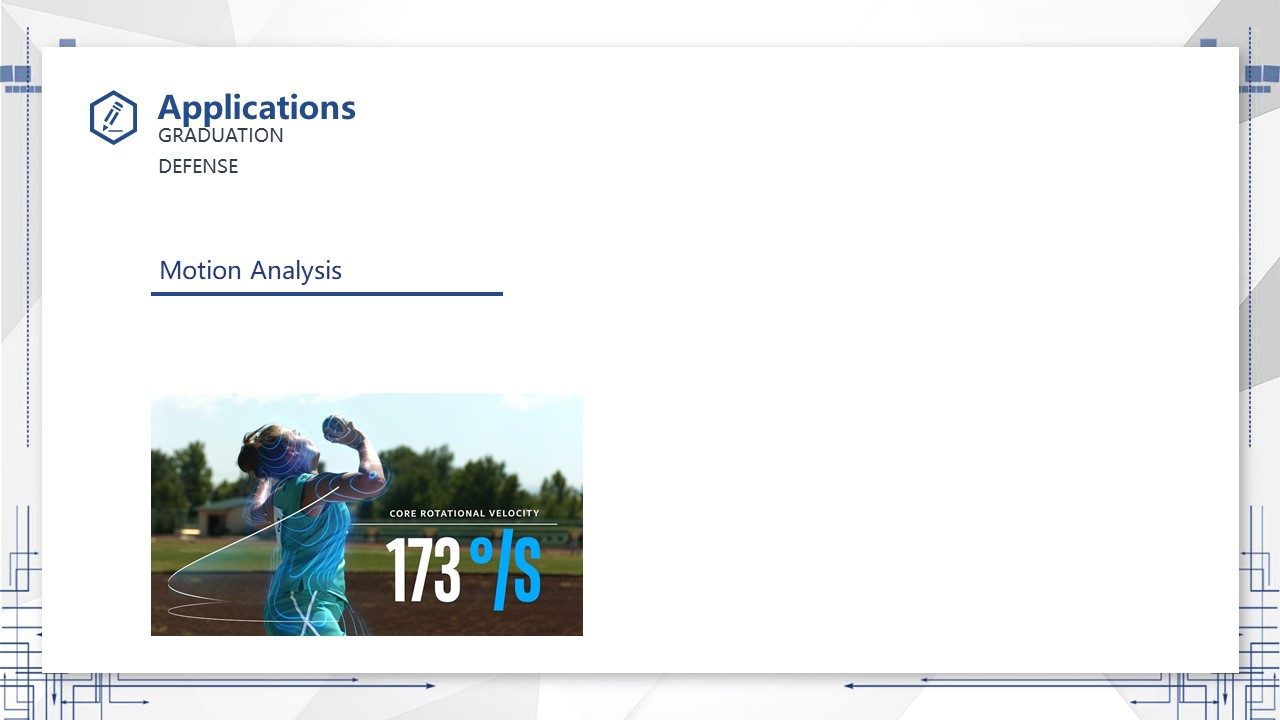 |
motion analysis
MOT is still employed in motion analysis, particularly in sports, by tracking and capturing information on athletes’ positions and movements, this technology can assist in analyzing and tracking athletes; actions and performance, aiding in performance evaluation and the development of effective training plans. Ultimately, leading to improved training outcomes.
|
| ICACT20240469 Slide.20
[Big Slide]
[YouTube] |
Chrome Click!! |
 |
Part5:CONCLUSIONS
|
| ICACT20240469 Slide.21
[Big Slide]
[YouTube] |
Chrome Click!! |
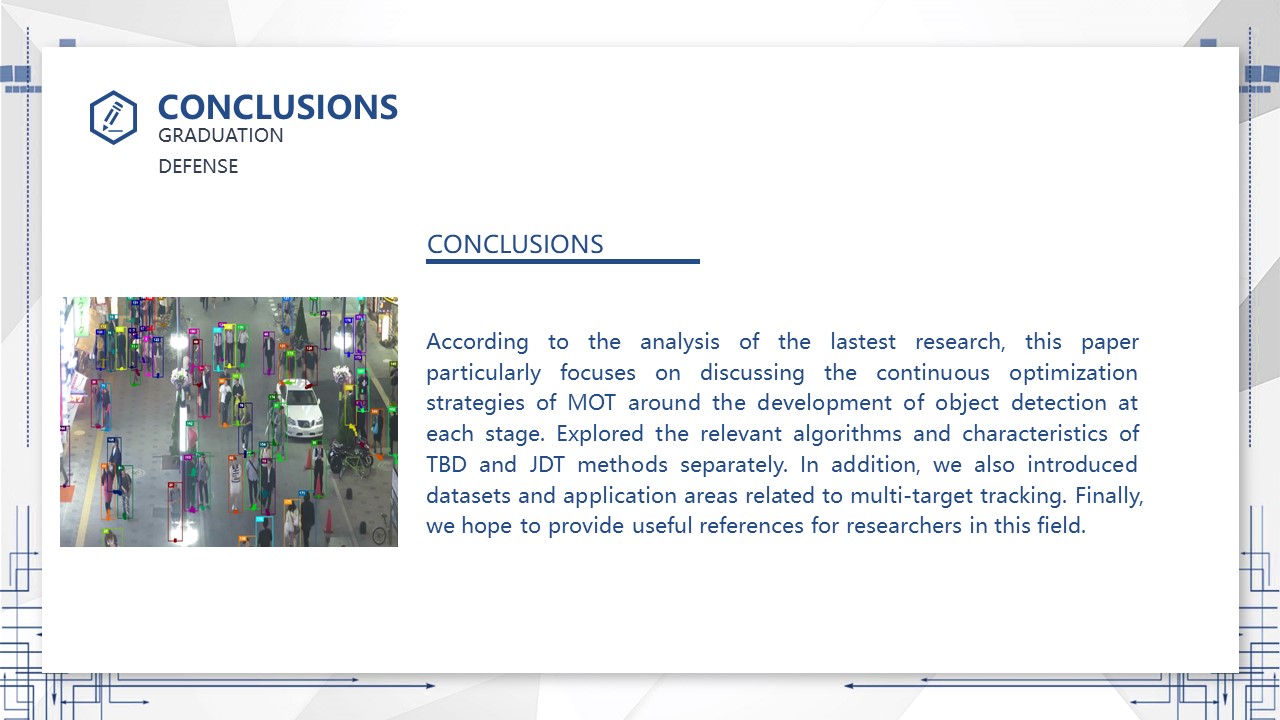 |
Finally, According to the analysis of the lastest research, this paper particularly focuses on discussing the continuous optimization strategies of MOT around the development of object detection at each stage. Explored the relevant algorithms and characteristics of TBD and JDT methods separately. In addition, we also introduced datasets and application areas related to multi-target tracking. Finally, we hope to provide useful references for researchers in this field. |
| ICACT20240469 Slide.22
[Big Slide]
[YouTube] |
Chrome Click!! |
 |
That concludes my presentation. Thank you, everyone. |