 |
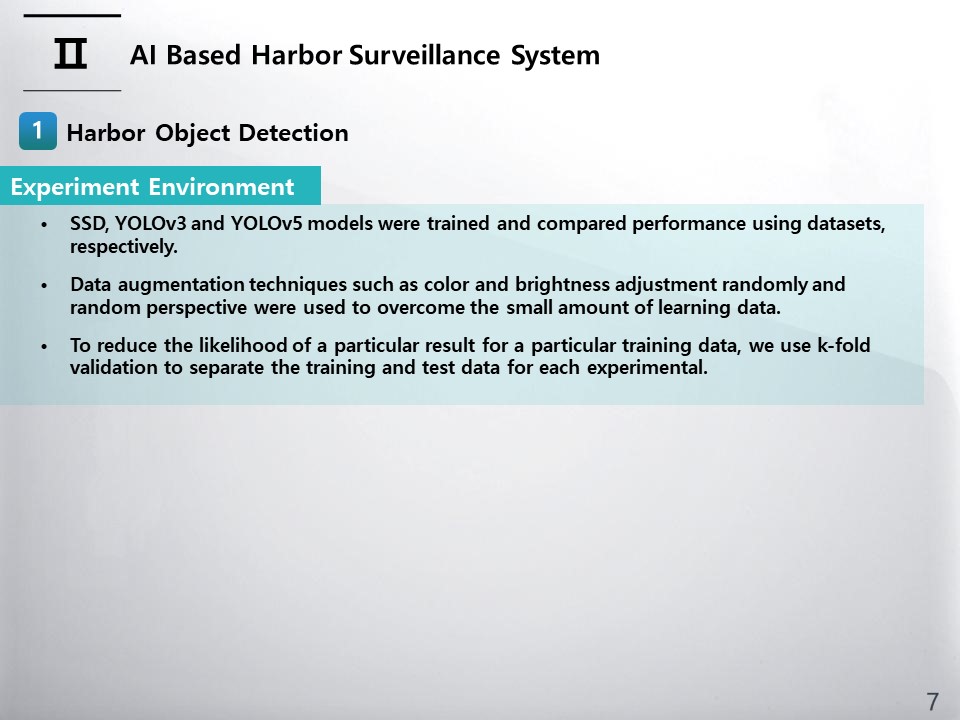
For object recognition for harbor monitoring, SSD, YOLOv3 and YOLOv5 models were trained and compared performance using datasets, respectively. Since deep learning requires a large amount of learning data, data augmentation techniques such as color and brightness adjustment randomly and random perspective were used to overcome the small amount of learning data. To reduce the likelihood of a particular result for a particular training data, we use k-fold validation to separate the training and test data for each experimental (i.e., k=5 in this study).
|
 IEEE/ICACT20230138 Slide.06
[Big Slide]
[YouTube]
IEEE/ICACT20230138 Slide.06
[Big Slide]
[YouTube]