 |
Next section is Cloud-based E-Learning Implementation.
Before we moving to Cloud-based E-Learning Implementation, I will explain first about cloud computing. The cloud computing is a computing model that allows on-demand network access to shared computing resources provided by service providers. So the principle of cloud computing is to allow us to access shared computing resources, on-demand, and this means this principle is linked up to ANGKASA project main goal is to make sure educational institutions as users, only need to pay for e-learning service fees according to use (pay-on-demand) as explained before in Introduction part. Thats why we implementing the cloud computing model to virtual e-learning system.
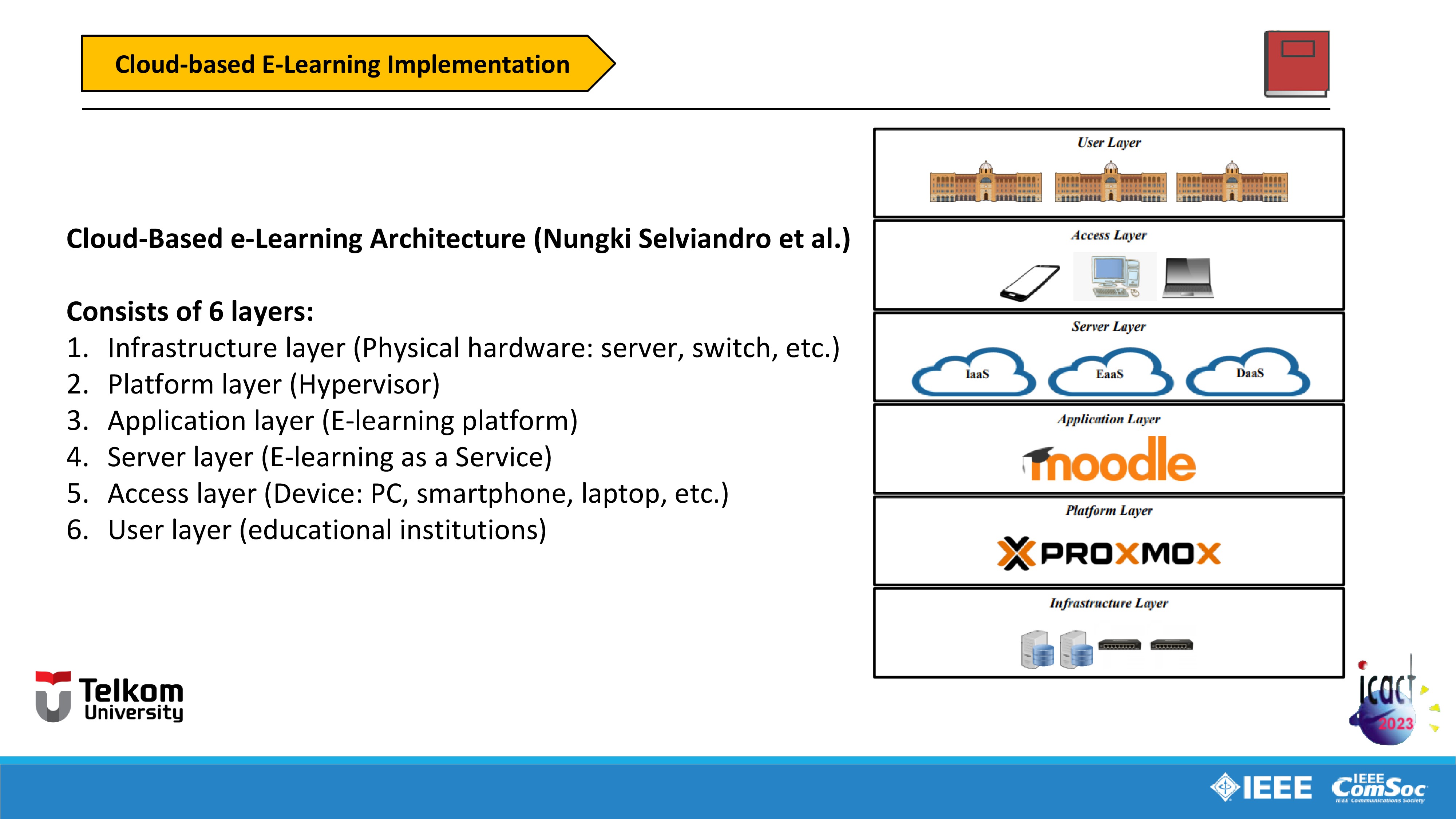
So we moving on to the Cloud-Based e-Learning Architecture used in the study by Nungki Selviandro et al.
This architecture is divided by 6 layers. I will explain it one by one from bottom layer to top layer.
First is Infrastructure layer which consists Physical hardware such as server, switch, etc.
Second is Platform layer consist of Hypervisor like Proxmox Virtual Environment.
Third is Application layer consist of E-learning platform like Moodle, TalentLMS, etc.
Fourth is Server layer contains of E-learning as a Service, Infrastructure as a Service, and Desktop as a Service.
Fifth is Access layer contains of Personal Devices like PC, smartphone, laptop, etc.
And sixth is User layer which contains educational institutions or other institutions as the users. |
 IEEE/ICACT20230068 Slide.09
[Big Slide]
[YouTube]
IEEE/ICACT20230068 Slide.09
[Big Slide]
[YouTube]