 |
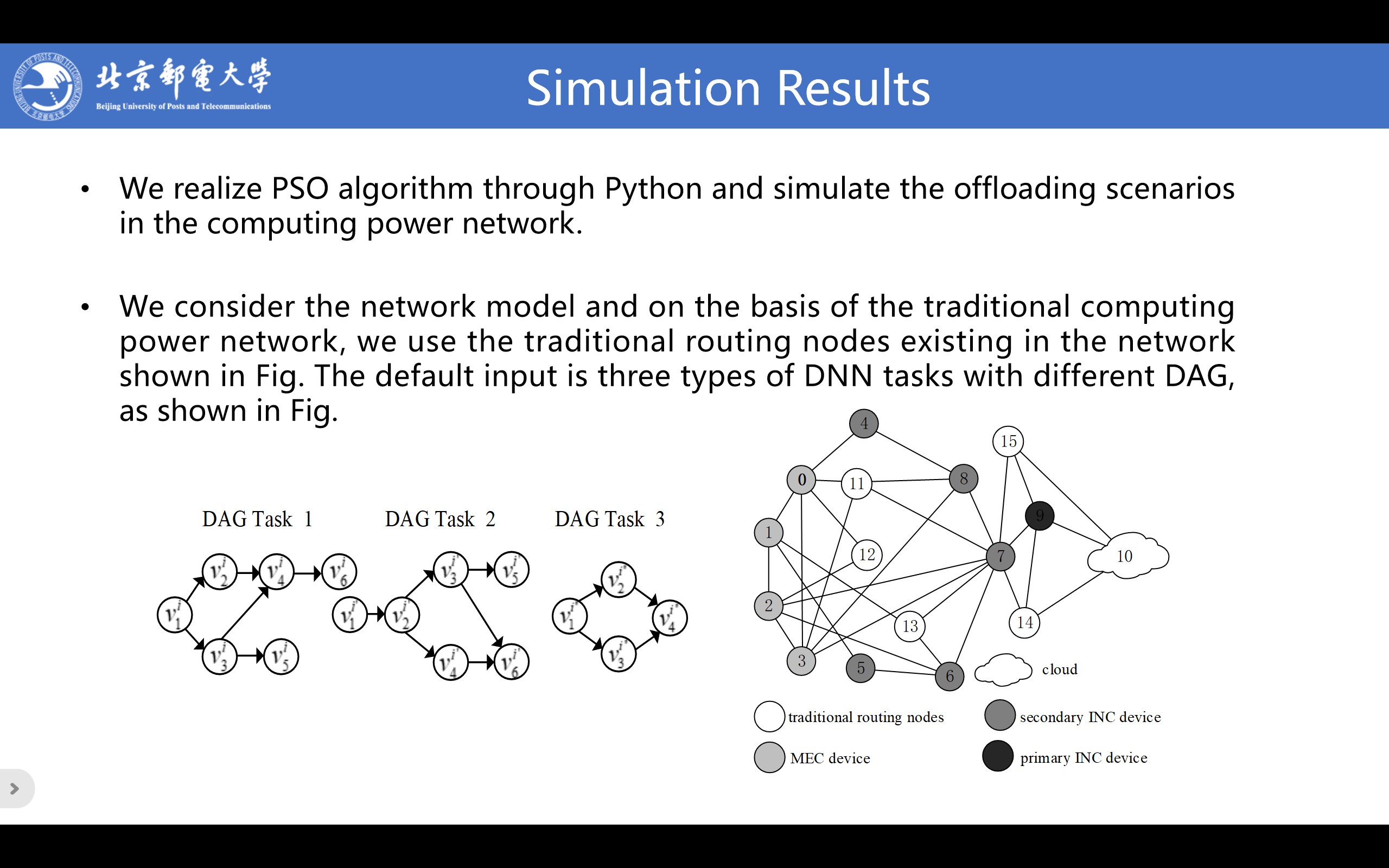
We realize PSO algorithm through Python and simulate the offloading scenarios in the computing power network.
In the network topology, parameters such as links are set randomly. In this simulation, the link is set to 100Mbps. We set the computing resource to 2 GHz for each MEC device, to 5 GHz for each primary INC device and to 3 GHz for each secondary INC device. The default unit computation cost of node is set to 1. For cloud, we set the computing resource to 10 GHz and the default unit computation cost to 1.12. The proportion of remaining computing resources is randomized to (0.6,0.8).
The default input is three types of DNN tasks with different DAG. For inference task i, service access is randomly performed from four arbitrary edge nodes and the task deadline is randomized to (20,75) seconds. The transmission ratio of each subtask is set to (0.01,0.05) and the amount of transmitted data is randomized to (1.5, 2) Mbit. By default, the distance between subtasks is the number of hops between offloaded nodes and the unit of transmission is set to 0.5. In addition, we set the inertia weight ¥ø to 0.08 and the speed constraint V_max to 10. We set the learning factor c_1 to 0.2 and c_2 0.5. We set the swarm size to 10 and the number of iterations to 20. During the evaluation process, the value of each parameter may change. |
 IEEE/ICACT20230136 Slide.13
[Big Slide]
IEEE/ICACT20230136 Slide.13
[Big Slide]