 |
So based on the experiment and the result shows that:
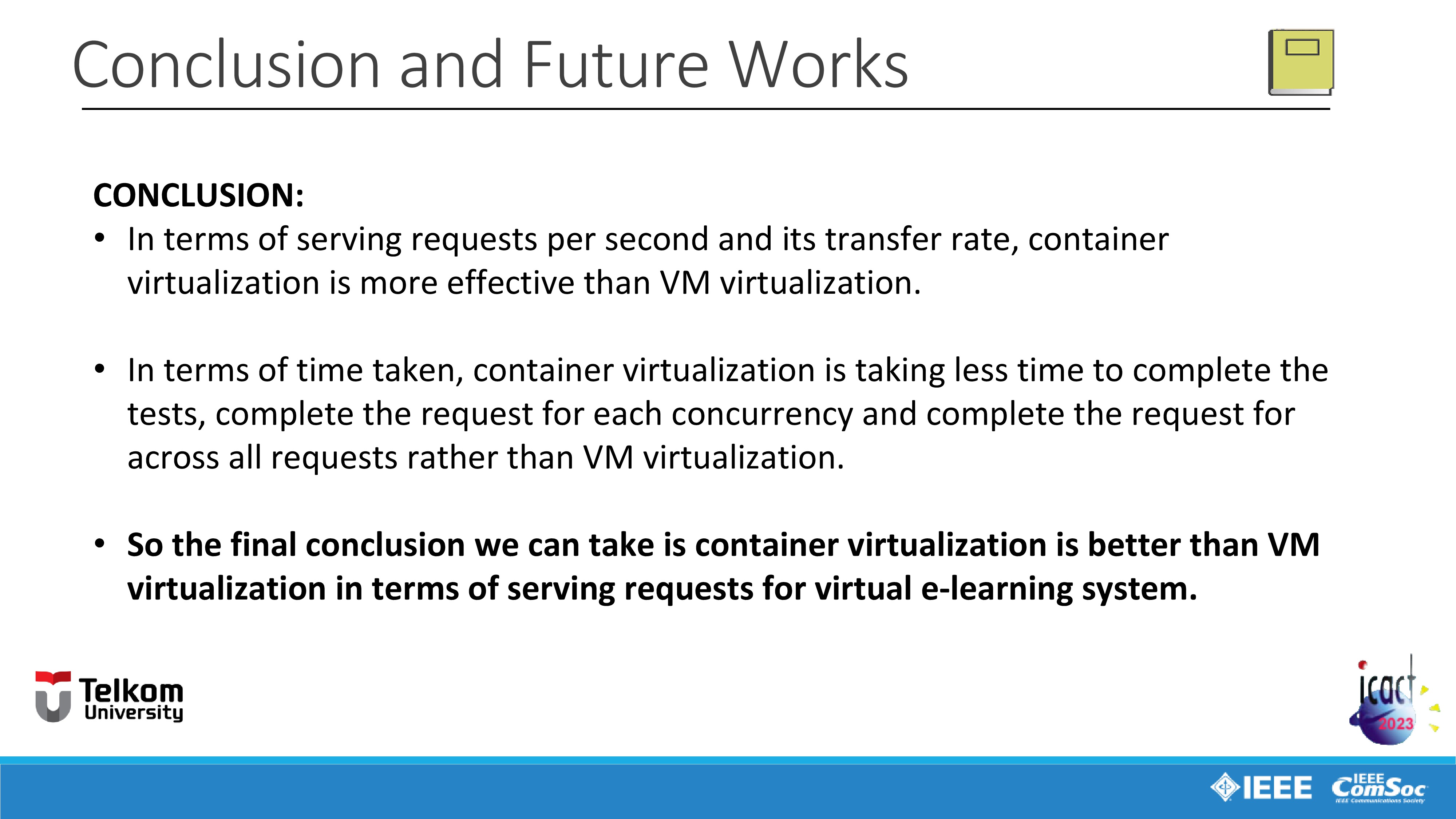
First point is, In terms of serving requests per second and its transfer rate of data, container virtualization has higher serving rate of requests per second and also has higher transfer rate of data which means is more effective than VM virtualization.
And in terms of time taken, container virtualization is taking less time to complete the tests, complete the request for each concurrency and complete the request for across all requests which means is also more effective than VM virtualization.
This happens because if we look back to the related works in the second part of this presentation outline and on the literatures about Virtualization technology as I explained before, unlike VM, container virtualization does not simulate a full operating system and only isolates applications with their dependencies called container. And According to Docker, a container is a lightweight, stand-alone, executable package of a piece of software that includes everything needed to run it. This means Docker containers are much smaller and require far fewer resources so that resource usage becomes more effective such as memory usage, CPU, network, and etc. unlike VM virtualization that fully simulates operating system into virtual machine and use more resources.
So the final conclusion we can take is container virtualization is better than full virtualization or VM virtualization in terms of serving requests for virtual e-learning system. |
 IEEE/ICACT20230068 Slide.26
[Big Slide]
[YouTube]
IEEE/ICACT20230068 Slide.26
[Big Slide]
[YouTube]