ICACT20230234 Slide.15
[Big slide for presentation]
ICACT20230234 Slide.15
[Big slide for presentation]
|
Chrome Text-to-Speach Click!! Click!! |
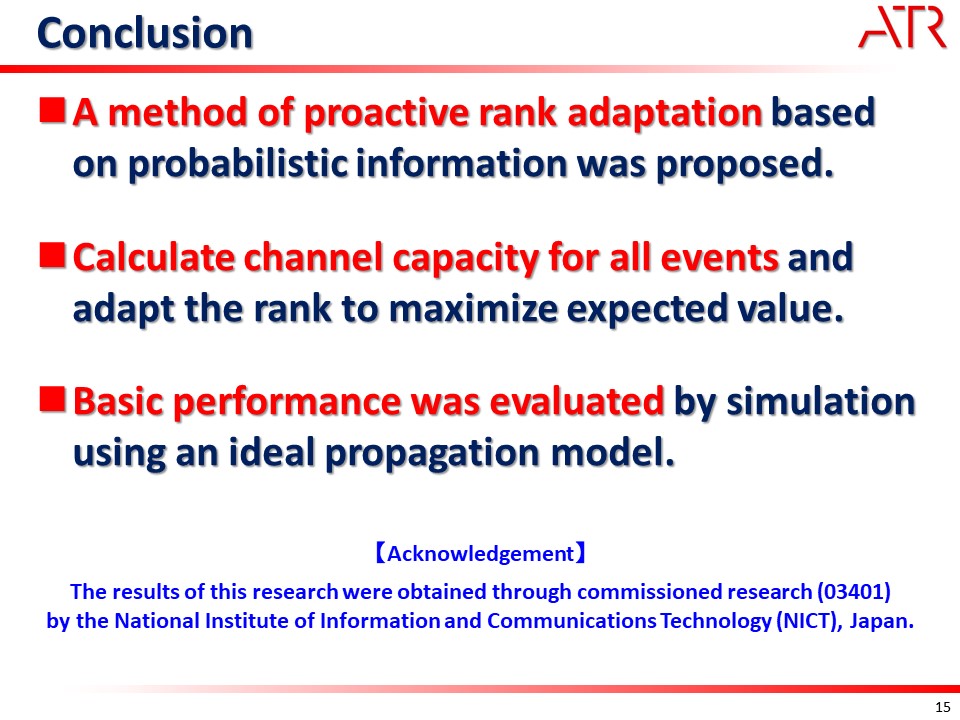 |
We now conclude this presentation. A method of proactive rank adaptation based on probabilistic information was proposed. The propose method is to calculate channel capacity for all events and adapt the rank to maximize expected value. Basic performance was evaluated by simulation using an ideal propagation model. Thank you for your kind attention.
|
|
ICACT20230234 Slide.14
[Big slide for presentation]
|
Chrome Text-to-Speach Click!! |
 |
In this study, the desired wave was assumed to be Rayleigh (perfect scattering) and the interference wave was assumed to be free space (no scattering). This assumption is simple but quite limiting. Therefore, future study should be conducted in detail on the Nakagami-Rice distribution, where direct and scattered waves are mixed. As the amount of direct waves increases, rank adaptation becomes a more complex problem, as multiple streams cannot be separated at the receiver.
|
|
ICACT20230234 Slide.13
[Big slide for presentation]
|
Chrome Text-to-Speach Click!! |
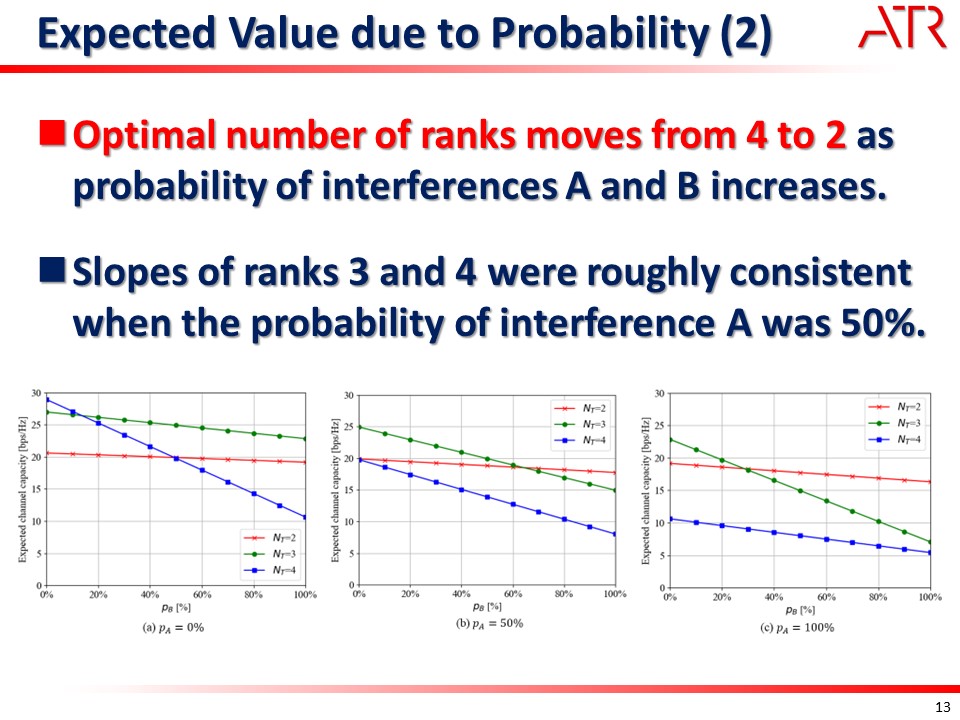 |
Furthermore, it shows the change in expected value when both p_A and p_B are varied. Optimal number of ranks moves from 4 to 2 as probability of interferences A and B increases. Slopes of ranks 3 and 4 were roughly consistent when the probability of interference A was 50%. It can be seen that the expected channel capacity can be maintained by selecting the appropriate rank according to probability.
|
|
ICACT20230234 Slide.12
[Big slide for presentation]
|
Chrome Text-to-Speach Click!! |
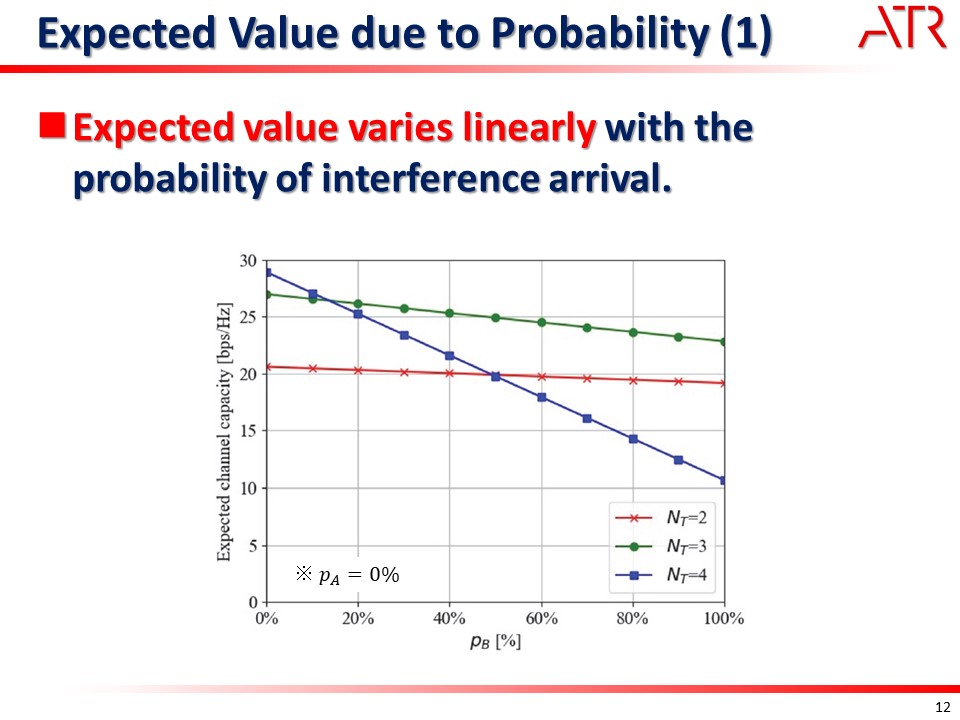 |
Next, we show the change in expected value with the different the probability of arrival of interference. In this figure, the probability of arrival of interference A is 0%, meaning it is the result of a single interference. You can see that the expected value varies linearly with the probability of arrival of the interference. When the probability is 100%, rank 3 is optimal, which indicates the degree of freedom to suppress a single interference wave.
|
|
ICACT20230234 Slide.11
[Big slide for presentation]
|
Chrome Text-to-Speach Click!! |
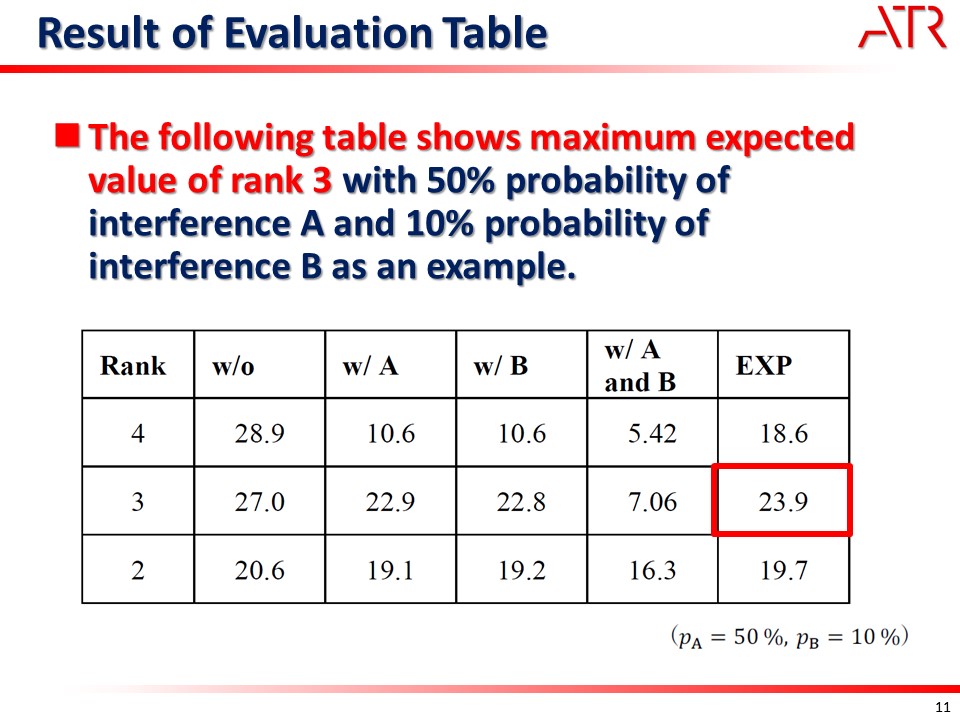 |
First, the results of the evaluation table calculations at a specific probability of arrival are shown here. The following table shows maximum expected value of rank 3 with 50% probability of interference A and 10% probability of interference B as an example. Thus, probabilistic information can be used to determine rank.
|
|
ICACT20230234 Slide.10
[Big slide for presentation]
|
Chrome Text-to-Speach Click!! |
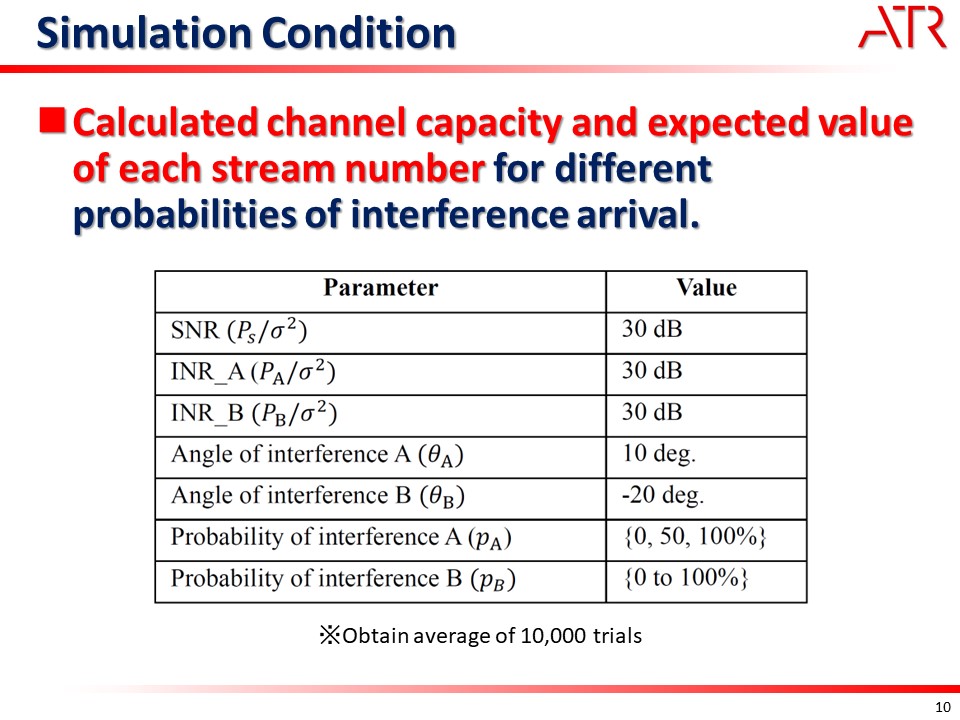 |
Numerical calculations were used to obtain specific channel capacities. We calculated channel capacity and expected value of each stream number for different probabilities of interference arrival. Specific simulation conditions are shown in this slide.
|
|
ICACT20230234 Slide.09
[Big slide for presentation]
|
Chrome Text-to-Speach Click!! |
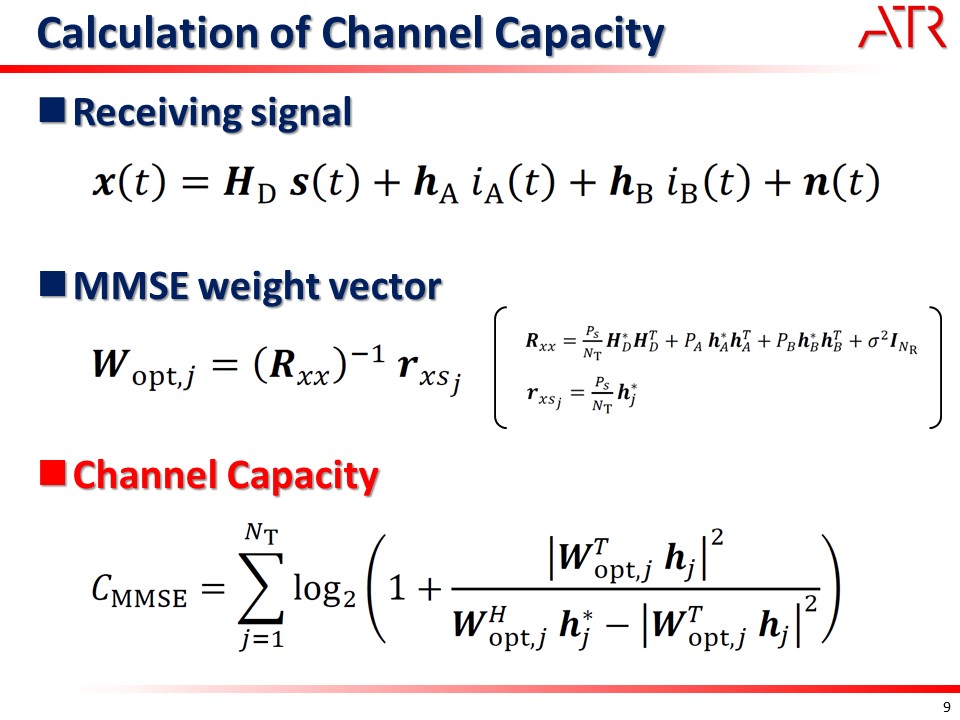 |
From the channel matrix, we calculated the channel capacity when interference is suppressed by MMSE. First, the received signal can be expressed by this equation. MMSE weight vector is generated by the correlation matrix like this. Then, channel capacity can be calculated with this formula.
|
|
ICACT20230234 Slide.08
[Big slide for presentation]
|
Chrome Text-to-Speach Click!! |
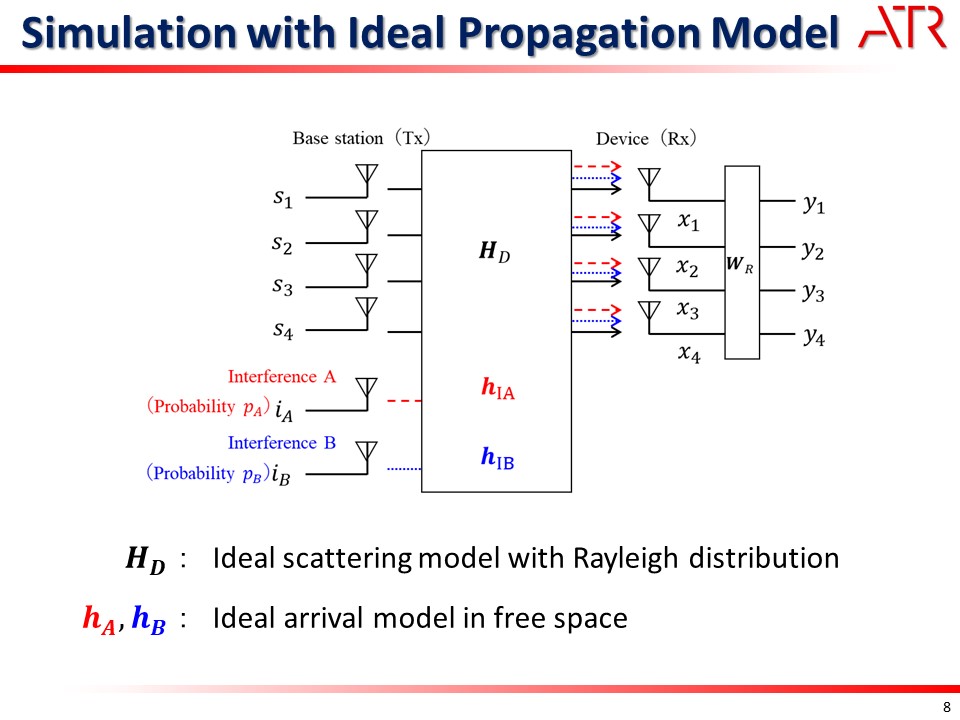 |
In this study, we first assumed ideal propagation as a simple model. We assumed that the channel matrix of the desired wave follows a Rayleigh distribution. For interference waves, an arrival model in free space was assumed.
|
|
ICACT20230234 Slide.07
[Big slide for presentation]
|
Chrome Text-to-Speach Click!! |
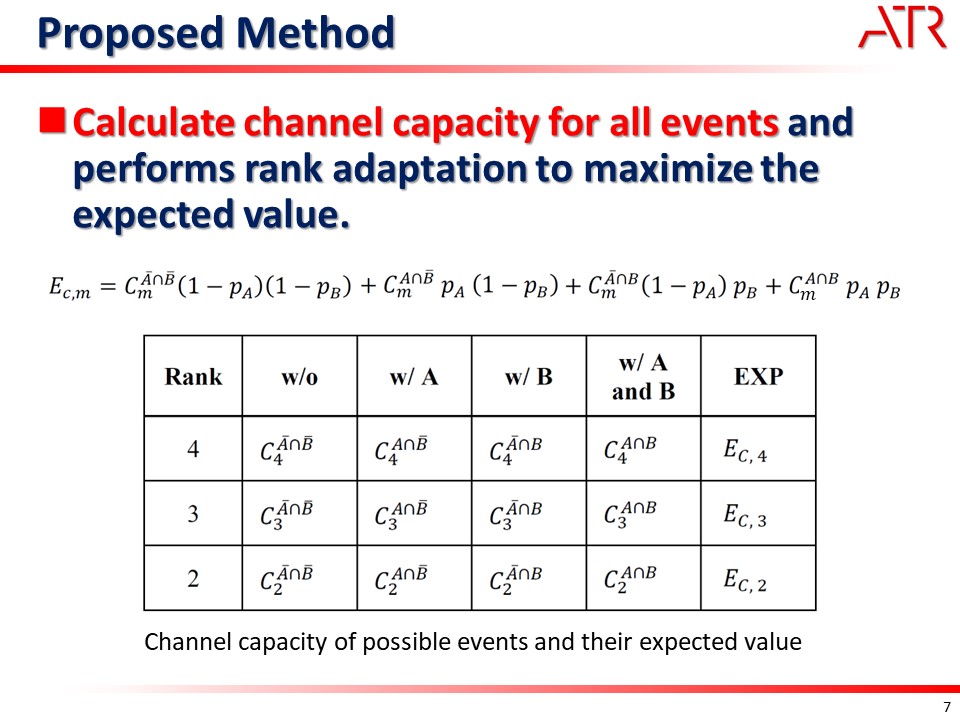 |
We propose to calculate the channel capacity for all events and perform rank adaptation to maximize the expected value. When considering two interference waves, A and B, there are four events. The probabilities of arrival of interfering waves are denoted as p_A and p_B, respectively. Then, The expected value of the number of streams m can be expressed like this equation. By calculating the expected value for each rank, we can determine the number of streams that will maximize that value.
|
|
ICACT20230234 Slide.06
[Big slide for presentation]
|
Chrome Text-to-Speach Click!! |
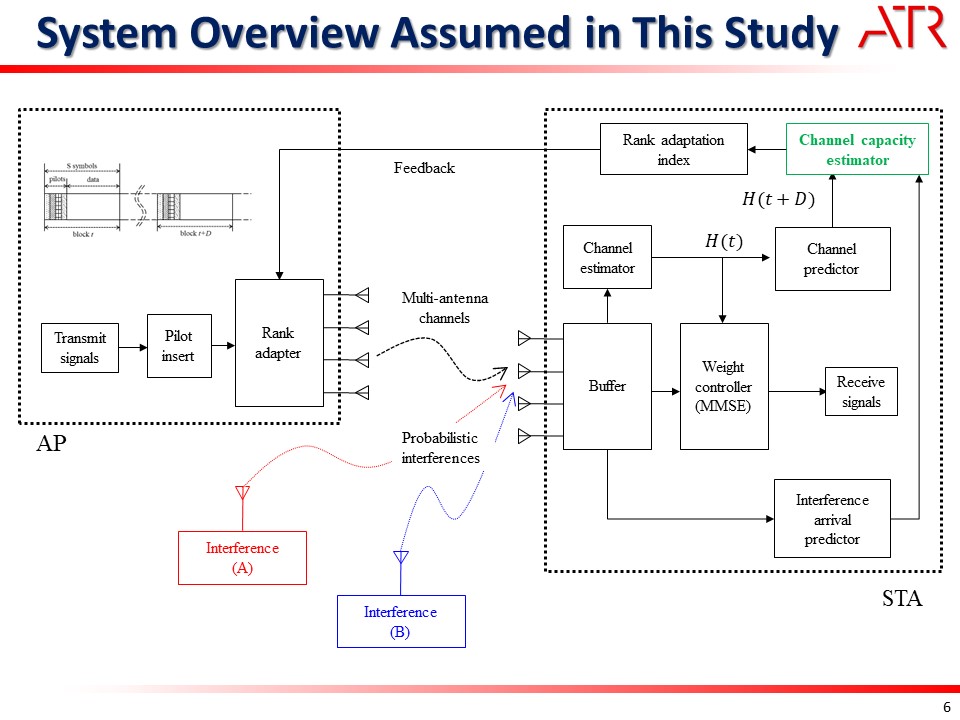 |
This slide shows an overview of the system assumed in this study. Consider the arrival of interference for a 4×4 single-user MIMO system. The left side represents the base station (AP) and the right side represents the terminal (STA). The channel matrix obtained by the predictor and the probability of arrival of the interfering wave are used to determine the rank. In this study, we assumed that future information is completely predictable. Also, we do not consider the IRS operating mode this time.
|
|
ICACT20230234 Slide.05
[Big slide for presentation]
|
Chrome Text-to-Speach Click!! |
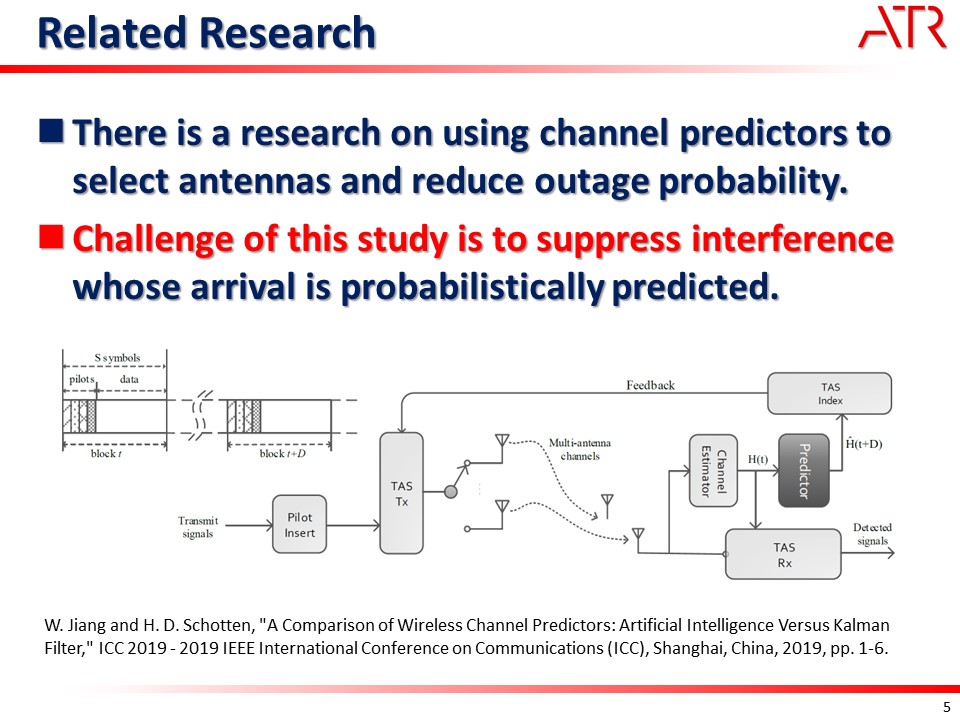 |
There is a related research on using channel predictors to select antennas and reduce outage probability. On the other hand, challenge of this study is to suppress interference whose arrival is probabilistically predicted.
|
|
ICACT20230234 Slide.04
[Big slide for presentation]
|
Chrome Text-to-Speach Click!! |
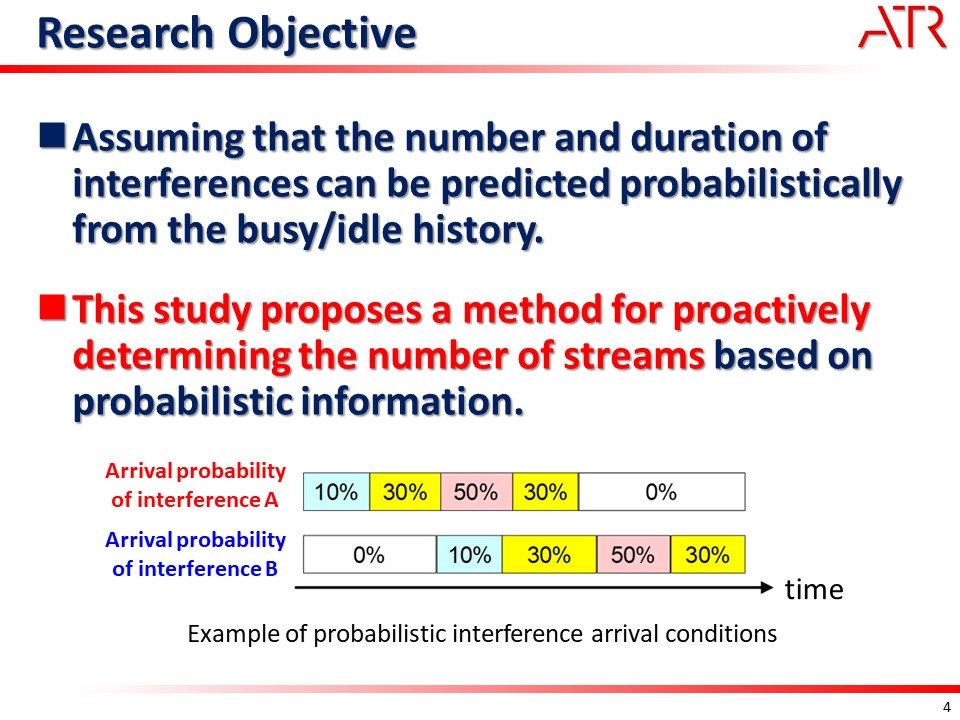 |
The purpose of this study is to suppress such complex interference. Suppose that the number and duration of interferences can be predicted probabilistically from the busy/idle history, as shown in this figure. However, rank adaptation in conventional MIMO transmission systems is performed for determined interference. Then, this study proposes a method for proactively determining the number of streams based on probabilistic information.
|
|
ICACT20230234 Slide.03
[Big slide for presentation]
|
Chrome Text-to-Speach Click!! |
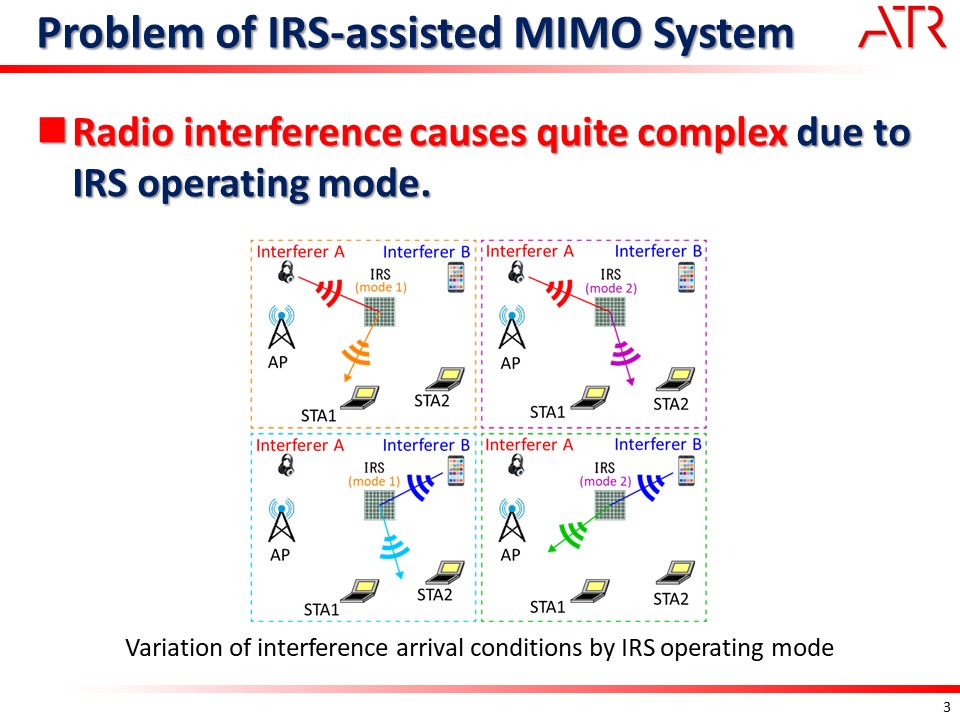 |
There are challenges with IRS-assisted MIMO systems. One of them is that radio interference causes quite complex due to the IRS operating mode. This figure shows the variation of the interference arrival conditions with IRS mode: with two interference sources and two IRS modes, there are four interference arrival conditions. The interference arrival situation increases with the product of the interference source and the IRS mode.
|
|
ICACT20230234 Slide.02
[Big slide for presentation]
|
Chrome Text-to-Speach Click!! |
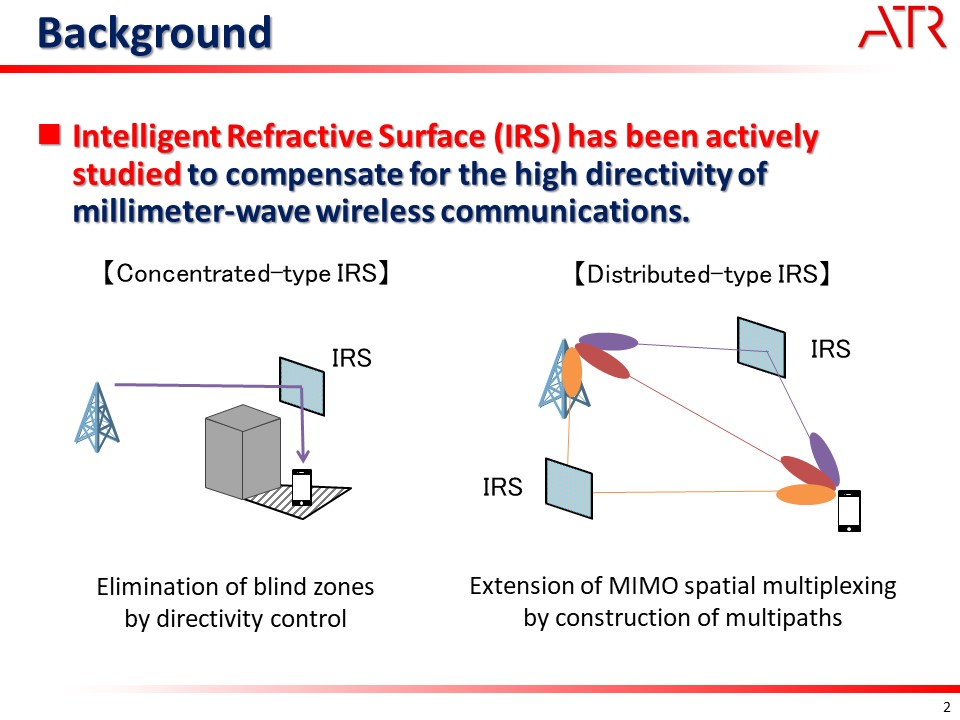 |
Recently, Intelligent Refractive Surface (IRS) has been actively studied. IRS is expected to compensate for the high directivity of millimeter-wave wireless communications by controlling the reflections. There are two main types of IRS systems possible: centralized and distributed. The centralized IRS, shown at left, eliminates blind zones by controlling the directivity of the signal. On the other hand, the distributed IRS shown on the right can extend MIMO spatial multiplexing by configuring multipaths.
|
|
ICACT20230234 Slide.01
[Big slide for presentation]
[YouTube] |
Chrome Text-to-Speach Click!! |
 |
Hello, my name is Takayuki Matsumuro of ATR Wave Engineering Laboratories, Japan. Our presentation is entitled Proactive rank adaptation method using probabilistic interference arrival information.
|